Life and Reign of Archelaus of Macedon
Archelaus of Macedon, who reigned from 413 BC until his death in 399 BC, was a transformative leader who reshaped the kingdom of Macedon through extensive administrative, military, and cultural reforms.
His tenure marked a critical period in the region’s development, as he laid the groundwork for Macedonia’s emergence as a powerful state and prepared it for the influence it would later wield under kings like Philip II and Alexander the Great.
Archelaus’s contributions spanned multiple aspects of governance and left a lasting impact on Macedonia’s political stability and cultural significance.
Early Life and Path to the Throne
Archelaus was born into the Macedonian royal family as the son of Perdiccas II, the king of Macedon, and a woman named Simache. His ascent to the throne, however, was complex and shrouded in historical ambiguity. Ancient sources, including Plato’s Gorgias, suggest that Archelaus may have resorted to violent measures to secure his position as king. According to these accounts, he allegedly killed his uncle Alcetas and a young half-brother, whose mother, Cleopatra, might also have been Archelaus’s stepmother and possibly even his wife. These alleged actions remain speculative and have not been verified, but they reflect the turbulent nature of succession in ancient Macedonian royalty, where family members frequently vied for power.
Regardless of the truth behind these accounts, Archelaus assumed the throne in 413 BC, succeeding his father, Perdiccas II. His reign began at a time when Macedonia faced internal instability and external threats, particularly from the neighboring Greek city-states.
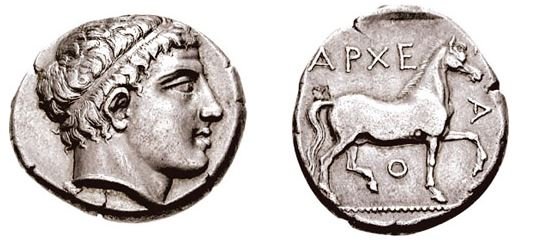
Image: Didrachm of Archelaus
Diplomatic Success with Athens
One of Archelaus’s notable achievements was his diplomatic approach to dealing with Athens, a powerful Greek city-state that had previously posed a significant threat to Macedonia. Athens, weakened by a devastating defeat in the Sicilian Expedition in 413 BC, was in dire need of resources to rebuild its naval fleet. Archelaus took advantage of this opportunity by supplying Athens with essential timber from Macedonia’s forests, which was highly valued for shipbuilding.
By aiding Athens during this vulnerable period, Archelaus improved relations between the two states. In gratitude, the Athenians honored him and his children with the titles of proxenos (state representative) and euergetes (benefactor). These honors strengthened his diplomatic standing and provided Macedonia with a valuable ally in the region, bolstering Macedonia’s status within the Greek world.
Military Reforms and Infrastructure Development
Archelaus implemented substantial military reforms that improved the organization and capabilities of the Macedonian army. Recognizing the need for a well-trained and disciplined military force, he focused on strengthening the hoplite infantry and cavalry, which would later play a critical role in Macedonian warfare. Archelaus’s improvements to the cavalry—a vital component of Macedonian military strategy—helped lay the groundwork for the renowned Companion Cavalry that would become the hallmark of his descendants’ armies.
To support his military goals, Archelaus embarked on ambitious infrastructure projects. He constructed fortresses across strategic locations to secure the kingdom’s borders and ensure the swift deployment of troops. He also built straight, reliable roads to connect various parts of the kingdom, making it easier for the military to mobilize in times of need. These roads not only facilitated military movements but also enhanced communication and trade within Macedonia, further integrating the kingdom’s diverse regions.
Another element of Archelaus’s military reform was the issuance of high-quality coinage, which provided the kingdom with a stable and trusted currency. This new coinage helped streamline economic transactions, particularly within the army, and contributed to Macedonia’s growing influence in the region.
Cultural Flourishing and the Move to Pella
Beyond his military and administrative reforms, Archelaus also sought to establish Macedonia as a cultural center that could rival the esteemed city-states of southern Greece. To achieve this, he relocated the Macedonian capital from Aigai (modern-day Vergina) to Pella, a city with a more advantageous location. The move to Pella allowed Archelaus to build a new palace that would serve as the administrative and cultural hub of the kingdom. This relocation was a symbolic shift that emphasized Macedonia’s evolution from a peripheral territory to a more unified and strategically positioned state.
At Pella, Archelaus welcomed many artists, intellectuals, and cultural figures to his court, including some of the most prominent names of the time. Among his guests were the tragedian Euripides, who wrote The Bacchae and Archelaus while residing in Macedonia, and the painter Zeuxis, renowned for his artistic innovations. Archelaus’s patronage of the arts elevated the cultural profile of his kingdom and attracted the attention of the wider Greek world, positioning Macedonia as a center of artistic and intellectual activity.
Archelaus also initiated the reorganization of the Olympia at Dion, an important religious and cultural festival held in honor of Zeus and the Muses. This event, which featured athletic and musical competitions, drew participants from across Greece, allowing Macedon to engage with the cultural elite of the Greek world. The Olympia at Dion not only strengthened Macedonian ties with other Greek states but also showcased the kingdom’s growing cultural sophistication.
Family and Marriage Alliances
Archelaus used marriage alliances strategically to secure his kingdom’s internal stability and to prevent potential rivalries from undermining his rule. He married his eldest daughter to the King of Elimea, a neighboring ruler, as part of a peace agreement during a conflict with the Lyncestae, a nearby Macedonian tribe. This marriage cemented alliances within the region and helped maintain stability along Macedonia’s borders.
He also married his younger daughter to Amyntas II, whom some sources label as his son. Historians debate whether Amyntas was indeed Archelaus’s biological son or simply a close relative, but the marriage served to link Archelaus’s line with that of Menelaus, Alexander I’s second son, who held influence within the Macedonian royal family. By consolidating these family ties, Archelaus sought to secure loyalty among Macedonian nobility and prevent internal disputes that might threaten his rule.
Complicated Succession and the Question of Argaeus and Pausanias
The royal lineage of Archelaus is somewhat convoluted, with historians divided on the relationships between various family members. There are conflicting accounts regarding whether Argaeus II and Pausanias, both challengers to later Macedonian rulers, were Archelaus’s sons. The historian Theopompus referred to both men as potentially being Archelaus’s sons, though this view is not universally accepted. Historian Nicholas Hammond suggests that Archelaus’s marriage alliances were designed to prevent succession struggles with the line of Menelaus and strengthen his own lineage’s claim to the throne.
The uncertainty surrounding Archelaus’s family and potential heirs reflects the challenges faced by the Macedonian monarchy in securing smooth transitions of power. The unclear succession lines and disputed paternity claims foreshadowed the political instability that would occasionally trouble the Macedonian throne after Archelaus’s death.
The Assassination of Archelaus
Archelaus’s reign ended abruptly in 399 BC when he was assassinated during a hunt. Various accounts of his death exist, with differing explanations regarding the motives and conspirators involved. The historian Aelian reported that Crateuas, a royal page, along with two Thessalians and a Macedonian named Decamnichos, conspired to kill Archelaus. Decamnichos, according to some sources, bore a personal grudge against Archelaus after being humiliated at court. Apparently, Decamnichos had insulted Euripides, whom Archelaus defended by allowing the poet to punish him. This humiliation may have motivated Decamnichos to seek revenge, leading to his involvement in the king’s assassination.
Other versions of the story suggest that Archelaus’s death may have been politically motivated, as rival factions within Macedonia could have sought to remove him to assert their own claims to power. However, the exact reasons behind his assassination remain a matter of historical speculation.

Image: Bust of Euripides.
Legacy of Archelaus’s Reign
Although his life ended suddenly, Archelaus’s reign had a lasting impact on Macedonia. His military and administrative reforms strengthened the kingdom’s defenses and economic stability, making Macedonia a more cohesive and powerful state. The roads he constructed, fortresses he established, and military improvements he implemented laid the foundation for Macedonia’s eventual rise as a dominant force in the Greek world. These infrastructural and military advancements would be essential for his successors, particularly Philip II and Alexander the Great, as they expanded Macedonian influence across the Greek mainland and beyond.
Archelaus’s cultural initiatives also enhanced Macedonia’s reputation. By promoting the arts, hosting renowned Greek intellectuals, and reorganizing the Olympia at Dion, he helped integrate Macedonia more fully into the cultural sphere of Greece. These efforts showcased Macedonian achievements to the wider Greek world and demonstrated that Macedonia, once viewed as a peripheral state, could contribute meaningfully to the shared Hellenic heritage.
The relocation of the capital to Pella marked a shift in Macedonia’s political center of gravity, and the new city would later become synonymous with Macedonian power. Pella would remain the capital and cultural heart of Macedonia for generations, serving as the birthplace of Alexander the Great and a symbol of the kingdom’s strength and prestige.
Conclusion
Archelaus of Macedon was a forward-thinking and resourceful leader whose reign transformed Macedonia from a relatively disorganized territory into a stable and influential kingdom. His skillful diplomacy, notably with Athens, elevated Macedonia’s standing among the Greek city-states, while his military and infrastructural reforms strengthened its internal cohesion and security. Through his patronage of the arts and the establishment of Pella as a cultural center, Archelaus brought a new level of sophistication to Macedonia, aligning it more closely with the cultural achievements of the wider Greek world.
Despite the violent end to his life, Archelaus’s legacy endured. His reforms set the stage for the eventual expansion of Macedonian power under Philip II and Alexander the Great, who would bring Macedonia to unprecedented heights. Archelaus’s reign thus stands as a foundational period in Macedonian history, reflecting a blend of political savvy, cultural ambition, and military foresight that would resonate through the kingdom for generations to come.
Frequently Asked Questions

How did Archelaus come to power in Macedonia?
Archelaus ascended to the throne in 413 BC under unclear circumstances. According to Plato’s Gorgias, he may have killed his uncle Alcetas and a young half-brother to secure his rule, though this claim is unverified.
What complicated Archelaus’s family dynamics?
Archelaus’s mother, Simache, had been enslaved by his uncle Alcetas, creating complex family ties. Additionally, there is speculation that his wife, Cleopatra, might have been his stepmother.
How did Archelaus use marriage alliances within his family?
Archelaus married his elder daughter to the King of Elimea during a conflict and his younger daughter to Amyntas II, possibly to prevent power struggles. Historian Nicholas Hammond suggests these alliances aimed to stabilize relations within Macedonian noble lines.
What diplomatic achievement improved Macedonia’s relationship with Athens during Archelaus’s reign?
After Athens suffered a defeat in Syracuse in 413 BC, Archelaus provided them with timber, essential for rebuilding their fleet. This generosity strengthened ties with Athens, who honored him and his children with the titles proxenos and euergetes.
What administrative reforms did Archelaus implement in Macedonia?
Archelaus improved Macedonian coinage quality, built strongholds, constructed roads for military movement, and enhanced the organization of the cavalry and hoplite infantry, significantly strengthening the kingdom’s defenses.
How did Archelaus contribute to Macedonian culture?
Archelaus moved the capital to Pella and transformed it into a cultural center, inviting artists and intellectuals like the painter Zeuxis and tragedian Euripides. He also revitalized the Olympia at Dion, hosting athletic and musical competitions.
What was the Olympia at Dion, and how did Archelaus influence it?
The Olympia at Dion was a festival honoring Zeus and the Muses, featuring athletic and musical competitions. Archelaus expanded this event, attracting renowned athletes and artists from across Greece and personally competing in the chariot race event.
How did Archelaus die, and who was involved in his assassination?
Archelaus was assassinated in 399 BC during a hunt. Accounts suggest that a page named Crateuas, along with two Thessalians and a Macedonian named Decamnichos, killed him. Decamnichos reportedly held a grudge after being humiliated by the poet Euripides, whom Archelaus had defended.
Archelaus was succeeded to the throne by his son, Orestes.





