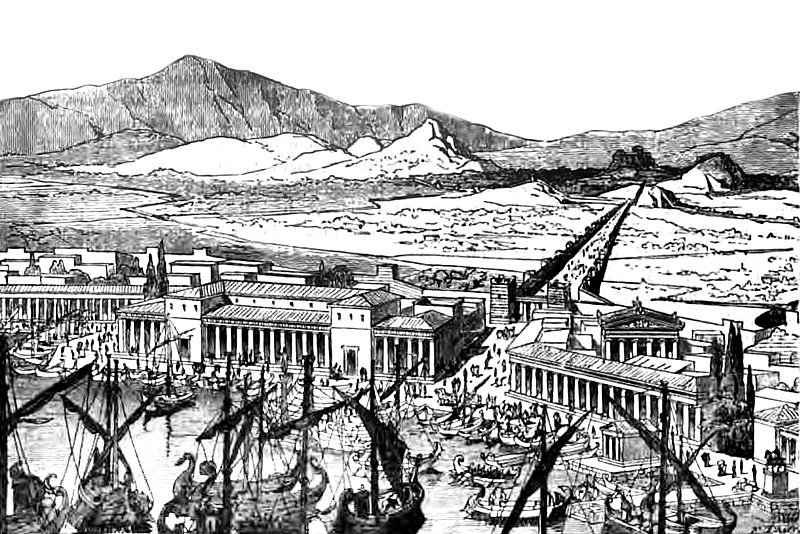
The Long Walls of Athens and the port of Piraeus.
The Long Walls of Athens, a monumental feat of ancient Greek engineering, played a pivotal role in the military and economic strategy of the city-state. While similar walls existed in other locations, such as Corinth and Megara, the Athenian Long Walls are renowned for their strategic importance and historical significance. Spanning approximately 6 kilometers (3.7 miles), these walls connected Athens to its vital ports at Piraeus and Phaleron, ensuring the city’s survival during sieges.
Origins and Early Construction
The need for the Long Walls arose in the aftermath of the Greco-Persian Wars, particularly following the destruction of Athens’ fortifications by the Persians in 480–479 BC. After the Persian retreat, Athens embarked on an ambitious rebuilding campaign under the leadership of Themistocles, who envisioned a fortified city connected to the sea.
Sparta, wary of Athens’ growing power, opposed the construction of the walls, fearing they would make Athens a formidable force. Themistocles cleverly managed to delay Spartan interference while construction progressed, employing diplomatic and strategic maneuvers. By the time Sparta realized the walls’ significance, they were already high enough to protect the city.
The Long Walls were fortifications connecting Athens to its ports at Piraeus and Phaleron, securing access to the sea during sieges.
Between 462 and 458 BC, Athens constructed two Long Walls: one linking the city to the old port at Phaleron and the other to the newer, strategically superior port of Piraeus. These fortifications were completed despite Spartan resistance and setbacks like the Battle of Tanagra in 457 BC. The walls transformed Athens into a virtually impregnable city, reliant on its naval power and sea-based supply lines.
Strategic Importance
The Long Walls reflected Athens’ shift from a traditional land-based hoplite strategy to one centered on naval dominance. This transformation began in the early 5th century BC, particularly during the wars with Aegina and Persia. By securing access to its ports, Athens could import vital supplies, including grain from the Hellespont and Black Sea regions, ensuring the city’s resilience during prolonged sieges.
With the Long Walls, Athens became an “island” on the mainland, immune to conventional land-based assaults. In ancient Greek warfare, capturing a walled city typically required either starvation or treachery, both of which the walls were designed to prevent. As long as Athens controlled the sea, its safety and prosperity were assured.
Evolution and Expansion
In the 440s BC, Athens added a third wall, known as the Middle or Southern Wall. This structure paralleled the Athens-Piraeus Wall and addressed vulnerabilities in the original design. While Phaleron’s port had declined in importance, Piraeus became Athens’ primary economic and military harbor. The Middle Wall narrowed the area between the existing walls, reducing the risk of amphibious invasions.
From their inception under Themistocles to their reconstruction during the Corinthian War, Long Walls played a defining role in Athens’ history.
The construction of the Middle Wall also reflected Athens’ response to shifting geopolitical realities. By the mid-5th century, Athens’ dominance at sea faced challenges, and additional fortifications were necessary to maintain security. The new wall enhanced the city’s defenses, particularly against potential attacks from the direction of Phaleron.
The Peloponnesian War and the Long Walls
During the Peloponnesian War (431–404 BC), the Long Walls were integral to Pericles’ defensive strategy. Anticipating Spartan attempts to force a land battle, Pericles urged Athenians to shelter behind the walls and rely on their navy to counterattack and sustain the city. This approach allowed Athens to survive initial Spartan invasions, though it came at a high cost.
While the walls protected Athens from direct assault, the city faced severe hardships. Spartan raids devastated Attica’s countryside, and a plague in 430–429 BC, exacerbated by overcrowding within the walls, claimed many lives, including Pericles’. Despite these challenges, the Long Walls remained a cornerstone of Athenian defense, enabling the city to endure the war’s early years.
In the later stages of the war, the Spartan occupation of Decelea in 413 BC placed relentless pressure on Athens. The city’s reliance on its ports became absolute, but the loss of naval superiority following the disastrous Sicilian Expedition weakened Athens. In 404 BC, after the decisive Spartan victory at Aegospotami, Athens was forced to surrender, and the Long Walls were dismantled, marking the end of its dominance.
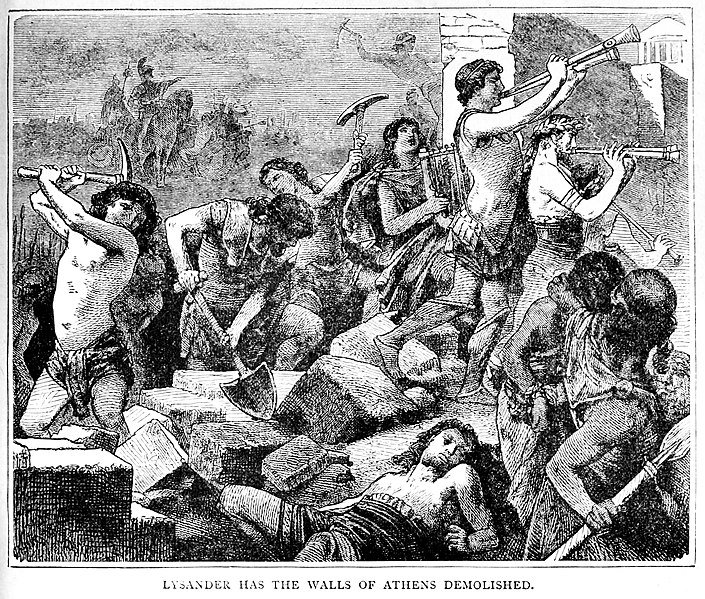
In 404 BC, Lysander ordered the demolition of Athens’ walls, marking the end of the Peloponnesian War.
Reconstruction and the Corinthian War
Despite their destruction, the Long Walls were rebuilt during the Corinthian War (395–387 BC) with financial and military support from Persia. The Persian satrap Pharnabazus II, eager to counter Spartan power, provided resources and manpower. Athenian admiral Conon played a key role in overseeing the reconstruction, which restored Athens’ defensive and strategic capabilities.
The rebuilding of the Long Walls symbolized Athens’ recovery and determination to reclaim its status. By 391 BC, the walls were completed, and Athens once again enjoyed protection from land-based threats, enabling its resurgence as a significant player in Greek geopolitics.

In 393 BC, Pharnabazus II, the Achaemenid satrap of Hellespontine Phrygia, financed the reconstruction of Athens’ walls.
The Long Walls in the 4th Century BC
Throughout the 4th century BC, the Long Walls remained central to Athenian strategy. The city’s naval power was restored, and its maritime supply routes secured, allowing Athens to withstand sieges. However, advances in siegecraft rendered the walls increasingly vulnerable to contemporary military tactics.
To address these vulnerabilities, Athens undertook further fortification efforts, incorporating advanced construction techniques. Despite these measures, the rise of Macedon under Philip II and Alexander the Great diminished Athens’ independence, and the Long Walls’ strategic significance waned.
Later History and Final Destruction
By the 1st century BC, the Long Walls were still standing, a testament to their enduring construction. However, during the First Mithridatic War (87–86 BC), the Roman general Sulla besieged Athens and Piraeus, ultimately destroying the Long Walls. This marked the final chapter in the history of these iconic fortifications.
A brief history of Ancient Athens and how it became the birthplace of Western Civilization
Frequently Asked Questions
When were the Long Walls built and destroyed?
They were constructed in the mid-5th century BC, destroyed by Spartans in 403 BC after the Peloponnesian War, and rebuilt during the Corinthian War (395–391 BC).
Why were the Long Walls significant to Athens’ military strategy?
They ensured Athens’ supply lines by sea, making the city impervious to land-based sieges and enabling reliance on its naval power.
What role did Themistocles play in the walls’ construction?
Themistocles delayed Spartan opposition, allowing Athens to fortify the city after the Persian invasions.
Why were additional walls like the Middle Wall constructed?
To strengthen defenses after Athens shifted its reliance to Piraeus as the primary port and to narrow potential invasion routes.
How did the Long Walls influence the Peloponnesian War?
They supported Pericles’ strategy of avoiding land battles, relying on naval dominance and supplies, though the siege tactics and a plague tested their resilience.
What led to the Long Walls’ destruction and rebuilding?
Their destruction in 404 BC followed Athens’ defeat by Sparta. Rebuilt with Persian aid during the Corinthian War, they restored Athens’ security.
How did the Long Walls become obsolete?
Advanced siege techniques and changes in geopolitical control, especially under Macedonian dominance, rendered them ineffective by the 4th century BC.





