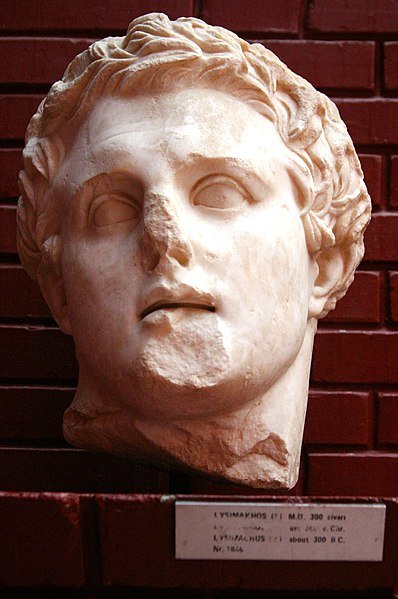
A Hellenistic marble bust of Lysimachus, dated around 300 BC, at the Ephesus Archaeological Museum.
Lysimachus (c. 360 BC – 281 BC) was a prominent figure among the successors of Alexander the Great. Born in Thessalian stock and raised in Macedon, he rose to power as a skilled general, governor, and eventually, a king ruling Thrace, Asia Minor, and Macedon. His life was marked by political intrigue, military conquests, and personal turmoil.

Early Life and Career
Lysimachus was born around 360 BC to a noble Thessalian family, with ties to the Argead court of Macedon. His father, Agathocles, was a close advisor to Philip II of Macedon, giving Lysimachus and his siblings access to royal privileges. Some sources suggest that his mother might have been named Arsinoe, and his grandfather was possibly Alcimachus.
Lysimachus was a key figure in the tumultuous period following Alexander’s death, navigating alliances and rivalries to carve out a significant kingdom.
Raised and educated in the Macedonian court at Pella, Lysimachus and his brothers enjoyed high-ranking positions under Alexander the Great. A famous anecdote recounts how Alexander punished Lysimachus by throwing him to a lion, a punishment he survived by killing the lion barehanded, earning further respect from Alexander.
During Alexander’s campaigns, Lysimachus served as one of the somatophylakes (bodyguards) and demonstrated his bravery and loyalty in India, earning ceremonial honors at Susa in 324 BC. After Alexander’s death in 323 BC, Lysimachus was appointed as strategos (governor) of Thrace, a region fraught with challenges from local tribes and internal revolts.

The Struggle of the Diadochi
Lysimachus played a pivotal role during the Wars of the Diadochi, allying with other successors like Cassander, Ptolemy, and Seleucus against Antigonus. In 315 BC, Antigonus attempted to weaken Lysimachus by inciting Thracian and Scythian tribes. Despite these threats, Lysimachus strengthened his hold over Thrace and founded the city of Lysimachia on the Chersonese in 309 BC to secure his territories.
In 306/305 BC, Lysimachus declared himself king, mirroring the actions of other Diadochi. By 302 BC, he formed a coalition with Cassander, Ptolemy, and Seleucus against Antigonus, entering Asia Minor with a sizable force. After the decisive Battle of Ipsus in 301 BC, where Antigonus was defeated and killed, Lysimachus gained control of Lydia, Ionia, Phrygia, and parts of northern Asia Minor.
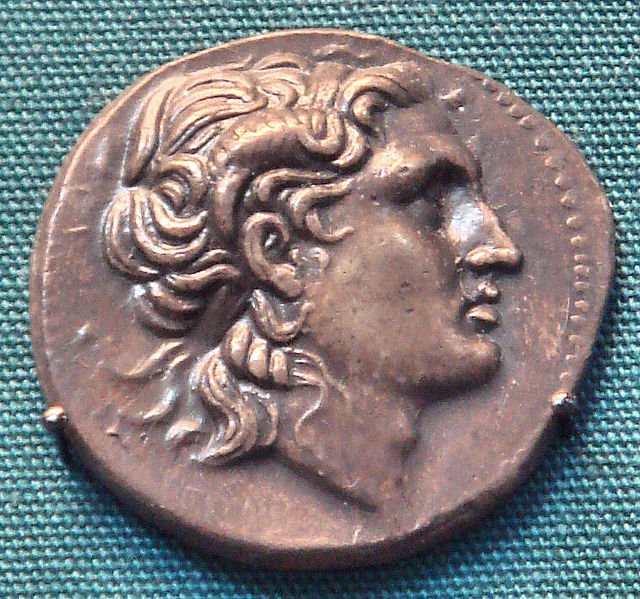
Alexander shown as the king’s divine patron on the obverse of a Lysimachus coin.
Lysimachus further solidified his position by marrying Amastris, a Persian princess, and later, Arsinoe II, the daughter of Ptolemy I of Egypt. These alliances reflected his strategy of balancing power among the Diadochi. However, the relationship with Seleucus, his former ally, became strained as Seleucus grew more powerful.
Between 297 and 287 BC, Lysimachus faced challenges from Demetrius I of Macedon and the Getae. Captured by the Getae, he was later released under amicable terms. In 287 BC, Lysimachus and Pyrrhus of Epirus expelled Demetrius from Macedon, but Lysimachus soon ousted Pyrrhus to claim the throne for himself.
Successor Wars that erupted after the death of Alexander the Great
Later Years: Domestic Strife and Decline
The later years of Lysimachus were marked by personal and political turbulence. His marriage to Arsinoe II became a source of contention as she sought to secure the succession for her sons, overshadowing Lysimachus’ older children from his previous marriage. Arsinoe accused Agathocles, Lysimachus’ eldest son, of conspiring with Seleucus, leading to his execution.
Despite his achievements, Lysimachus’ later years were overshadowed by domestic conflicts and the betrayal of allies.
The unjust killing of Agathocles caused widespread discontent, leading many cities in Asia Minor to revolt. Disillusioned by Lysimachus’ actions, key allies and friends abandoned him, including Agathocles’ widow and children, who fled to Seleucus.
The Battle of Corupedium and Death
In 281 BC, Seleucus invaded Lysimachus’ territories in Asia Minor. The two former allies faced off at the Battle of Corupedium, where Lysimachus was defeated and killed. His body, found days later guarded by his loyal dog, was buried in Lysimachia by his surviving son, Alexander.
Marriages and Descendants
Lysimachus married three times, and his marriages played significant roles in his political alliances:
- Nicaea: Daughter of Antipater, regent of Macedon. They had three children:
- Agathocles
- Eurydice
- Arsinoe I
- Amastris: A Persian princess. Their union was brief, ending in divorce.
- Arsinoe II: Daughter of Ptolemy I. They had three sons:
- Ptolemy I Epigonos
- Lysimachus
- Philip
He also had a son, Alexander, with an Odrysian concubine.
Frequently Asked Questions
What was Lysimachus’ relationship with Alexander the Great?
Lysimachus served as one of Alexander’s bodyguards during his Persian campaigns and gained recognition for his bravery. A legend claims he killed a lion with his bare hands, earning Alexander’s favor.
What role did Lysimachus play after Alexander’s death?
Following Alexander’s death in 323 BC, Lysimachus was appointed governor (strategos) of Thrace. He later declared himself king in 306/305 BC, like other Diadochi, and expanded his control over Thrace, Asia Minor, and Macedonia.
How did Lysimachus consolidate power in Thrace?
Lysimachus suppressed revolts, founded the city of Lysimachia as a strategic hub, and defended his territory against neighboring tribes and rival Diadochi.
What was Lysimachus’ role in the Battle of Ipsus?
At the Battle of Ipsus in 301 BC, Lysimachus allied with Seleucus, Ptolemy, and Cassander to defeat Antigonus I Monophthalmus. He gained significant territories in Asia Minor after Antigonus’ death.
What led to Lysimachus’ later troubles?
Domestic conflicts, including the murder of his son Agathocles—likely influenced by his third wife, Arsinoe II—alienated his allies and incited revolts in his territories.
What caused Lysimachus’ downfall?
Seleucus invaded Lysimachus’ territory after the internal strife weakened his position. Lysimachus was defeated and killed in the Battle of Corupedium in 281 BC.