Major Facts about the Akkadian Empire
The Akkadian Empire, the world’s first empire, was established by Sargon of Akkad around 2334 BCE and marked a significant chapter in ancient Mesopotamian history. Here are some key facts about the Akkadian Empire and the factors that contributed to its fall:

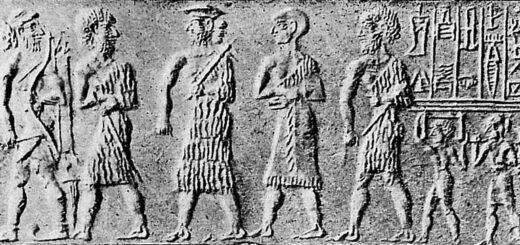
Image: A sculpture work showing Sargon of Akkad (first left) along with several dignitaries of the Akkadian Empire.
Establishment and Expansion
- Founding: Sargon the Great founded the Akkadian Empire, unifying various city-states of Mesopotamia under one ruler for the first time.
- Capital: Akkad (the exact location remains unidentified) served as the empire’s capital and namesake.
- Extent: At its zenith, the empire encompassed large portions of Mesopotamia, including parts of modern-day Iraq, Syria, Turkey, and Iran.
Achievements
- Administration: The empire was known for its sophisticated bureaucracy and the introduction of the Akkadian language as a lingua franca, which facilitated administration and cultural integration.
- Military: It boasted a powerful army that utilized advanced weapons and strategies, enabling vast territorial conquests.
- Art and Culture: The Akkadians contributed significantly to Mesopotamian art, literature (including the Epic of Gilgamesh), and architecture, reflecting their rich cultural heritage.
Reasons for the Decline
- Environmental Challenges: A severe drought, likely part of the 4.2-kiloyear event, resulted in widespread famine and economic hardship.
- Political Instability: Successive rulers after Sargon struggled to maintain control, leading to internal strife and weakening central authority.
- External Invasions: The Gutians, from the Zagros Mountains, invaded and further destabilized the empire, capitalizing on its internal vulnerabilities.
- Economic Decline: The environmental and political challenges disrupted trade routes and agricultural production, undermining the empire’s economic foundation.
Collapse
- End of the Empire: The empire began to fragment after the reign of Shar-Kali-Sharri around 2154 BCE, with regions and city-states asserting their independence or falling under the control of invaders like the Gutians.
- Legacy: Despite its collapse, the Akkadian Empire’s innovations in governance, culture, and technology had a lasting impact on subsequent Mesopotamian civilizations and are remembered as foundational elements of early urban society.