Marcus Aurelius, a Roman emperor reigning from 161 to 180 CE, is one of history’s most compelling figures. Best known as a philosopher-emperor, his Meditations offers a window into the mind of a ruler grappling with the complexities of power, ethics, and personal virtue. However, referring to him as a “Philosopher-King” evokes the Platonic ideal from The Republic, where philosophers govern justly and wisely. Whether Marcus truly aligns with this ideal, or whether his legacy fits better within the Stoic tradition as a philosopher who happened to be an emperor, is a nuanced question.

Marble bust of Roman Emperor Marcus Aurelius, Musée Saint-Raymond
Early Life and Philosophical Foundations
Marcus Aurelius was born in 121 CE into a prominent Roman family. His early life was shaped by privilege and education, providing fertile ground for his intellectual growth. His tutors, such as Junius Rusticus, exposed him to Stoic philosophy, which deeply influenced his worldview. Stoicism emphasizes rationality, self-control, and alignment with nature, making it a practical guide for Marcus’s future roles.
From an early age, Marcus displayed a commitment to Stoicism, wearing simple clothes and shunning luxury despite his aristocratic upbringing. This foundational training instilled in him the virtues of wisdom, courage, justice, and temperance, the cornerstones of Stoic ethics. Unlike the Platonic philosopher-king, who seeks to impose ideal governance, Marcus’s approach to power was marked by a personal quest for ethical living amid the chaos of imperial rule.

A bust of young Marcus Aurelius (Capitoline Museum)
The Emperor’s Burden
Marcus’s ascension to power came at a turbulent time. Co-ruling initially with Lucius Verus and later alone, he faced constant warfare, plagues, and economic instability. His reign was less about enacting grand philosophical reforms and more about managing crises while adhering to his principles.
The Platonic philosopher-king is an architect of an ideal society, yet Marcus was constrained by the pragmatics of empire. His Meditations reveal a man acutely aware of his responsibilities, striving to act justly despite the pressures of governance. He writes: “Waste no more time arguing about what a good man should be. Be one.” This sentiment reflects his emphasis on personal virtue over systemic overhaul, differentiating him from Plato‘s visionary ideal.
Meditations: A Stoic’s Diary
Meditations, written as private reflections, illuminates Marcus’s philosophy. Far from a manual for governance, it serves as a self-help guide for maintaining Stoic equanimity. Key themes include the impermanence of life, the futility of ambition, and the importance of accepting fate. Marcus constantly reminds himself to focus on what he can control—his thoughts and actions—while remaining indifferent to external outcomes.
For example, he writes, “You have power over your mind—not outside events. Realize this, and you will find strength.” This inward focus marks a departure from Plato’s philosopher-king, whose strength lies in shaping external realities. Marcus’s philosophy was more about enduring the world’s imperfections than transforming them.
Marcus Aurelius as Philosopher-Emperor
As emperor, Marcus Aurelius embodied Stoic ideals in his governance. He sought to administer justice and maintain stability, often placing the well-being of the empire above personal comfort. His reign was marked by military campaigns along the Danube frontier, defending Rome from barbarian invasions. Despite the hardships of war, Marcus strived to balance the demands of leadership with his philosophical principles.
He showed remarkable clemency and patience, both virtues extolled by Stoicism. For instance, during the Marcomannic Wars, he chose to negotiate peace rather than pursue complete annihilation of the enemy, reflecting a pragmatic yet humane approach. Similarly, his legal reforms aimed at protecting vulnerable populations, such as slaves and orphans, showcase his commitment to justice.

Equestrian Statue of Marcus Aurelius at the Capitoline Museums
Challenges to the Philosopher-King Ideal
Despite his philosophical depth, Marcus Aurelius’s reign highlights the limitations of applying the philosopher-king ideal to real-world governance. Plato’s philosopher-king is an idealist, crafting a utopia guided by reason. Marcus, by contrast, operated within the constraints of Roman imperial politics, where pragmatism often outweighed idealism.
One notable blemish on his legacy is his decision to name his son, Commodus, as his successor. Commodus’s reign marked the beginning of Rome’s decline, raising questions about Marcus’s judgment. Critics argue that a true philosopher-king would prioritize the good of the state over dynastic loyalty. This decision underscores the tension between Marcus’s philosophical aspirations and his role as a practical ruler.

Having jointly ruled Rome with his father Marcus Aurelius from 177 to 180 A.D., Emperor Commodus found himself unprepared to fill the big shoes left behind by Aurelius. In 192, Commodus was killed by his wrestling partner Narcissus in a plot orchestrated by his mistress Marcia and his Praetorian Guard prefects Laetus and Eclectus. Commodus was succeeded by Pertinax, who was in turn assassinated by the Praetorian Guard.
Philosophical Contributions and Legacy
Marcus Aurelius’s Meditations has transcended its historical context to become a timeless philosophical text. Its appeal lies in its universality; readers across centuries have found solace and guidance in its pages. Unlike the abstract ideals of Plato’s Republic, Marcus’s reflections offer a grounded, accessible philosophy that resonates with individuals navigating the complexities of life.
His legacy as a philosopher-emperor is also evident in his influence on subsequent generations. Leaders such as Frederick the Great and Bill Clinton have drawn inspiration from his writings, viewing him as a model of ethical leadership. However, whether this makes him a philosopher-king in the Platonic sense is debatable.
Comparison with Plato’s Philosopher-King
Plato’s philosopher-king is an intellectual paragon, governing a just society through reason and philosophical insight. This ideal ruler is more concerned with the collective good than personal virtue, striving to align society with the Forms—universal truths underlying reality. By contrast, Marcus Aurelius focused on individual ethics, emphasizing personal responsibility and resilience.
While Marcus’s reign exhibits flashes of the philosopher-king ideal, such as his commitment to justice and rationality, he lacked the transformative vision characteristic of Plato’s archetype. His governance was reactive, shaped by the immediate challenges of empire, rather than proactive efforts to create an ideal society.
Conclusion
Marcus Aurelius’s dual identity as a philosopher and emperor positions him uniquely in history. While his Stoic principles deeply influenced his leadership, they also highlight the divergence between personal ethics and systemic reform. He was a philosopher-emperor, exemplifying the Stoic ideal of virtue in action, but not a philosopher-king in the Platonic sense.
Frequently asked questions about Marcus Aurelius

Marcus Aurelius (r. 161-180 AD) was the last Emperor of the Pax Romana. Image: Bust of Marcus Aurelius
Who was Marcus Aurelius, and why is he called a “Philosopher-King”?
Marcus Aurelius was a Roman emperor (121–180 CE) renowned for blending his role as a ruler with his Stoic philosophy. He is called a “Philosopher-King” for his dedication to personal virtue, governance guided by ethical principles, and his philosophical reflections recorded in Meditations.
What were Marcus Aurelius’s early influences in philosophy?
Marcus was educated in rhetoric, poetry, Greek, Latin, and philosophy, with Stoicism becoming his guiding principle. His tutor, Junius Rusticus, introduced him to Stoicism, shaping his ethical framework and commitment to personal virtue.
How did Cassius Dio describe Marcus Aurelius’s character as a ruler?
Cassius Dio praised Marcus for refraining from offenses, acting justly, and maintaining his virtue throughout his life and reign, calling him a ruler of unmatched moral excellence.
What is Meditations, and what does it reveal about Marcus Aurelius?
Meditations is Marcus Aurelius’s collection of private philosophical reflections. It reveals his Stoic philosophy, emphasizing self-improvement, emotional resilience, and focusing on what one can control while accepting external challenges.
What was Marcus Aurelius’s perspective on his role in the world?
Marcus viewed himself as a global citizen, transcending his identity as a Roman emperor. He saw it as his duty to humanity, reflecting his cosmopolitan Stoic outlook.
What challenges did Marcus face during his reign, and how did he respond?
Marcus faced plagues, wars, and political intrigue. Despite his frailty, he displayed resilience and selflessness, even selling his possessions to fund military campaigns instead of taxing the populace.
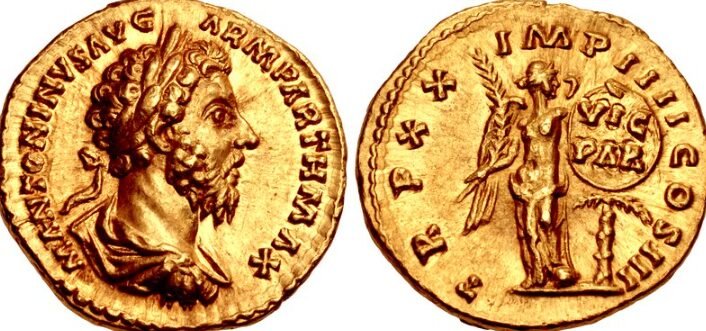
Aureus of Marcus Aurelius
How did Marcus Aurelius demonstrate Stoicism in governance?
Marcus emphasized justice, often imposing lighter penalties for crimes and treating enemies with fairness. His actions reflected a commitment to Stoic virtues such as duty, compassion, and fairness.
Why is Marcus Aurelius’s decision to appoint Commodus as his successor criticized?
Commodus’s disastrous reign led to Rome’s decline, casting doubt on Marcus’s judgment. Critics argue this choice undermines his alignment with Plato’s philosopher-king ideal, which prioritizes the state’s welfare over personal ties.
What is the difference between Plato’s philosopher-king and Marcus Aurelius as a ruler?
Plato’s philosopher-king is an ideal ruler with knowledge of the Good, aiming to create a just society. Marcus embodied Stoic virtues but focused on maintaining stability rather than transforming society, reflecting a pragmatic rather than idealistic approach.

A 2nd century Roman sculpted portrait of Marcus Aurelius
How does Marcus Aurelius’s legacy endure?
Marcus is remembered as a philosopher-emperor whose Stoic ideals guided his governance. His Meditations continues to inspire readers with practical wisdom, and his reign is seen as a model of ethical leadership in turbulent times.
Was Marcus Aurelius a philosopher-king in Plato’s sense?
While Marcus embodied many virtues associated with Plato’s philosopher-king, his rule was more pragmatic than transformative. He was a philosopher-emperor, practicing Stoicism in leadership, though not entirely aligning with Plato’s ideal.





