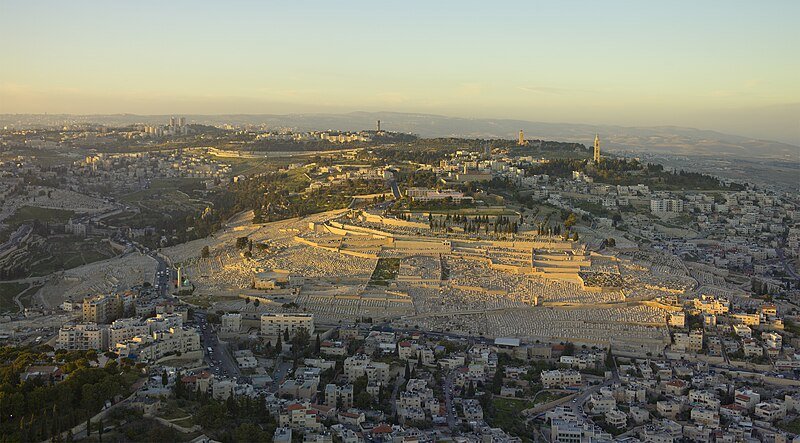
An aerial view of the Mount of Olives.
The Mount of Olives, also known as Mount Olivet, is a historically and religiously significant mountain ridge located in East Jerusalem, adjacent to the Old City. This ancient site derives its name from the vast olive groves that once covered its slopes. Over the centuries, it has served as a burial ground, a place of worship, and a site of religious significance for Jews, Christians, and Muslims alike. With its panoramic views of Jerusalem and its long-standing association with biblical events, the Mount of Olives continues to be a focal point for pilgrimage and historical exploration.
Geography and Geology
The Mount of Olives forms part of a 3.5-kilometer-long mountain ridge running east of Jerusalem’s Old City. It is separated from the city by the Kidron Valley, also known as the Valley of Jehoshaphat. The ridge consists of three peaks:
- Mount Scopus (826 meters)
- At-Tur (818 meters), the highest point of the Mount of Olives
- The Mount of Corruption (747 meters), located on the southern end
Geologically, the ridge is composed of Late Cretaceous sedimentary rock, primarily soft chalk interspersed with harder layers of flint. While the chalk is easy to quarry, its fragile nature has made it unsuitable for large-scale construction. However, the mountain’s composition has allowed for the creation of numerous man-made burial caves, some dating back thousands of years.
The Mount of Olives’ long history, deep religious significance, and breathtaking views of Jerusalem’s Old City make it a site of profound cultural and historical importance.
Historical Significance
The Jewish Connection
Since ancient times, Jews have venerated the Mount of Olives, using it as a site for burial and religious observance. The southern slopes of the mount house the Silwan necropolis, an elite burial site during the era of the Kingdom of Judah. The Jewish cemetery, which covers much of the western slope, has been in use for over 3,000 years and is home to approximately 145,000 graves.
During the Second Temple period, the Mount of Olives played a significant role in Jewish religious life. It was the site where religious officials marked the beginning of a new month, and it also became a place for mourning the destruction of the Temple. The festival of Sukkot was often observed here, as the mount provided an unobstructed view of the Temple Mount.
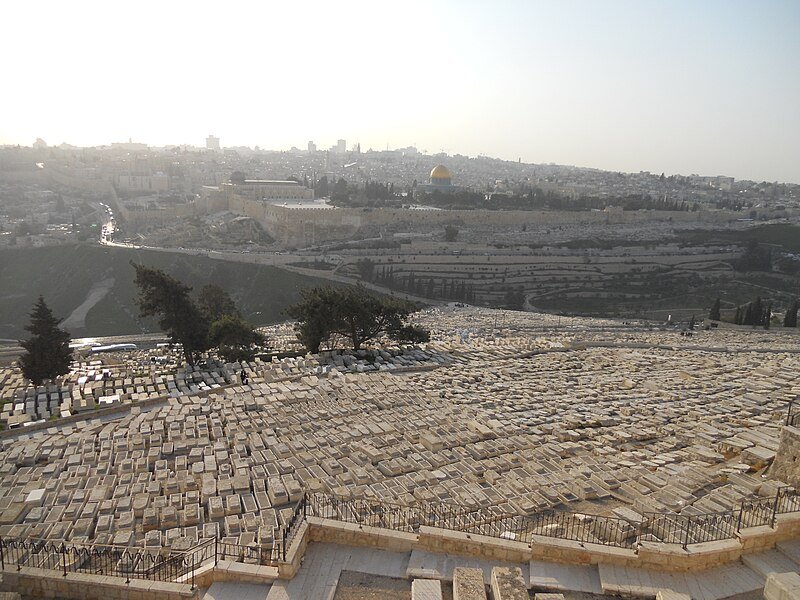
Jewish cemetery located on the Mount of Olives
The Roman and Byzantine Periods
During the 1st century CE, the Mount of Olives was a site of political and religious unrest. A Jewish prophetic figure known as “the Egyptian” is recorded in historical texts as having led a rebellious movement on the mount, aiming to bring down the walls of Jerusalem. His group was swiftly defeated by Roman forces, though he managed to escape.
The Siege of Jerusalem in 70 CE, which led to the destruction of the Second Temple, saw Roman legions stationed on the Mount of Olives. In the aftermath, Jews continued to use the site for religious mourning, particularly on Tisha B’Av, the annual day of lamentation for the Temple’s destruction.
The Islamic and Medieval Periods
Following the Islamic conquest in the 7th century, the Mount of Olives remained a site of spiritual significance. In 1187, after Saladin recaptured Jerusalem from the Crusaders, he granted control of the mount to two of his commanders. The mountain continued to host Christian monasteries, mosques, and Jewish tombs, symbolizing the coexistence of different faiths in the region.
By the 19th century, Jewish communities sought to protect their sacred burial grounds from desecration. In the 1850s, Jewish leaders paid local Arab villagers to guard the cemetery and prevent vandalism, highlighting the site’s enduring importance.
The Mount of Olives During the 20th Century
The Mount of Olives faced a turbulent period during the 1948 Arab-Israeli War. Under the armistice agreement between Israel and Jordan, a special committee was supposed to ensure free access to holy sites, including the Jewish cemetery. However, during Jordan’s control from 1948 to 1967, Jewish access was entirely prohibited. Many graves were desecrated, tombstones were uprooted, and parts of the cemetery were destroyed to make way for roads, buildings, and even latrines for Jordanian military barracks.
After the 1967 Six-Day War, Israel regained control over East Jerusalem, including the Mount of Olives. Restoration efforts were undertaken to restore desecrated graves, and burials resumed. Despite international disputes over Israel’s annexation of East Jerusalem, the Jewish cemetery remains one of the most sacred and significant burial sites for Jews worldwide.
The Mount of Olives is a historic mountain ridge in East Jerusalem, known for its religious significance in Judaism, Christianity, and Islam.
Religious Significance
The Mount of Olives has deep messianic significance in Jewish tradition. Based on the prophecy in Zechariah 14:4, it is believed that when the Messiah arrives, he will stand on the Mount of Olives, splitting it in two and ushering in the resurrection of the dead. This belief has led many Jews to seek burial on the Mount of Olives, hoping to be among the first to be resurrected.
Additionally, the mount is mentioned in II Samuel 15:30, when King David fled from Absalom, weeping as he ascended the mount. The site also played a role in Jewish history during the First Temple period, when Solomon‘s wives introduced idol worship on its southern peak.
For Christians, the Mount of Olives is closely tied to the life, death, and resurrection of Jesus Christ. Several key New Testament events took place on the mount, including:
- Jesus’ weeping over Jerusalem (Luke 19:41)
- The Olivet Discourse, in which Jesus predicted the destruction of the Temple and the end times (Matthew 24–25)
- Jesus’ prayer in the Garden of Gethsemane, at the foot of the Mount of Olives, before his arrest (Luke 22:39–46)
- The Ascension of Jesus into heaven, as recorded in Acts 1:9–12
Today, the Mount of Olives is a major Christian pilgrimage site, attracting visitors from around the world.
In Islamic tradition, the Mount of Olives is known as At-Tur. It is referenced in Islamic eschatology as a place connected to Judgment Day. Some interpretations suggest that a bridge linking the Mount of Olives to the Al-Aqsa Mosque will play a role in the final resurrection and judgment.
Landmarks on the Mount of Olives
The Mount of Olives is home to numerous historical and religious landmarks, including:
- Jewish Cemetery – One of the world’s oldest and most significant Jewish burial sites.
- Garden of Gethsemane – The site where Jesus prayed before his arrest.
- Church of All Nations – Built over the traditional rock where Jesus prayed in Gethsemane.
- Church of the Pater Noster – A Christian site commemorating Jesus teaching the Lord’s Prayer.
- Russian Orthodox Church of Mary Magdalene – A stunning Russian-style church dedicated to Mary Magdalene.
- Chapel of the Ascension – Believed to mark the location where Jesus ascended into heaven.
- Augusta Victoria Hospital – A German-built hospital and church with a distinctive bell tower.
Modern Challenges and Preservation Efforts
In recent decades, the Mount of Olives has faced vandalism, political tensions, and urban development pressures. Tombs have been desecrated, and at times, security concerns have discouraged visits. In 2010, an international committee was established to prevent further destruction and ensure ongoing restoration efforts.
Despite these challenges, Israel continues to maintain and protect the site, and ongoing archaeological research seeks to uncover more of its ancient history.

Frequently asked questions
Why is the Mount of Olives important in Jewish tradition?
It is home to one of the world’s oldest Jewish cemeteries, with around 150,000 graves. Jewish tradition holds that the resurrection of the dead will begin here when the Messiah comes, based on the prophecy in Zechariah 14:4.
What Christian events took place on the Mount of Olives?
Jesus frequently visited the mount, where he delivered the Olivet Discourse, prayed in the Garden of Gethsemane, wept over Jerusalem, and ascended to heaven after his resurrection.
How was the Mount of Olives affected during the 20th century?
During Jordanian control (1948–1967), Jewish access was restricted, and thousands of graves were desecrated. After Israel regained control in 1967, restoration efforts were undertaken, and burials resumed.
What are the major landmarks on the Mount of Olives?
Key sites include the Jewish Cemetery, Garden of Gethsemane, Church of All Nations, Church of the Pater Noster, Russian Orthodox Church of Mary Magdalene, and the Chapel of the Ascension.
What role does the Mount of Olives play in Islamic tradition?
In Islam, it is known as At-Tur and is associated with Judgment Day. Some Islamic traditions suggest a bridge will connect it to the Al-Aqsa Mosque during the resurrection.
How does the Mount of Olives relate to biblical prophecy?
Zechariah 14:4 predicts that the mount will split in two when the Messiah arrives, marking the beginning of the resurrection. This belief has made it a sought-after burial site for centuries.
What modern challenges does the Mount of Olives face?
The site has experienced vandalism, political disputes, and development pressures. International efforts have been made to restore and preserve its historical and religious heritage.
FACT CHECK: At World History Edu, we strive for utmost accuracy and objectivity. But if you come across something that doesn’t look right, don’t hesitate to leave a comment below.





