The main trigger of the Mughal-Safavid War of 1649-1653 had to do with the Safavids capture of Kandahar at a time when the Mughals were engaged with the Uzbeks. The city’s strategic importance and historical claims by both empires fueled the conflict.
Background and Strategic Importance of Kandahar
The Mughal-Safavid War of 1649–1653 was a pivotal conflict fought over the strategic fortress city of Kandahar, located in present-day Afghanistan. The Safavid Empire, led by Shah Abbas II, sought to reclaim the region, which had been a subject of contention between the two empires for decades. The Mughal emperor Shah Jahan considered Kandahar vital for both economic and military reasons, as it was one of the twin ‘gateway cities’—alongside Kabul—providing access to Hindustan.
Historically, the Safavids had laid claim to Kandahar since the reign of Shah Tahmasp, and they had momentarily secured it during Humayun’s exile in Persia. However, Mughal dominance was re-established when the fortress was handed over to them by Ali Mardan Khan, a Kurdish nobleman who defected from the Persian court. Under Mughal control, Kandahar was crucial in maintaining trade routes and securing the flow of warhorses essential for Mughal cavalry. The loss of this region would not only compromise the empire’s western frontier but also disrupt trade and military logistics.
The Mughals had also been engaged in military conflicts with the Janid Uzbeks of Central Asia. The campaign in Balkh (1646–1647) had exhausted Mughal resources and morale, weakening their ability to defend their western borders. This vulnerability provided an opportune moment for the Safavids to launch their assault.
The Persian Invasion and Fall of Kandahar (1649)
Shah Abbas II, recognizing the weakened state of the Mughal frontier, led an army of approximately 40,000 soldiers from Isfahan in early 1648. The Persians swiftly captured Bost, an important stronghold leading to Kandahar, before laying siege to the city itself on December 28, 1648. The Mughal commander Daulat Khan Mayi failed to maintain discipline among his troops, leading to internal disarray. The siege lasted a mere two months, culminating in the fall of Kandahar to the Persians on February 22, 1649.
The rapid collapse of Mughal defenses at Kandahar underscored the empire’s vulnerabilities, exacerbated by the recent failures in Balkh. Shah Jahan, unable to afford further territorial losses, immediately prepared a counteroffensive.
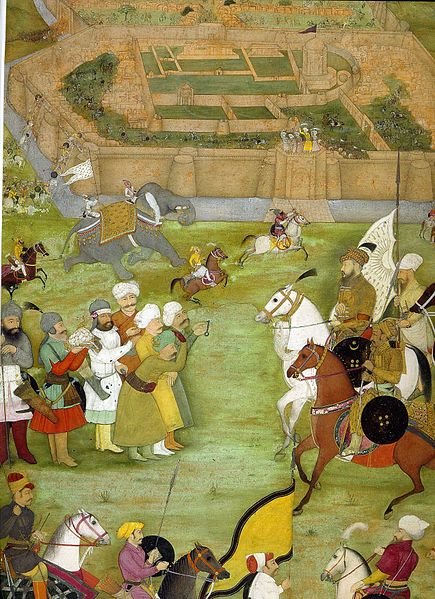
“The Surrender of Kandahar”, a miniature painting in the Padshahnama, shows the Persians handing over the city’s keys to Kilij Khan in 1638.
Mughal Counteroffensives and the Three Sieges of Kandahar
First Siege (1651)
Determined to recover the lost province, Shah Jahan sent his son, Aurangzeb, along with the vizier Sa’dullah Khan, at the head of a formidable army of 50,000 soldiers. The force comprised Mughal Rajput allies, local Afghan levies, and elite Sayyid warriors. Upon reaching Kandahar, Aurangzeb successfully engaged the Safavid forces outside the city but struggled to breach its fortified walls. The Mughal artillery, despite its strength, failed to make a significant impact against the Persian defenses. Furthermore, the arrival of winter worsened conditions, making supply lines vulnerable to raids. Consequently, the siege was abandoned, marking the first failed attempt to retake the city.
Second Siege (1652)
Unwilling to accept defeat, Shah Jahan launched another campaign in 1652, once again under Aurangzeb’s command. This time, external factors complicated the Mughal efforts. Abdul Aziz, the Khan of Bukhara, had formed an alliance with the Safavids and sent a force of 9,500 Uzbek soldiers to harass Mughal supply lines near Kabul. While the Uzbeks could not directly lift the siege, they managed to disrupt reinforcements and logistics, weakening Mughal resolve. After two months of battle, Aurangzeb, facing persistent Persian resistance and logistical nightmares, was once again forced to withdraw.
Third and Final Siege (1653)
Realizing that previous failures stemmed from insufficient artillery power, Shah Jahan assigned his eldest son and heir-apparent, Dara Shikoh, to lead the third assault in 1653. This campaign was accompanied by two of the heaviest artillery pieces in the Mughal arsenal. However, despite a prolonged five-month siege, the Mughals could neither breach the city’s walls nor starve its defenders into submission. The Safavids, well-prepared and deeply entrenched, withstood every Mughal offensive. Finally, on September 29, 1653, after three years of relentless but unsuccessful attempts, the Mughals abandoned their efforts to retake Kandahar.
The Mughal-Safavid War of 1649–1653 was not just a battle for Kandahar but a defining moment that shaped the geopolitical landscape of South Asia.
Environmental and Logistical Challenges
The war was not only defined by battles but also by the harsh realities of the terrain and climate. The Hindu Kush region was notorious for its severe winters and treacherous mountain passes. Mughal armies, accustomed to the relatively temperate conditions of India, struggled to adapt to the extreme conditions. The logistical difficulties were immense—unlike in the fertile plains of Hindustan, local food supplies were insufficient, forcing the army to transport large quantities of grain over vast distances.
Mughal supply lines were continuously threatened by Afghan tribal raiders, many of whom were either independent warlords or loosely allied with the Safavids. Additionally, Uzbek incursions further destabilized the Mughal position. Unlike in India, where Banjaras (grain-carriers) ensured a steady supply of food and livestock, such infrastructure was absent in Afghanistan, making sustained military campaigns even more arduous.
Another challenge was financial. The Mughal treasury, already strained by the expensive Balkh campaign, struggled to finance multiple military expeditions. The need to carry vast sums of bullion for troop payments across difficult terrain further exposed Mughal convoys to enemy raids. This financial burden ultimately contributed to the Mughals’ inability to sustain prolonged warfare in the region.
Aftermath and Consequences
The loss of Kandahar to the Safavids was a significant blow to Mughal prestige. It marked the definitive end of Mughal territorial ambitions in Central Asia and shifted their focus entirely towards the Indian subcontinent. Despite being a powerful empire, the Mughals found themselves constrained by logistical and geographical challenges that made further westward expansion impractical.
For the Safavids, the victory was a major triumph. Not only did they secure a strategically important city, but they also reinforced their influence in Afghanistan. Kandahar remained under Persian control until it was captured by the rising Afghan leader Mir Wais Hotak in the early 18th century, setting the stage for the eventual decline of Safavid rule.
Ultimately, the Mughal-Safavid war marked the beginning of a shift in Mughal priorities, focusing more on internal consolidation rather than external expansion.
Politically, the war also had repercussions within the Mughal court. The repeated failures in Kandahar undermined Shah Jahan’s position, particularly among his sons. Aurangzeb, despite his defeats, gained valuable military experience that later influenced his policies as emperor. Meanwhile, Dara Shikoh’s inability to recapture the city further weakened his standing, indirectly contributing to his downfall in the Mughal succession struggle.
Furthermore, the war exposed the limits of Mughal military power beyond the Indian subcontinent. While the Mughals had a well-equipped and vast army, their inability to maintain prolonged campaigns in hostile, mountainous terrain demonstrated the challenges of fighting in regions outside their natural strongholds.
Questions and Answers
Why was Kandahar vital to the Mughals?
It was a crucial trade and military gateway linking Hindustan to Central Asia, essential for controlling trade routes and securing warhorses.
How did Shah Abbas II of Persia capture Kandahar?
He led a 40,000-strong army in 1648 and seized Kandahar in February 1649 after a brief siege, exploiting Mughal instability following their failed Balkh campaign.
What were Aurangzeb’s attempts to retake Kandahar?
He led multiple sieges (1651, 1652) but failed due to harsh winters, strong Safavid defenses, and disruptions by Uzbek forces.
Why did the 1653 Mughal siege under Dara Shikoh fail?
Despite heavy artillery and a prolonged five-month siege, the Mughals couldn’t breach Kandahar’s walls or starve the defenders into surrender.
What role did the environment play in the war?
The harsh Hindu Kush terrain, brutal winters, and constant raids by tribal groups and Uzbeks hindered Mughal supply lines and troop movements.
How did the Safavids and Uzbeks collaborate?
The Uzbeks allied with the Safavids, sending about 9,500 troops in 1652 to harass Mughal supply lines, weakening their ability to sustain the siege.
What was the final outcome of the war?
After repeated failures, the Mughals abandoned all attempts to retake Kandahar by September 1653, solidifying Safavid control over the region.





