Muhammad Iqbal
Sir Muhammad Iqbal, often referred to as Allama Iqbal, was a prominent philosopher, poet, and politician whose works greatly influenced the political consciousness of Muslims in British India. He played a pivotal role in conceptualizing the idea of Pakistan and remains a revered figure in South Asia, particularly in Pakistan, where he is celebrated as the national poet.
In the article below, World History Edu delves into poetry and philosophy, focusing on his views of self-awareness, spiritual revival, and the collective upliftment of the Muslim Ummah.
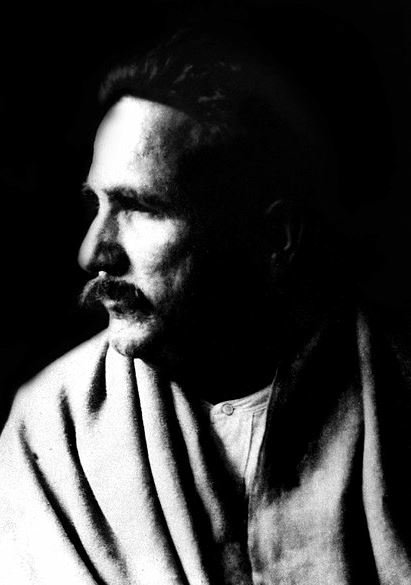
A 1930s photo of Muhammad Iqbal.
Early Life and Education
Born on November 9, 1877, in Sialkot, Punjab (then part of British India), Iqbal hailed from a Kashmiri Muslim family. His father, Sheikh Noor Muhammad, was a tailor but was known for his religious devotion. His mother, Imam Bibi, was a pious woman who played a significant role in shaping his character. Iqbal’s ancestry traced back to Kashmiri Brahmins who had embraced Islam in the 15th century.
Iqbal received his early education at Scotch Mission College in Sialkot, where he was greatly influenced by Syed Mir Hassan, a noted scholar and professor of Arabic. After completing his intermediate studies, he joined Government College Lahore, where he earned a Bachelor’s degree in Philosophy, English Literature, and Arabic in 1897, followed by a Master’s degree in Philosophy in 1899. He excelled academically and was deeply influenced by his professor, Sir Thomas Arnold, who encouraged him to pursue further studies in Europe.
Higher Studies in Europe
In 1905, Iqbal traveled to England for higher studies. He enrolled at Trinity College, Cambridge, where he obtained a Bachelor of Arts degree in 1906. During this time, he also became a barrister at Lincoln’s Inn. In 1907, he moved to Germany and pursued a Doctorate in Philosophy at the University of Munich, where he completed his dissertation, The Development of Metaphysics in Persia. He was deeply influenced by Western philosophers such as Friedrich Nietzsche, Henri Bergson, and Goethe, as well as Islamic scholars like Rumi and Al-Ghazali.
Return to India and Literary Contributions
Upon his return to Lahore in 1908, Iqbal began practicing law but soon devoted himself to literature and philosophy. His poetry, primarily in Persian and Urdu, explored themes of self-realization, spiritual awakening, and the revival of Islamic civilization. His most notable works include:
- Asrar-e-Khudi (Secrets of the Self) – 1915: This philosophical poem emphasized the development of an individual’s self-awareness and selfhood.
- Rumuz-i-Bekhudi (Secrets of Selflessness) – 1918: Complementing his earlier work, this book advocated for collective unity and selflessness in a Muslim society.
- Bang-e-Dara (The Call of the Marching Bell) – 1924: A collection of Urdu poetry that included the famous patriotic poem Saare Jahan Se Achha.
- Payam-e-Mashriq (Message of the East) – 1923: A response to Goethe’s West-östlicher Diwan, stressing the moral superiority of the East over the materialistic West.
- Javid Nama (Book of Eternity) – 1932: A spiritual journey through time and space, inspired by Dante’s Divine Comedy.
- Zarb-i-Kalim (The Rod of Moses) – 1936: A poetic critique of contemporary politics and philosophy.
Top Scholars of the Islamic Golden Age and their Major Achievements
Political Ideals and Activism
Although Iqbal was not a conventional politician, his political thoughts profoundly shaped the ideology of Muslim nationalism in India. His Allahabad Address (1930) is regarded as a turning point in the struggle for an independent Muslim state. In this speech, Iqbal called for a separate homeland for Muslims in Northwestern India, laying the groundwork for what would later become Pakistan.
Iqbal was elected as a member of the Punjab Legislative Council in 1927 and later became the president of the All India Muslim League (Punjab branch). He strongly supported Muhammad Ali Jinnah, recognizing him as the only leader capable of uniting the Muslims of India. His letters to Jinnah were instrumental in convincing him to return to Indian politics and lead the Muslim League toward achieving Pakistan.
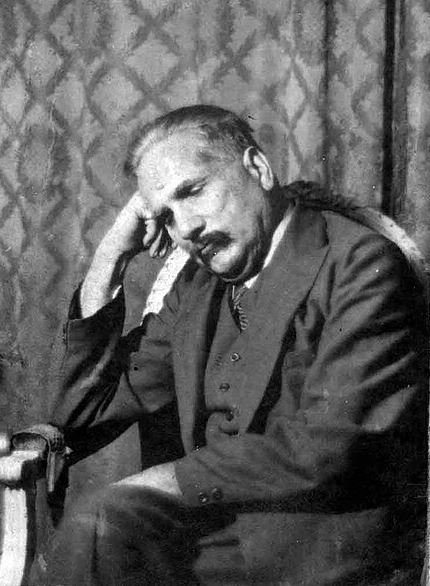
A 1930 photo of Muhammad Iqbal.
READ MORE: Partition of India: History, Causes & Effects
Religious and Philosophical Contributions
Iqbal’s philosophy was deeply rooted in Islamic thought, and he sought to reinterpret religious principles in the context of modernity. His Reconstruction of Religious Thought in Islam, a collection of lectures published in 1930, laid the intellectual foundation for the modern revival of Islamic philosophy.
His concept of Khudi (Selfhood) emphasized individual empowerment, while his vision of Ijtihad (reinterpretation) advocated for a dynamic and evolving approach to Islamic jurisprudence. He was critical of Western materialism and Muslim conservatism, urging a balanced approach to religious and scientific progress.
Iqbal’s dream of an independent Muslim state materialized in the form of Pakistan, where his ideas remain deeply embedded in the nation’s identity and aspirations.
Last Years and Legacy
Iqbal’s health began to decline in the early 1930s. He suffered from a chronic throat illness and spent his last years in Lahore, where he continued to write and inspire future generations. He passed away on April 21, 1938, and was buried near the Badshahi Mosque in Lahore, where his tomb remains a significant site of homage.
Following the creation of Pakistan in 1947, Iqbal was recognized as the ideological father of the nation. His birthday, November 9, is celebrated as Iqbal Day, a public holiday in Pakistan.

Global Influence and Recognition
Iqbal’s works have been translated into several languages, including English, Persian, German, and Arabic. He is revered in Iran, where he is known as Iqbal-e-Lahori, and his poetry played a role in inspiring the Iranian Revolution. His influence extends to Turkey, Afghanistan, and the Arab world, where his ideas continue to shape Islamic intellectual discourse.
Timeline of Muhammad Iqbal (1877–1938)
- 1877: Born on November 9 in Sialkot, British India, to a Kashmiri family.
- 1893: Matriculated from Scotch Mission College, Sialkot.
- 1895: Completed Intermediate studies in Arts from Government College Lahore.
- 1897: Graduated with a BA in Philosophy, English Literature, and Arabic from Government College Lahore.
- 1899: Earned an MA in Philosophy and became a lecturer at Oriental College, Lahore.
- 1903: Published Ilm ul Iqtisad (The Science of Economics).
- 1905: Traveled to England for higher education.
- 1906: Completed BA at Trinity College, Cambridge, and was called to the bar at Lincoln’s Inn.
- 1908: Obtained a PhD in Philosophy from the University of Munich; returned to Lahore and resumed teaching.
- 1915: Published Asrar-e-Khudi (Secrets of the Self).
- 1923: Knighted by the British government.
- 1930: Delivered the Allahabad Address, proposing an independent Muslim state.
- 1938: Passed away on April 21 in Lahore.
Frequently Asked Questions
Where was Muhammad Iqbal born and educated?
He was born in Sialkot, British India (now Pakistan). He studied at Government College Lahore, Cambridge University, and the University of Munich, where he earned a PhD in philosophy.
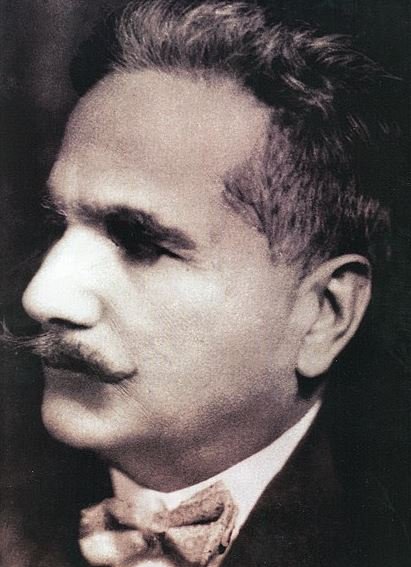
A 1938 photo of Muhammad Iqbal.
What is Iqbal’s most famous literary work?
His notable works include Asrar-e-Khudi, Rumuz-e-Bekhudi, Bang-e-Dara, and The Reconstruction of Religious Thought in Islam.
How did Iqbal contribute to the idea of Pakistan?
In his 1930 Allahabad Address, he proposed a separate Muslim state in northwestern India, laying the ideological foundation for Pakistan.
What role did he play in the All-India Muslim League?
He was an active member, advocating for Muslim rights and unity. He influenced Muhammad Ali Jinnah to lead the movement for Pakistan.
Why is Iqbal called the “Poet of the East”?
His poetry, in Persian and Urdu, emphasized Islamic revival, self-empowerment, and resistance against colonialism, gaining widespread recognition.
How did Iqbal view the West and modern civilization?
While admiring Western scientific progress, he criticized its materialism and detachment from spirituality, advocating for a balance between reason and faith.
What was Iqbal’s relationship with Rumi?
He considered Rumi his spiritual guide and frequently referenced his teachings, blending Sufi mysticism with modern philosophical thought.

A depiction of Rumi by Hossein Behzad , an Iranian painter.
How is Iqbal honored today?
He is Pakistan’s national poet, and his birth anniversary, Iqbal Day (November 9), is a public holiday. His works continue to inspire scholars and leaders.
What were Iqbal’s final years like?
He suffered from illness in his later years and passed away in Lahore in 1938. His tomb is located near the Badshahi Mosque, Lahore.





