Nabu: Ancient Babylonian God of Wisdom and Literacy
Nabu, the ancient Babylonian god of wisdom and literacy, played a central role in Mesopotamian religious and intellectual life. Revered for his association with writing, communication, and knowledge, Nabu’s influence extended well beyond Babylon, making him one of the most significant deities in the region’s history. His worship flourished from the second millennium BC, and his importance grew alongside the cultural and political development of the Babylonian and Assyrian empires.

Nabu was the Babylonian god of literacy, wisdom, and scribes, associated with the planet Mercury in Babylonian astronomy. Image: Colossal statue of the god Nabu, 8th century BC, from Nimrud, on display in the National Museum of Iraq
Origins and Name Meaning
Nabu’s name is derived from the Akkadian word nabû, which means “announcer” or “authorized person.” This etymology reflects Nabu’s role as a divine messenger and communicator of wisdom, emphasizing his function as the god of writing and scribes. His name is linguistically connected to several other Semitic languages, such as Hebrew, Aramaic, and Arabic. In these languages, similar terms (nāḇi, nabiyy) mean “prophet” or “one who announces.” This commonality across different cultures reinforces Nabu’s identity as a figure of communication and prophecy.
Nabu’s origins are somewhat obscure, though he is first mentioned in Mesopotamian texts as a deity of lesser importance. Over time, however, his role expanded, and he became more widely revered. His significance in Babylonian society rose substantially during the first millennium BC, especially after being identified as the son of Marduk, the supreme god of the Babylonian pantheon. Nabu’s elevation to this status brought him closer to the center of Babylonian religious life and cemented his role as a key figure in the mythology of the region.
Nabu’s Worship and Role in Babylonian Religion
Nabu was primarily worshipped in the city of Borsippa, located near Babylon. Borsippa was considered a “sister city” to Babylon, and Nabu’s temple, known as Ezida, was one of its most important religious sites. Each year, during the New Year’s festival (Akitu), Nabu’s statue was transported from Borsippa to Babylon in a grand ceremonial procession. The purpose of this journey was for Nabu to symbolically pay homage to his father, Marduk, at the great temple in Babylon. This annual event reinforced Nabu’s status as a god of both local and empire-wide importance.
Nabu’s role in Babylonian religion was closely tied to his association with wisdom, literacy, and writing. As the patron god of scribes, Nabu was seen as the divine scribe, responsible for recording human fates and determining the destinies of individuals and nations. His position as the god of writing also extended into the realms of law, governance, and the rational arts, making him central to the administration and intellectual culture of the Babylonian empire. Scribes, who played a crucial role in maintaining the bureaucracy and documenting the empire’s history, revered Nabu as their divine protector.
In addition to his connection with writing, Nabu was also regarded as a god of vegetation, symbolizing growth and renewal. This association highlights the multifaceted nature of Nabu’s character, blending intellectual and natural forces. His worship reflected the Babylonian understanding of a world governed by divine order, where knowledge, law, and nature were intricately linked.
Symbolism and Iconography
Nabu was commonly depicted with a stylus and tablet, the tools of a scribe, which symbolized his authority over writing and literacy. These objects were sacred to Nabu, and offerings made in his temple often included clay tablets, inscribed with special calligraphic skill, reflecting the high value placed on the written word in Mesopotamian culture.
Through his association with writing, ancient Mesopotamian god Nabu symbolized the intellectual achievements of the Babylonians and Assyrians.
In some depictions, Nabu’s figure was accompanied by a wedge shape, which also symbolized the stylus used in cuneiform writing. The Babylonian king Nabonidus, whose name literally means “Nabu is exalted,” carried a royal scepter adorned with Nabu’s wedge symbol, underscoring the god’s political and cultural importance.
Nabu was also portrayed wearing a horned cap, a standard symbol of divinity in Mesopotamian art. His posture, with hands clasped in the gesture of priesthood, reinforced his connection to the religious and intellectual authority. He was often shown riding a winged dragon, known as Sirrush, an image originally associated with Marduk. This association with the dragon served to further link Nabu with his father and underscored his divine power and lineage.
The Role of Nabu in Fate and Prophecy
One of Nabu’s most important functions in Babylonian religion was his role in determining fate. As the divine scribe, Nabu was believed to inscribe the destinies of both individuals and entire nations. His role in writing these fates aligned him with the broader Mesopotamian belief in a universe governed by order, where the gods played a central role in determining outcomes. Nabu’s power over fate made him a figure of reverence and respect, as people believed that their destinies lay in his hands.
In this capacity, Nabu was also connected to prophecy. As the god who could foretell and inscribe the future, he was linked to other prophetic gods in the Mesopotamian pantheon, particularly the moon god Sin, who had similar oracular abilities. Nabu’s prophetic aspect extended his influence beyond the intellectual and bureaucratic spheres, making him a deity consulted for guidance and predictions.
Association with Planet Mercury and Astrology
In Babylonian astronomy, Nabu was associated with the planet Mercury. This association further underscored his role as a god of communication, since Mercury, the swift-moving planet, was seen as a divine messenger. In Babylonian astrological texts, Nabu’s connection with Mercury was well established, and the planet’s movements were interpreted as omens and signs of divine will. Mercury’s orbit, which closely follows that of the moon, linked Nabu to lunar aspects and reinforced his connection with Sin, the moon god.
Nabu’s connections to fate and astrology linked him to broader religious beliefs about divine order and the cosmos.
Mercury’s role in Babylonian astrology was not limited to Nabu alone. It had previously been connected with Ninurta, another god associated with writing and warfare. However, as Nabu’s influence grew, he gradually took over this connection, reflecting his rise to prominence within the pantheon. This association with Mercury also added a celestial dimension to Nabu’s authority, as his influence was believed to extend beyond the earthly realm and into the heavens.
Nabu’s Decline and Legacy
Nabu’s worship continued well into the late periods of Mesopotamian history, but it began to decline after the fall of the Neo-Babylonian Empire and the loss of cuneiform writing. By the 2nd century AD, as the art of cuneiform became a lost skill and was replaced by alphabetic scripts, Nabu’s role as the god of scribes and writing naturally diminished. With the rise of new religious systems, such as Christianity and Zoroastrianism, the gods of the ancient Mesopotamian pantheon gradually lost their influence.
However, Nabu’s legacy did not entirely disappear. In later traditions, such as Mandaean cosmology, Nabu’s connection with the planet Mercury persisted. The Mandaeans, a religious group with roots in the Mesopotamian region, continued to refer to Mercury as ʻNbu, preserving the ancient association with the Babylonian god.
Spread of Nabu’s Cult Outside Mesopotamia
Nabu’s influence was not confined to Babylon and Assyria. His cult spread beyond Mesopotamia, particularly into Egypt during the Neo-Babylonian period, when Semitic communities in Egypt adopted Nabu as one of their deities. In Egypt, Semitic theophoric names incorporating Nabu were common, reflecting his widespread appeal. Additionally, Nabu was worshipped by Jewish and Canaanite communities in Elephantine and Aswan, alongside other gods like Yahweh, Anat, and Bethel.
Nabu is also mentioned in the Hebrew Bible, where he appears as Nəḇo, a reference to the Babylonian deity. In the prophetic books of Isaiah and Jeremiah, Nabu is mentioned in the context of foreign gods, illustrating his presence in the wider ancient Near Eastern religious landscape.
Syncretism with Other Deities
During the Hellenistic period, Nabu’s role as a god of wisdom, writing, and prophecy led to his identification with several deities from other cultures.
In the Greek world, he was equated with Apollo, the god of prophecy and arts. In the Roman tradition, Nabu was associated with Mercury, the god of communication and commerce. In Egypt, he was linked to Thoth, the god of writing, wisdom, and the moon.
This process of syncretism allowed Nabu’s influence to persist even as the political landscape of the ancient world changed, and it helped cement his legacy as a divine figure connected to wisdom, knowledge, and communication.
Frequently Asked Questions
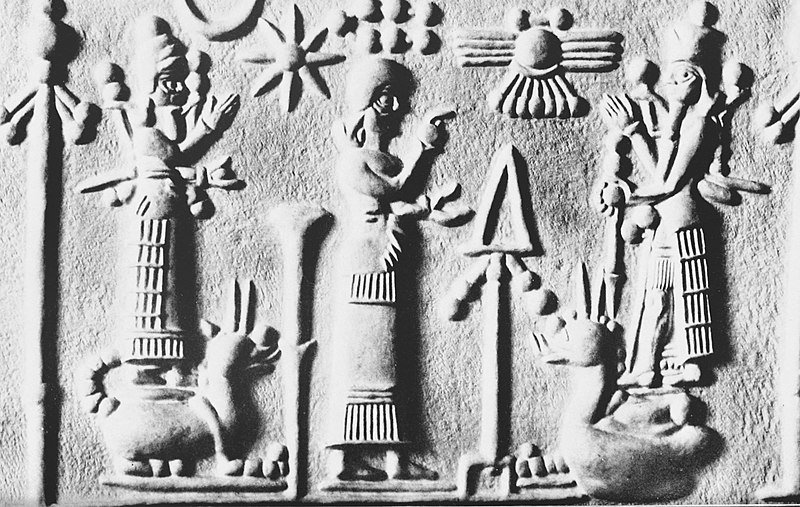
Ancient Mesopotamian god Nabu represented rational arts and was highly revered for his influence on writing and knowledge, making him a central figure in Babylonian intellectual and religious life. Image: Late Assyrian seal depicting a worshipper between Nabu and Marduk, standing on their servant dragon Mušḫuššu, 8th century BCE.
What does Nabu’s name mean, and what are its linguistic roots?
Nabu’s name means “announcer” or “authorized person” in Akkadian. It shares linguistic roots with Semitic languages, including Hebrew (nāḇi) and Arabic (nabiyy), both meaning “prophet.”
How did Nabu gain prominence in Babylonian religion?
Nabu gained prominence in the 1st millennium BC when he was recognized as the son of Marduk, the chief god of Babylon. His worship centered in Borsippa, where his statue was brought to Babylon each New Year to honor Marduk.
What symbols are associated with Nabu?
Nabu’s symbols include a stylus and a tablet, representing his connection to writing and knowledge. He is also associated with a wedge-shaped symbol, which was featured on the royal scepter of the Babylonian king Nabonidus.
What was Nabu’s role as the god of writing and wisdom?
Nabu was revered as the inventor of writing and the divine scribe who recorded human fates. He was also associated with the rational arts and considered a god of vegetation.
Who was Nabu’s wife, and what did their relationship signify?
Nabu’s wife was the goddess Tashmet, symbolizing his divine family connections and further solidifying his position within the pantheon of Babylonian gods.
How was Nabu connected to fate and prophecy?
As a divine scribe, Nabu was believed to inscribe human destinies, giving him a role in determining fate. He was linked to the moon god Sin and associated with the planet Mercury in Babylonian astronomy.
How was Nabu visually depicted in Mesopotamian art?
Nabu was depicted wearing a horned cap, symbolizing his divinity, and standing with his hands clasped in a gesture of priesthood. He was often shown riding a winged dragon, Sirrush, which originally symbolized Marduk.
When did Nabu’s worship decline, and why?
Nabu’s worship continued until the 2nd century AD when the art of cuneiform writing was lost, leading to a decline in his direct cultural influence.
How did Nabu’s influence spread outside Mesopotamia?
Nabu’s cult spread to Egypt and other regions, where Semitic names incorporating Nabu were common. He was worshipped alongside Yahweh and other gods in Elephantine and Aswan, and his name appears in the Hebrew Bible as Nəḇo.
With which other deities was Nabu identified during the Hellenistic period?
During the Hellenistic period, Nabu was identified with Apollo, Hermes, Mercury, and Thoth, deities associated with wisdom, prophecy, and communication. This syncretism reflects his enduring influence across different cultures.





