Nakba Day: Origin Story & Significance to the Palestinians
Nakba Day, observed annually on May 15, marks a poignant chapter in the history of the Palestinian people. This date commemorates the “Nakba” or “Catastrophe,” referring to the mass displacement of Palestinians that followed the establishment of the state of Israel in 1948. The origins and significance of Nakba Day encapsulate a series of historical events, cultural impacts, and ongoing political implications that resonate deeply within Palestinian society and across the international community.

Nakba Day encapsulates a historical and ongoing struggle faced by Palestinians. It is a day of remembrance that brings to light the enduring impact of the events of 1948 on generations of Palestinians. Image: A 1948 picture of Palestinian refugees.
Origin Story of Nakba Day
The story of Nakba Day begins with the expiration of the British Mandate for Palestine on May 14, 1948, and the subsequent declaration of the establishment of the State of Israel by the Jewish leadership in Palestine. In the wake of this declaration, a complex and tragic series of events unfolded that would reshape the Middle East profoundly.
Historical Background
The roots of the Nakba lie in the early 20th century, particularly with the Balfour Declaration of 1917, in which Britain supported the establishment of a “national home for the Jewish people” in Palestine, then a part of the Ottoman Empire and later under British control after World War I. This declaration, coupled with the migration of Jewish populations to Palestine, fueled tensions between Jewish immigrants and the Arab population.
Throughout the 1930s and 1940s, these tensions escalated into violence, peaking during the Arab Revolt of 1936-1939. The end of World War II and the Holocaust intensified pressure to resolve the plight of Jewish refugees, leading to the United Nations’ proposal to partition Palestine into Jewish and Arab states in 1947. This proposal was accepted by the Jewish leadership but rejected by the Arab leaders, who opposed the establishment of Israel.

The Balfour Declaration of 1917, endorsing a Jewish homeland in Palestine and subsequent Jewish immigration, led to the Arab Revolt and a divisive 1947 UN partition proposal, sparking war and mass Palestinian displacement. Image: A letter from Arthur Balfour (British Foreign secretary) to the head of the British Jewish community, Walter Rothschild.
The 1948 War and Palestinian Exodus
The declaration of the State of Israel was immediately followed by military intervention from neighboring Arab states, leading to the Arab-Israeli War of 1948. During this conflict, between 700,000 and 900,000 Palestinian Arabs fled or were expelled from their homes in the territory that became Israel. The reasons for this exodus are deeply contested and complex, involving a combination of forced expulsions and fear of the ongoing war.
Many Palestinians left their homes expecting to return after the cessation of hostilities. However, the conclusion of the war, marked by Armistice Agreements in 1949, left Israel in control of much of the territory originally allotted to the Arab state under the UN partition plan, preventing the return of Palestinian refugees.
This displacement led to a refugee crisis that has persisted for decades, with many Palestinians living in refugee camps in neighboring Arab countries and in the Gaza Strip and the West Bank.
Significance of Nakba Day
This Nakba Day is a poignant reminder of the enduring impacts of displacement and loss that define the Palestinian narrative and identity. It symbolizes the struggle for recognition, rights, and return that continues to this day.
Across Palestinian communities and the diaspora, Nakba Day is observed with solemnity and serves as a moment for collective mourning, reflection, and renewed resolve. Politically and culturally, it reinforces Palestinian claims and aspirations for statehood and justice, while also calling for international attention to their ongoing plight and the unresolved conflict in the region.
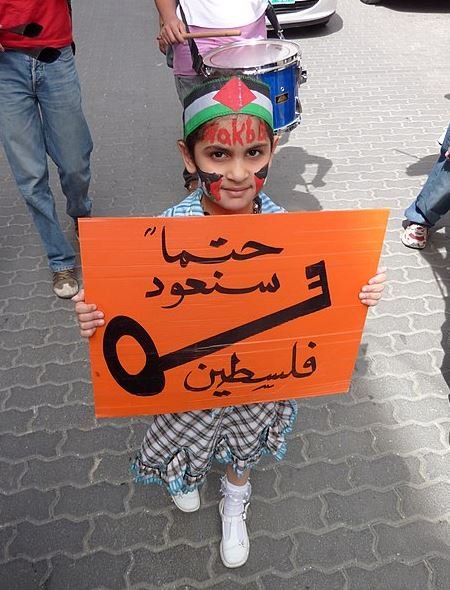
Nakba Day is observed by Palestinians, both within the Palestinian territories and in the diaspora, as a day of remembrance and mourning. It is a significant event that highlights the plight, resistance, and resilience of the Palestinian people. Image: A young girl carrying a sign, which reads “Surely we will return, Palestine.” at a 2010 Nakba Day protest in the Palestinian city of Hebron, West Bank.
READ MORE: What are the most heavily militarized borders in the world?
Cultural and Political Impact
The Nakba has had a profound cultural impact on the Palestinian identity, shaping its literature, art, and collective memory. The event is a cornerstone of Palestinian nationalism, symbolizing the loss, displacement, and yearning for a homeland. It also serves as a powerful reminder of the unresolved issues surrounding Palestinian statehood and the right of return for refugees.
Politically, Nakba Day serves as an occasion for Palestinians to assert their rights and express their grievances against ongoing Israeli policies perceived as oppressive or discriminatory. It is also a day for mobilizing international support for the Palestinian cause, highlighting issues such as settlement expansion, the status of Jerusalem, and the conditions in Gaza.
Israel-United States Relation and its impact on the Middle East Peace Process
International Observance and Controversy
Nakba Day is not without controversy. In Israel, the public commemoration of Nakba Day has been met with mixed reactions and, at times, legislative attempts to limit such observances, citing them as undermining the legitimacy of the State of Israel. Internationally, Nakba Day has been a focal point for debates on the Israeli-Palestinian conflict, drawing attention to the broader implications for Middle East peace and international law.

READ MORE: Origin and history of the conflict between Israel and Palestine
FAQs
What does the Arabic term “Nakba” literally translate to, and how is it historically significant?
The Arabic term “Nakba” literally translates to “the catastrophe.” It refers to the ethnic cleansing and violent displacement of Palestinians during the 1948 Palestine war, marking a critical and traumatic period in Palestinian history.
How many Palestinians were displaced during the Nakba in 1948, and what were some of the methods used to force their exodus?
During the Nakba in 1948, approximately 750,000 Palestinians, about half of Palestine’s predominantly Arab population, were expelled from their homes or made to flee. Methods used included violent actions by Zionist paramilitaries and later by the Israel Defense Forces, alongside massacres and the depopulation of Arab-majority towns and villages.
Nakba Day, observed on May 15, commemorates the “Nakba” or “Catastrophe,” marking the mass displacement of Palestinians during the 1948 Arab-Israeli War following the establishment of Israel.
What percentage of the land area of the former Mandatory Palestine was controlled by Israel by the end of the 1948 war, and what was the impact on the Palestinian population?
By the end of the 1948 war, Israel controlled 78% of the total land area of the former Mandatory Palestine. At least 15,000 Palestinian Arabs had been killed, and hundreds of villages were depopulated or destroyed.
How do Palestinian and Israeli national narratives differ in their interpretation of the events of the Nakba?
The Palestinian national narrative views the Nakba as a collective trauma that defines their national identity and political aspirations. In contrast, the Israeli national narrative perceives these events as part of the war of independence, establishing their aspirations for statehood and sovereignty.
What was the Six-Day War? – History, Causes, Casualties, & Consequences
What is Nakba Day and how is it observed?
Nakba Day is observed on May 15 by Palestinians to commemorate the displacement that occurred during the 1948 Palestine war. It takes place one day after Israel’s Independence Day, symbolically reflecting the contrasting perspectives on the events of 1948.

What cultural symbols and expressions have emerged among Palestinians in response to the Nakba?
The Nakba has profoundly influenced Palestinian culture and is symbolized by various elements such as Handala, the Palestinian keffiyeh, and the 1948 keys. Numerous books, songs, and poems reflecting on the Nakba have been created, shaping the collective memory and identity of the Palestinian people.
What is “Nakba denial,” and how has scholarship changed perceptions of the Nakba?
Nakba denial refers to the rejection or minimization of the factual history regarding the displacement and suffering of Palestinians during the 1948 war. Growing scholarship, including works by the Israeli New Historians, has challenged these denials by bringing to light detailed historical accounts of the events, thereby changing perceptions and understanding of the Nakba.





