Nure-Onna: The Snake Woman in Japanese Folklore

Nure-onna is part of Japan’s broader folkloric tradition of yōkai, which are supernatural creatures that exist outside the formal boundaries of Shinto or Buddhism. While she isn’t part of any official religious canon, her stories are a significant part of the cultural imagination and oral storytelling tradition in Japan.
Japanese folklore is rich with strange, powerful, and terrifying creatures, many of which come from ancient myths passed down through generations. Among them is the Nure-onna (濡女), one of the more enigmatic and mysterious figures in the country’s mythological landscape. Part woman, part serpent, she is a compelling yet fearsome character who both enthralls and frightens.
Her name can be translated as “wet woman” (nure meaning “wet” and onna meaning “woman”), which is a fitting description for her often drenched appearance. Though the Nure-onna appears in various forms throughout Japan’s regional stories, her core characteristics remain fairly consistent—she is a predatory being, often linked with water, and a symbol of both danger and supernatural allure.
Origins and General Description
Nure-onna is typically described as a creature with the head of a woman and the body of a snake. Depending on the version of the myth, her snake-like body can vary in size from being as long as a few meters to more than fifty meters. She is often found near rivers, lakes, or seashores, frequently in a dripping-wet state, hence the “nure” part of her name.
Her hair is usually long and wild, sometimes wet and disheveled, giving her a haunting appearance. Though she might seem fragile or in need of help at first glance, the Nure-onna is a dangerous creature, driven by malicious intent.
This combination of woman and snake evokes a sense of both fascination and fear. The snake in Japanese culture, as in many others, carries dual meanings. It can symbolize rebirth and renewal but also danger, treachery, and death.
The Nure-onna’s human form adds another layer of complexity, for she is not merely a beast but a supernatural being that can manipulate emotions and the perceptions of her victims, much like other seductive yet dangerous female figures found in global mythologies, such as the Greek sirens or the Slavic rusalka.
Did you know…?
Nure-onna is typically found near bodies of water such as seas, rivers, and lakes. In some regions, she is referred to as “nureyomejo” and appears as a supernatural phenomenon at sea.
Variations of the Myth
The Nure-onna legend, like many myths, has multiple regional variations across Japan, each offering a slightly different depiction of the snake-woman and her interactions with humans. Despite these variations, certain elements remain consistent: Nure-onna is a fearsome creature with an insatiable thirst for blood or a strong desire to drown her victims.
The Classic Nure-onna
One of the most well-known versions of the Nure-onna myth involves her being spotted near rivers or shores, often appearing to be a woman in distress. She might be holding a small bundle, which she presents as a baby, crying and asking for help.
However, this baby is nothing more than a ruse. When an unsuspecting passerby takes the baby, it begins to grow heavier and heavier, making it impossible for the person to drop it. The victim becomes immobilized, either crushed under the baby’s immense weight or too weak to escape, at which point the Nure-onna reveals her true form and attacks. Sometimes she drains the victim’s blood, using her long snake tongue to suck it from their body; other times, she drags them into the water to drown.
Nure-onna and Ushi-oni
In some legends, the Nure-onna is associated with another fearsome creature, the Ushi-oni (牛鬼), or “ox demon.” In these stories, Nure-onna serves as a lure, leading victims into the waiting arms of the Ushi-oni, which typically dwells in rivers and attacks humans. The combination of these two monsters creates a gruesome partnership, with Nure-onna using her deceptive appearance to make people vulnerable before the Ushi-oni strikes with brute force.
Nure-onna as a Vengeful Spirit
In certain regional myths, Nure-onna is not a purely malevolent figure but a vengeful spirit, seeking justice for wrongs committed against her or her family. In these versions, she takes the form of a snake-woman to punish those who have wronged her or desecrated her grave. This variation adds a more complex moral dimension to the Nure-onna, portraying her not simply as a monster but as a spirit driven by anger or grief.
Nure-onna as a Protector of the Sea
Some more benevolent interpretations of Nure-onna suggest that she is not an entirely evil creature. In these stories, she is seen as a protector of the sea, rivers, or lakes, punishing only those who pollute or harm the natural world. In this version, she becomes an avenging guardian of nature, a protector of the purity of water sources, and a creature whose wrath is reserved for those who disrespect the environment.
Appearance and Symbolism

The name “Nure-onna” means “wet woman” in Japanese, and it refers to her constantly wet appearance, especially her hair, which is always dripping in the legends. Image: “Nure-onna” (濡女) from the Gazu Hyakki Yagyō by Japanese scholar and poet Toriyama Sekien
Nure-onna’s appearance and her connection with water make her a deeply symbolic figure in Japanese folklore. Water, particularly in the form of rivers, oceans, or rain, is often associated with the boundary between life and death, the known and the unknown. It is the domain of spirits and otherworldly beings.
In Shinto, Japan’s indigenous belief system, water is revered for its purity, yet it also harbors great mystery and danger. Nure-onna, being both of the human and serpent world, straddles these boundaries, making her an embodiment of the dangers that come with interacting with the supernatural, especially when it is tied to water.
Her snake-like form is also significant. In many cultures, snakes are dualistic symbols, representing life and death, creation and destruction. In Japan, snakes are often linked to yōkai (supernatural creatures) and spirits, with some even believed to be reincarnations of human souls. The snake’s ability to shed its skin symbolizes regeneration and transformation, but in the case of the Nure-onna, it represents something more sinister: the capacity to deceive, ensnare, and destroy.
Nure-onna’s deceptive nature—disguising herself as a helpless woman or mother—ties into a broader tradition of femme fatale figures in myth and folklore. These figures, like sirens or succubi, use their beauty and vulnerability to lure men to their doom. Nure-onna, with her haunting beauty and deadly intent, fits into this archetype while also being uniquely tied to Japanese concepts of purity, nature, and vengeance.
Interpretations and Themes
The Nure-onna myth explores several important themes in Japanese culture, many of which reflect broader global concerns about the nature of fear, trust, and survival. The fact that Nure-onna often disguises herself as a woman in need speaks to the dangers of misplaced empathy. The Nure-onna plays on the human impulse to help others, particularly those who appear vulnerable, which she then uses to her advantage. This manipulation of empathy might reflect deeper concerns about the dangers lurking beneath the surface of everyday life, warning listeners to be cautious of appearances.
Moreover, Nure-onna’s connection to water and her snake form reflect humanity’s long-standing anxieties about the unknown, particularly the natural world. Water, especially deep or fast-moving water, has always been associated with danger, and snakes, with their ability to appear and disappear quickly, often evoke fear. Nure-onna embodies both of these primal fears in a single, mythological figure. Her myth might also be interpreted as a cautionary tale about the power of nature and the perils of crossing into territories where human beings are not meant to venture.
The Nure-onna’s use of the “baby” as a ruse is another fascinating element of her myth. The image of a helpless infant is universally evocative of care and protection, which makes the moment when the baby turns into a deadly weight particularly horrifying. It’s a reversal of expectations—a theme common in many Japanese ghost stories, where what initially seems benign turns out to be malevolent.
Nure-onna in Popular Culture
Like many Japanese yōkai, the Nure-onna has found her way into popular culture. She appears in various anime, manga, and video games, often as a villainous or antagonistic character. In these modern interpretations, Nure-onna’s form might be exaggerated or stylized, but her core characteristics—a serpentine body, a beautiful but deceptive face, and a connection to water—remain intact.
One example of her presence in popular media is the long-running manga and anime series GeGeGe no Kitaro, where she appears as a supernatural antagonist. In many of her appearances, her ability to disguise her intentions and her supernatural power over water are highlighted, making her a formidable foe for the series’ protagonists.
Additionally, the concept of Nure-onna, with her hybrid human-serpent form and her association with water, has influenced other fictional characters in Japanese horror and supernatural genres. Films, television shows, and video games that delve into the eerie or supernatural often draw upon figures like Nure-onna to evoke fear and unease.
Megan Thee Stallion’s ‘Mamushi’
Comparisons with Other Mythological Figures
Nure-onna bears resemblance to various mythological figures across cultures. The most notable comparisons might be with the Greek Lamia or the Slavic Rusalka. Lamia, like Nure-onna, was a figure that lured and killed children or young men. Often portrayed as a half-serpent woman, Lamia was cursed by Hera after Zeus’ infidelity, leading to her monstrous form and actions. Similarly, Nure-onna’s serpentine body and deceptive tactics mirror Lamia’s mythological traits, suggesting that cultures across the world often associate serpentine imagery with dangerous female figures.
The Rusalka, a water spirit in Slavic mythology, is also comparable to Nure-onna. Rusalka are said to inhabit rivers and lakes, often dragging unsuspecting victims to their watery graves. They are also depicted as beautiful but dangerous women, much like Nure-onna, who can use their appearance to lure men to their deaths.
In both of these cases, the fusion of human and serpent or human and water spirit speaks to the primal fear that these hybrid beings elicit in people. They represent the collapse of boundaries—between the human and the animal, the living and the dead, and the known and the unknown—creating a potent figure of dread.
Conclusion
The Nure-onna is a fascinating and terrifying figure in Japanese folklore. As a snake-woman, she embodies a deep connection to nature, the supernatural, and the unknown, while also tapping into universal fears of deception, death, and vulnerability. Whether seen as a bloodthirsty predator, a vengeful spirit, or a protector of the natural world, the Nure-onna continues to capture the imagination of those who hear her story. Her legacy, like many figures from folklore, endures in modern media, ensuring that her mythological presence remains relevant even in contemporary settings.
Nure-onna, with her serpentine form, wet appearance, and deceptive methods, reflects humanity’s long-standing anxieties about the unknown—particularly the mysteries hidden in nature’s darkest corners. She serves as a reminder to be cautious, to respect the boundaries between the human and the supernatural, and to never underestimate the dangers that might lurk beneath the surface of a seemingly innocent encounter.
Questions and Answers
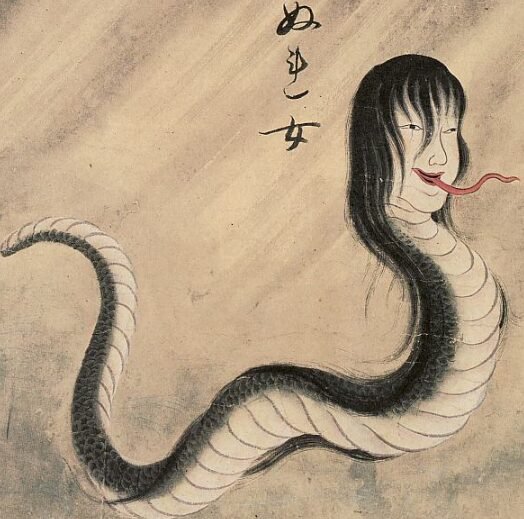
Nure-onna is a yōkai (supernatural creature) in Japanese folklore, depicted as a being with the head of a woman and the body of a snake. She is often associated with water, such as rivers, lakes, or seashores, and is known for luring humans into traps before attacking them. Image: “Nure-onna” (ぬれ女) from the Hyakkai-Zukan by Sawaki Suushi.
Here are some frequently asked questions (FAQs) about Nure-onna, the snake-woman from Japanese mythology:
What does the name “Nure-onna” mean?
“Nure-onna” (濡女) translates to “wet woman” in English. The name refers to her often dripping-wet appearance, as she is frequently seen near bodies of water.
What does Nure-onna do to her victims?
Nure-onna lures her victims by appearing as a distressed woman carrying a baby or in need of help. When someone approaches her, she reveals her true nature and attacks them. In some versions of the myth, the “baby” she carries becomes unbearably heavy, immobilizing the victim, making them easier to kill. Nure-onna may drain their blood or drown them in nearby water.
Why is Nure-onna associated with water?
Nure-onna is often depicted near water because she is a supernatural creature linked to rivers, lakes, or the ocean. Water in Japanese folklore is frequently associated with spirits, the boundary between life and death, and otherworldly beings. Nure-onna embodies this connection through her wet appearance and attacks near water sources.
Is Nure-onna always evil?
While Nure-onna is typically portrayed as a malevolent creature who preys on humans, some regional versions of the myth depict her as a vengeful spirit or even as a protector of nature. In these interpretations, she may only attack those who harm the environment or disrespect water sources, making her a more morally complex figure.
Is Nure-onna related to any other yōkai?
In some versions of her myth, Nure-onna is connected to the Ushi-oni (ox demon), another fearsome water-dwelling creature. The two sometimes work together, with Nure-onna luring victims into traps, allowing the Ushi-oni to attack them.
Also, Nure-onna shares similarities with other water yōkai like the isoonna of Kyushu. Both yōkai appear near water and use their humanoid appearance to deceive humans. Nure-onna is also compared to the ubume, a ghostly figure that hands cursed babies to people, and to the rokurokubi, another yōkai with snake-like characteristics.
How is Nure-onna similar to the rokurokubi?
Nure-onna is similar to the rokurokubi because both yōkai are part-human, part-creature, and share snake-like features. Both also display unpredictable and often violent behavior towards humans.
What is the symbolism of Nure-onna’s snake-like body?
The snake has various symbolic meanings in Japanese culture, representing both life and death, transformation, and danger. Nure-onna’s serpentine form reflects these dualities, embodying both the seductive and deadly aspects of her nature. Snakes are often linked to water and the supernatural in many cultures, making her a perfect figure for a water-related yōkai.
How does Nure-onna compare to other mythological figures?
Nure-onna shares similarities with other mythological creatures like the Greek Lamia and the Slavic Rusalka. All three figures are part-human, part-otherworldly beings who lure humans to their deaths, often with deceptive beauty or vulnerability.
What are some famous stories involving Nure-onna?
Many of Nure-onna’s stories involve her luring travelers by pretending to be a helpless woman holding a baby. One famous version depicts her offering the baby to a passerby, who soon realizes the baby is impossibly heavy and cannot escape. At that point, Nure-onna reveals her true form and attacks.
How can people protect themselves from Nure-onna?
There are no specific protections against Nure-onna in folklore, but general advice from yōkai stories suggests that staying away from isolated bodies of water and being cautious of strangers, especially those asking for help near rivers or shores, could be a good precaution.
According to the legend from Shimane Prefecture, if someone is handed a baby by Nure-onna, they should wear gloves when holding it. When the baby turns into a heavy stone, discarding the gloves would allow the victim to escape.
What are the legends involving Nure-onna from the Edo Period?
During the Edo Period, Nure-onna was frequently depicted in works like the Hyakkai Zukan and Gazu Hyakki Yagyō as a snake-bodied woman. Though there are few classical stories, folklorist Morihiko Fujisawa recounts a tale from 1819 in Shimane Prefecture, where Nure-onna lures victims by handing them a baby. Afterward, an ushi-oni (ox demon) appears to kill the victim, who is trapped by the baby turning into a heavy stone.
What are Nure-onna’s motives in different stories?
Nure-onna’s motives vary. In some stories, she is a bloodthirsty predator who crushes trees with her tail and feeds on human blood. In other versions, she seeks solitude and only attacks when disturbed while washing her hair near the water.
Why does Nure-onna appear as a woman?
Like other femme fatale figures in global mythology, Nure-onna uses her womanly appearance to manipulate the emotions of her victims, particularly their compassion. This allows her to disguise her true nature and prey on those who are too trusting or unsuspecting.