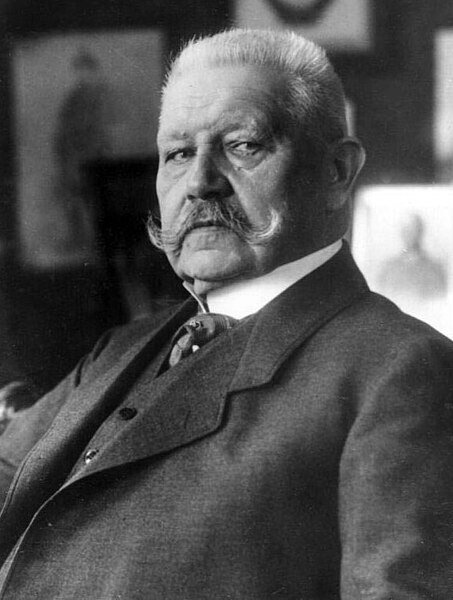
Official portrait of Paul von Hindenburg from 1925
Paul von Hindenburg was born on 2 October 1847 in Posen, Prussia (modern Poznań, Poland), into a family of minor Prussian nobility. He pursued a military career, entering the Cadet Corps School at Wahlstatt at the age of 11. Hindenburg became a second lieutenant in the Third Regiment of Foot Guards in 1866, just in time to fight in the Austro-Prussian War. He also saw action in the Franco-Prussian War (1870–71), earning distinctions for his service. By 1873, he joined the Prussian War Academy, beginning his ascent through the German military ranks.
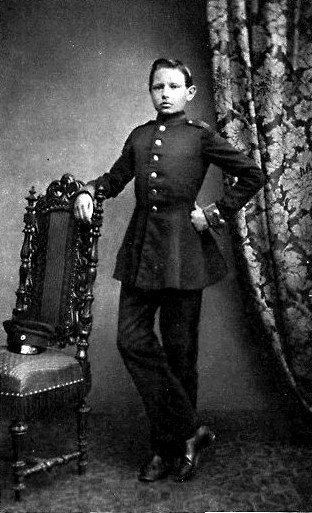
Hindenburg as a cadet in Wahlstatt, located in south-western Poland (1860).
Rise Through the German Military
Hindenburg’s early career included service in the General Staff, where he worked under influential commanders such as Count Alfred von Schlieffen, author of the Schlieffen Plan. By 1900, he had risen to the rank of lieutenant general. However, in 1911, after decades of service, he retired as a general of infantry, assuming he would spend the rest of his life in obscurity.
World War I: The Eastern Front and National Hero
When World War I erupted in 1914, Hindenburg was recalled from retirement to lead the German Eighth Army on the Eastern Front. His name became synonymous with the Battle of Tannenberg (1914), where his forces inflicted a crushing defeat on the Russian Second Army. This victory cemented his status as a national hero, and he became the face of Germany’s military successes. In 1916, he replaced General Erich von Falkenhayn as Chief of the Great General Staff, alongside his deputy, Erich Ludendorff. Together, they effectively established a de facto military dictatorship, overseeing Germany’s war strategy.
Despite early successes, including defeating Russia and forcing its withdrawal from the war with the Treaty of Brest-Litovsk (1918), Hindenburg and Ludendorff were unable to reverse Germany’s fortunes on the Western Front. The Allied offensives of 1918, including the Second Battle of the Marne and the Hundred Days Offensive, led to Germany’s eventual defeat.
How did the Germans react to the terms of the Versailles Treaty?
Post-War Role and the Stab-in-the-Back Myth
After Germany’s defeat, Hindenburg retired again in 1919. However, he re-entered public life by testifying before a parliamentary commission investigating Germany’s loss. During these hearings, he popularized the “stab-in-the-back myth” (Dolchstoßlegende), blaming Germany’s defeat not on its military but on supposed betrayal by politicians, socialists, and Jews on the home front. This myth would later be exploited by far-right movements, including the Nazis.
Presidency of the Weimar Republic
In 1925, Hindenburg reluctantly entered politics and was elected as the President of Germany. Though a staunch monarchist, he accepted the democratic Weimar Republic, albeit reluctantly. His presidency initially brought stability and confidence, particularly through his backing of Foreign Minister Gustav Stresemann’s policies, which sought reconciliation with Western powers.
Paul von Hindenburg reliance on authoritarian methods, his embrace of the stab-in-the-back myth, and his role in appointing Hitler as chancellor have cast a shadow over his reputation.
However, Hindenburg struggled to manage the political and economic crises that beset Germany during the Great Depression. In 1930, he began governing through presidential decrees under Article 48, bypassing the Reichstag. This move significantly weakened parliamentary democracy and paved the way for authoritarianism.
Rise of the Nazis
Hindenburg distrusted Adolf Hitler, whom he dismissively referred to as “that Austrian corporal.” Despite this, the growing strength of the Nazi Party in elections pressured Hindenburg to include them in government. In January 1933, under advice from his inner circle (including Franz von Papen), Hindenburg appointed Hitler as Chancellor of Germany, believing he could be controlled within a conservative coalition.
Enabling Hitler’s Dictatorship
After the Reichstag Fire (1933), Hindenburg signed the Reichstag Fire Decree, suspending civil liberties. He also approved the Enabling Act, granting Hitler the power to rule by decree. These actions effectively dismantled Germany’s democratic institutions. Though Hindenburg remained president until his death, his authority diminished as Hitler consolidated power.
Death and Legacy
Hindenburg died on 2 August 1934, at the age of 86, at his estate in Neudeck. Following his death, Hitler combined the offices of president and chancellor, declaring himself Führer of Germany. Hindenburg’s legacy is deeply controversial. While celebrated as a military hero during his lifetime, his presidency and decisions are criticized for enabling the rise of Nazi totalitarianism.
Frequently Asked Questions
What role did Paul von Hindenburg play in World War I?
Hindenburg served as a key military leader, overseeing Germany’s victory at Tannenberg and later becoming Chief of the General Staff, where he established a de facto military dictatorship with Erich Ludendorff.
How did Hindenburg contribute to the rise of Adolf Hitler?
As President of Germany, Hindenburg appointed Hitler as Chancellor in January 1933, enabling the Nazi Party’s rise to power despite his initial reservations.
What were Hindenburg’s notable achievements during his presidency?
Hindenburg stabilized the Weimar Republic temporarily and upheld Germany’s international treaties, but his decisions, particularly appointing Hitler, undermined democratic governance.
What is the “Hindenburg Myth”?
It refers to the personality cult surrounding Hindenburg, portraying him as a national hero and embodiment of German virtues, which persisted from World War I through his presidency.
How did Hindenburg view democracy and the Weimar Republic?
Hindenburg was a monarchist who reluctantly supported the Republic but distrusted democracy, ultimately enabling its downfall by aligning with authoritarian forces.
What was Hindenburg’s relationship with the Nazi Party?
Hindenburg disliked Hitler personally but viewed the Nazis as a means to counter leftist movements and restore national unity, a perspective that facilitated their consolidation of power.
Why is Hindenburg criticized for his role in German history?
Hindenburg is criticized for betraying the Republic by enabling Hitler’s rise, disregarding constitutional oaths, and undermining democratic institutions.