Pharaoh Huni: Life and Reign of the Ancient Egyptian King of the 3rd Dynasty
Pharaoh Huni is recognized as the last ruler of Egypt’s Third Dynasty during the Old Kingdom period, which marked a significant developmental era in Egyptian civilization.
Though his reign likely ended around 2613 BC, very little is concretely known about Huni, and he remains an enigmatic figure in Egyptian history. This scarcity of information is partly due to the minimal number of records and artifacts directly connected to him, leaving much of his life and reign a subject of scholarly debate.
However, Huni’s position as a transitional figure at the end of the Third Dynasty and his possible contributions to early pyramid construction have left a lasting legacy.
Early Evidence of Huni’s Name and Attestations
Few surviving artifacts mention Huni by name, making it challenging to form a detailed picture of his reign. Two primary objects directly link to him: a red granite conical stele and a polished magnesite stone bowl.
The first object, the granite stele, was discovered in 1909 on Elephantine Island and includes Huni’s name in a cartouche. The stele also references a royal palace called the “Palace of the Headband of Huni,” suggesting a connection to his rule. The stele’s distinctive cone shape, resembling a Benben stone, has led scholars to hypothesize that it may have served a prominent display purpose, perhaps within a stepped pyramid structure. Today, this artifact is housed in the Cairo Museum.
The second item, a magnesite stone bowl discovered in 2007 in South-Abusir, bears Huni’s name, though it is not enclosed in a cartouche. Instead, the inscription includes the Njswt-Bity title, meaning “King of Upper and Lower Egypt.” Although these items are sparse, they provide essential glimpses into Huni’s rule and highlight the sparse material culture associated with him.
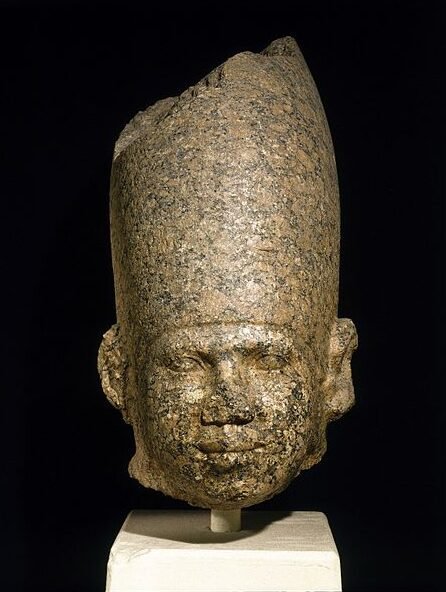
King Huni reigned for about 24 years until around 2613 BC, as suggested by the Turin King List. Image: A pink granite head, possibly depicting Huni, is displayed at the Brooklyn Museum.
Huni in Later Historical Records
Huni is also referenced in several later documents that, while not contemporary, offer valuable insights into his legacy. For example, the mastaba of the official Metjen at Saqqara contains a reference to a royal estate called Hut-nisut-hu, associated with Huni.
Additionally, the Fifth Dynasty Palermo Stone, a significant historical record, mentions a mortuary temple for Huni, although its exact location has yet to be discovered. Another notable reference to Huni appears in the Prisse Papyrus from the 13th Dynasty. This text, known for containing the Instructions of Kagemni, briefly notes Huni’s death and the succession of Sneferu, who became the first pharaoh of the Fourth Dynasty. Such references reinforce the view that Huni was the final ruler of the Third Dynasty, marking a transitional period in ancient Egypt.
Interpretations and Variations of Huni’s Name
The interpretation of Huni’s name has generated considerable debate among Egyptologists, as the hieroglyphic inscriptions associated with his name vary. In general, two primary forms of his name exist: an older version and a later Ramesside interpretation, which may have been altered or misinterpreted by scribes.
The earliest known representations of Huni’s cartouche include the hieroglyphs for Njswt Hw, often translated as “King Hu.” Egyptologist Ludwig Borchardt suggested that Ramesside-era scribes misunderstood and misread certain hieroglyphs in his name, potentially leading to inconsistencies.
Hans Gödicke offered an alternative reading, suggesting that Huni’s name might mean “He who belongs to the smiters,” indicating a possible theophoric, or deity-associated, name.
However, Egyptologists such as Rainer Stadelmann dispute this interpretation, citing a lack of linguistic evidence. Consequently, while Borchardt’s reading remains the more widely accepted, the translation and interpretation of Huni’s name continue to be subjects of scholarly debate.
The Mystery of Huni’s Horus Name
Like all Egyptian kings, Huni would have held a Horus name, symbolizing his divine connection to the god Horus. However, identifying Huni’s Horus name has proven challenging, as no surviving records explicitly confirm it.
Several Egyptologists have proposed that he might be linked with Horus Khaba, another king associated with the Layer Pyramid at Zawyet el-Aryan. This connection is based on the pyramid’s architectural style and artifacts found nearby, which suggest a Third Dynasty origin.
Another possible Horus name for Huni is Neb-hedjetnwb, translating to “Lord of the Golden Crown,” although this interpretation is also disputed.
Huni’s Potential Queen and Family Relationships
Determining Huni’s familial relationships has been equally challenging. Some evidence suggests that he may have had a queen named Djefatnebty, inferred from beer jar inscriptions discovered at Elephantine. These inscriptions refer to Djefatnebty as “Great One of the Hetes-Sceptre,” a title typically reserved for a queen.
However, the relationship between Djefatnebty and Huni remains speculative due to the limited and indirect nature of this evidence.
The question of Huni’s relationship with Sneferu, his likely successor and the first king of the Fourth Dynasty, is also unresolved. While Huni and Sneferu are mentioned together in later historical records, no direct evidence confirms a familial link between them.
Some scholars have speculated that Hetepheres I, the mother of King Khufu, might have been Huni’s daughter, thus establishing a bloodline connection between the Third and Fourth Dynasties. However, this theory remains uncertain, as there is no explicit documentation to support it.
Burial Site and Funerary Cult of Huni
Huni’s burial site remains one of the enduring mysteries of ancient Egyptian archaeology. Early theories posited that Huni was originally buried in the Meidum Pyramid, later modified by Sneferu into a “true pyramid.”
However, more recent evidence points to Sneferu’s exclusive association with this pyramid, based on inscriptions and nearby mastaba tombs that reference his name. Another hypothesis suggests that Huni may have been buried in the Layer Pyramid at Zawyet el-Aryan, as the nearby necropolis contains artifacts bearing the name of Horus Khaba.
In addition to these potential burial sites, Huni’s legacy is also evident in his mortuary cult. The Palermo Stone mentions donations made to Huni’s funerary complex, suggesting that he was remembered and revered by later generations. The cultic presence dedicated to him, even in subsequent dynasties, underscores the importance of his role as the final king of the Third Dynasty.
Huni and the Cultic Step Pyramids
Some scholars associate Huni with a series of smaller step pyramids along the Nile, which were likely used for ritual purposes rather than as burial structures. One of these cultic pyramids, located at the eastern end of Elephantine Island, is near the granite stele bearing Huni’s name. Given this proximity, it is possible that Huni commissioned these cultic pyramids as markers of royal authority or as part of a broader architectural program aimed at consolidating his influence across Egypt.
However, not all scholars agree on Huni’s connection to these cultic structures. For example, Andrzej Ćwiek suggests that the granite stele bearing Huni’s name might have been reused during the Ramesside period, complicating the attribution of these cultic pyramids to Huni. The only cultic pyramid with a confirmed royal connection is the Seila Pyramid at Faiyum Oasis, associated with Sneferu. This find suggests that Huni may have initiated this architectural style, with Sneferu continuing the tradition during his reign.
Huni’s Contributions to Early Architecture and Legacy
Despite limited archaeological evidence, Huni is believed to have made substantial contributions to early Egyptian architecture. As the last king of the Third Dynasty, Huni may have overseen early developments in pyramid construction, paving the way for Sneferu’s advancements in the Fourth Dynasty. Though Huni’s name was once associated with the Meidum Pyramid, subsequent findings indicate that this pyramid was likely completed by Sneferu, who made significant modifications to create a true pyramid.
However, Huni’s impact may be visible in the unfinished Layer Pyramid at Zawyet el-Aryan. Some scholars, including Rainer Stadelmann, propose that this structure was initially intended as Huni’s burial place. The Layer Pyramid’s design reflects the architectural transition from stepped pyramids to smooth-sided ones, illustrating the evolving complexity of Egyptian tomb construction.
Lasting Influence and Remembered Legacy
Despite the sparse records, Huni maintained a legacy that extended beyond his reign. His name appears on the Palermo Stone, a historical record from the Fifth Dynasty, indicating the persistence of his mortuary cult well after his death. In later Egyptian king lists, Huni is often cited, which underscores the significance of his role as a foundational figure at the close of the Third Dynasty.
Huni’s reign also marks an important transitional phase in ancient Egypt’s political landscape. With Sneferu’s ascension to the throne, the Fourth Dynasty began, ushering in an era of significant architectural achievements, particularly the construction of the true pyramids. This transition highlights Huni’s role in bridging two influential dynasties and establishing a foundation upon which his successors would build.
Conclusion
Pharaoh Huni remains an enigmatic figure in Egyptian history, his reign marked by limited evidence and much speculation. His significance as the last king of the Third Dynasty places him at a critical juncture in Egypt’s development, as he oversaw a period of architectural experimentation that would influence his successors. The scarcity of records and artifacts bearing his name contributes to the mystery surrounding his life and achievements, but the surviving references in later texts attest to his remembered influence.
Frequently Asked Questions
Who was Huni, and when did he rule Egypt?
Huni was the last pharaoh of Egypt’s Third Dynasty, ruling during the Old Kingdom period around 2613 BC.
What challenges do Egyptologists face when studying Huni’s reign?
Few records and artifacts directly connected to Huni survive, making details of his reign and identity difficult to confirm and subjects of scholarly debate.
What artifacts attest to Huni’s name?
Two primary artifacts include a red granite conical stele from Elephantine Island and a polished magnesite stone bowl found in South-Abusir.
What does the conical stele reveal about Huni?
The stele mentions a royal palace called the “Palace of the Headband of Huni” and likely served as a significant monument, possibly displayed near a stepped pyramid.
How is Huni’s name represented on the magnesite stone bowl?
The stone bowl bears Huni’s name without a cartouche but includes the title Njswt-Bity, meaning “King of Upper and Lower Egypt.”

Image: The cartouche of Huni appears on the reverse side of the Palermo Stone, within the register of Neferirkare.
Where else does Huni’s name appear in historical sources?
His name appears in the mastaba of Metjen at Saqqara, the Palermo Stone from the Fifth Dynasty, and the Prisse Papyrus from the 13th Dynasty.
How does the Prisse Papyrus reference Huni?
The Prisse Papyrus mentions Huni’s death and the ascension of Sneferu, supporting the view that Huni was the last ruler of the Third Dynasty.
What issues complicate the interpretation of Huni’s name?
Hieroglyphic variations in his cartouche have led to different readings, including “King Hu” and “He who belongs to the smiters.”
What theories exist regarding Huni’s Horus name?
Some Egyptologists propose Huni’s Horus name might be Horus Khaba, associated with the Layer Pyramid at Zawyet el-Aryan, or Neb-hedjetnwb, meaning “Lord of the Golden Crown.”
Who is Djefatnebty, and how might she be related to Huni?
Djefatnebty, likely a queen based on jar inscriptions found on Elephantine Island, might have been Huni’s consort, though this is not definitively confirmed.
Is there evidence connecting Huni to Sneferu, his likely successor?
Although Huni’s name appears alongside Sneferu’s in historical sources, no clear records confirm a familial link between them.
What are the theories regarding Huni’s burial site?
Early theories suggested Huni was buried in the Meidum Pyramid, later modified by Sneferu, but more recent evidence points to Sneferu’s sole association with this pyramid. Some scholars suggest the Layer Pyramid at Zawyet el-Aryan might be Huni’s burial site.
What role did Huni play in cultic architecture?
Smaller, cult-related pyramids along the Nile, including one on Elephantine Island, indicate that Huni may have constructed these monuments for ritual purposes, marking royal estates.
How did Huni’s legacy persist in later periods?
Huni maintained a lasting legacy with mentions on the Palermo Stone and later king lists, and his mortuary cult appears to have endured through subsequent dynasties.
How is Huni’s transition into the Fourth Dynasty significant in Egyptian history?
Huni’s probable succession by Sneferu, who introduced “true pyramid” construction, marks a shift in Egypt’s architectural and political landscape as the Fourth Dynasty began.





