Ancient Egyptian Pharaoh Sneferu: Life, Reign and Accomplishments
Sneferu, the first pharaoh of Egypt’s Fourth Dynasty (c. 2613–2589 BCE), is celebrated as a pioneering ruler who profoundly influenced Egypt’s architectural and cultural heritage.
His reign ushered in major advancements in pyramid construction, a shift from step pyramids to smooth-sided ones, which established the iconic architectural style for which Ancient Egypt is widely recognized.
Known in Greek as Soris, Sneferu’s achievements laid the groundwork for the monumental constructions of later pharaohs, including his son Khufu, who built the Great Pyramid of Giza.
READ MORE: History and Major Facts about the Old Kingdom of ancient Egypt

Estimates of Sneferu’s reign vary widely, from 24 years to possibly 48 years, depending on historical sources. Image: Limestone statue of Pharaoh Sneferu of the Old Kingdom; located at the Egyptian Musuem in Cairo, Egypt.
Origins and Meaning of Sneferu’s Name
The name Sneferu translates to “He has perfected me,” derived from the phrase “Horus, Lord of Maat, has perfected me.” This reflects the divine association Egyptians attributed to their pharaohs, considering them representatives of the gods on Earth.
Sneferu’s name carries connotations of harmony and perfection, qualities that Egyptians saw as essential for their king, who was responsible for upholding Maat (truth, balance, and order) across the land.

Cartouche name Sneferu in the Abydos King List
READ MORE: Most Revered Ancient Egyptian Deities
Ascension to the Throne and Succession
Sneferu succeeded King Huni, the last ruler of the Third Dynasty, marking the transition to Egypt’s Fourth Dynasty. Huni’s reign likely saw the beginnings of significant architectural projects, such as the step pyramid at Meidum, though these were completed and expanded under Sneferu.
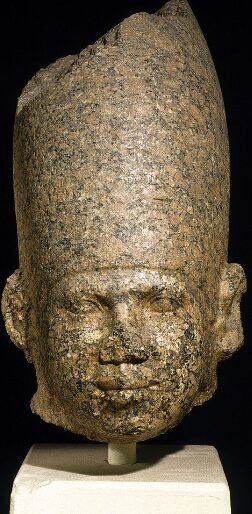
Pink granite head possibly depicting Huni, Brooklyn Museum, New York City
Ancient texts, such as the Papyrus Prisse, support the idea that Sneferu’s ascension followed Huni’s death, referring to Sneferu as a “beneficent king” who brought prosperity and stability to the land. Though it remains unclear if Huni was Sneferu’s biological father, Sneferu’s mother is believed to have been a noblewoman named Meresankh.
Sneferu married Hetepheres I, who became his chief queen and was the mother of Khufu. This union cemented the royal lineage, and Khufu would later succeed Sneferu, continuing his father’s architectural legacy by constructing the Great Pyramid at Giza.
Length of Sneferu’s Reign
The length of Sneferu’s reign has been debated among Egyptologists. Ancient records, including the Turin Canon, suggest that Sneferu ruled for 24 years, but this is now regarded as an underestimate. Inscriptions found at the Red Pyramid in Dahshur reference a 24th cattle count, which indicates a minimum reign of 24 years.
Additional records, however, suggest that Sneferu conducted cattle counts every two years rather than annually. This means that Sneferu’s rule could have extended closer to 27 or even 30 years. Most historians believe his reign lasted at least 30 years, given the immense scale of his building projects, though some sources speculate a longer reign of up to 48 years.
Innovations in Architecture: Pyramid Construction
Sneferu’s most enduring legacy is his transformation of pyramid construction. During his reign, Sneferu built three major pyramids, each representing a significant leap in architectural knowledge and technique. His innovations not only refined the aesthetics and structure of the pyramids but also showcased the technological advancements of the Fourth Dynasty.
The Pyramid at Meidum
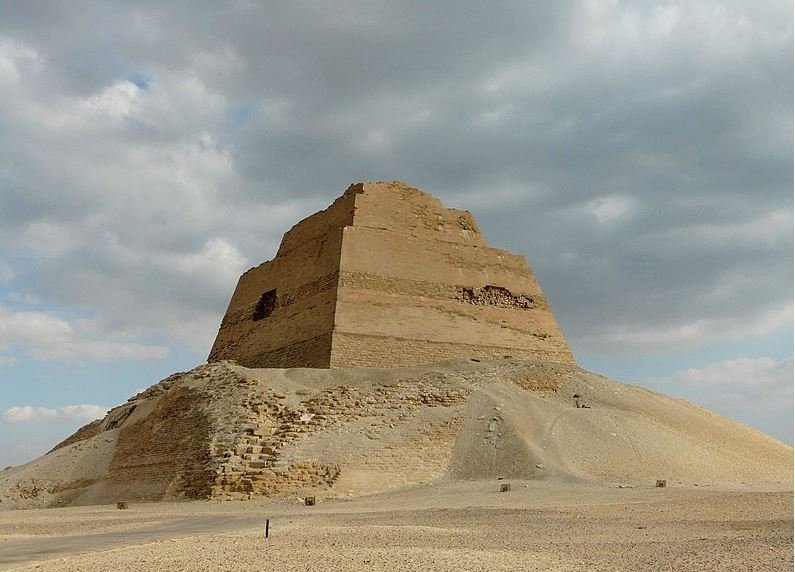
Image: The Meidum pyramid
Originally begun by Huni, the pyramid at Meidum was a step pyramid when Sneferu inherited it. He altered it into a smooth-sided pyramid, marking a shift in architectural style. However, the pyramid partially collapsed, likely due to structural issues during the transition. Although incomplete, the Meidum Pyramid represented an early attempt at creating a “true” pyramid with smooth sides, which would later become the standard design for royal tombs.
The Bent Pyramid at Dahshur

The Bent Pyramid, also known as the Rhomboidal Pyramid, was Sneferu’s next major project and a landmark in pyramid construction. The Bent Pyramid initially rose at a steep 54-degree angle but was modified halfway through construction to a shallower 43-degree angle. This change was likely made to avoid structural instability due to the pyramid’s size and height.
The unique bend in its shape gives it its name and highlights the architectural experimentation that defined Sneferu’s reign. The Bent Pyramid also featured dual entrances (one on the north side and another on the west), along with larger interior chambers and corbelled ceilings, showcasing further innovation in design.
The Red Pyramid at Dahshur

The Red Pyramid, Sneferu’s final pyramid and the first successful smooth-sided pyramid, stands as his architectural masterpiece. Built at a consistent angle of 43 degrees, it marked a refined approach to pyramid construction, avoiding the issues encountered with the Bent Pyramid.
Its name comes from the reddish hue of its limestone blocks, which are exposed as much of the outer casing was removed in later periods. While simpler internally than the Bent Pyramid, the Red Pyramid served as the model for future pyramids, including those at Giza. Some Egyptologists believe Sneferu may have been buried here, although his remains have not been definitively identified.
Military Campaigns and Foreign Policy
Sneferu’s reign extended beyond monumental architecture; he conducted military campaigns that expanded Egypt’s influence and secured vital resources.
His foreign expeditions into Nubia and Libya brought back captives who likely served as laborers on his building projects. An inscription details that Sneferu’s campaign in Libya resulted in the capture of over 11,000 prisoners and around 13,100 cattle, providing both a labor force and resources for sustaining construction efforts.
Additionally, Sneferu established trade routes and expeditions to acquire valuable materials. His ships sailed to Lebanon to procure cedar, a prized wood for construction and shipbuilding.
These expeditions underscore Egypt’s expanding trade network under Sneferu, as well as his ability to secure resources essential for his ambitious projects. In the Sinai Peninsula, Sneferu’s workers mined turquoise, a valuable stone that was used in art and jewelry.
Family and Dynasty
Sneferu’s union with Hetepheres I produced Khufu, who would go on to build the Great Pyramid at Giza, one of the Seven Wonders of the Ancient World. Khufu’s achievements were undoubtedly inspired by Sneferu’s architectural innovations, which set the standard for later monumental constructions.
Sneferu fathered several other children who held prominent roles in the kingdom. His son Ankhhaf served as a vizier under Khafre, Khufu’s son, and is known for his iconic bust in the Boston Museum of Fine Arts. Other sons, including Kanefer and Nefermaat I, held priestly and administrative positions, with Nefermaat serving as Sneferu’s first vizier.
Sneferu’s daughters, such as Hetepheres A and Meritites I, often married within the royal family to reinforce dynastic stability. This practice strengthened the royal lineage and kept power consolidated within the family.

Pharaoh Khufu was the father of Egyptian Pharaohs Djedefre and Khafre. Image: Ivory idol of Pharaoh Khufu
Legacy of Innovation and Influence
Sneferu’s reign is remembered for its remarkable contributions to pyramid construction, foreign trade, and royal administration. His architectural achievements reflect a transition from the experimental phase of the Third Dynasty pyramids to the refined, true pyramid structures of the Fourth Dynasty.
The innovations he introduced in pyramid construction not only transformed the Egyptian skyline but also set a precedent for his successors. The Red Pyramid, in particular, represents the culmination of these advancements, paving the way for Khufu’s construction of the Great Pyramid at Giza.
The stability and prosperity of Sneferu’s reign allowed for these developments, and his focus on monumental construction mirrored his desire to embody the divine and immortalize his legacy.
His foreign expeditions secured the resources and labor needed for these projects, showcasing his effective use of military power and diplomacy. The cedar wood ships he commissioned, such as the Praise of the Two Lands, represent one of the earliest known instances of a named vessel in history, underscoring his contributions to trade and naval exploration.
Theories on Sneferu’s Burial and Unidentified Remains
The location of Sneferu’s final resting place remains a mystery. While the Red Pyramid is often cited as his most likely burial site, no conclusive evidence has been found. In 1950, human remains were discovered in the Red Pyramid’s passageway, which were consistent with Fourth Dynasty mummification practices, though they could not be definitively identified as Sneferu’s. Egyptologists, including J.P. Lepre, speculate that undiscovered chambers within the Red Pyramid may contain Sneferu’s true burial chamber, though this theory remains unproven.
Did you know…?
There have been recorded accounts of slave trade as way back as the 3rd century BCE. For example, Pharaoh Sneferu of the 4th Dynasty of the Old Kingdom of Egypt, carried out many successful raids in what is today Sudan. The Egyptian king captured many prisoners of war before returning to Egypt. Image: Limestone statue of Pharaoh Sneferu of the Old Kingdom
Lasting Impact on Egyptian Society and Culture
Sneferu’s achievements resonate not only in the grandeur of his pyramids but also in the evolution of Egyptian society and its ideology. His reign exemplified the concept of a king who embodied divine qualities and upheld Maat, a balance essential to maintaining Egypt’s prosperity. By pushing the boundaries of architecture and establishing Egypt as a regional power, Sneferu set a powerful example for future pharaohs.
The influence of Sneferu’s architectural and cultural advancements extended beyond his lifetime, as the Fourth Dynasty is often regarded as the zenith of the Old Kingdom’s architectural achievements. His successors, especially Khufu, would build upon his foundations, making Sneferu one of the most influential pharaohs in Egyptian history. His reign marked a golden era of pyramid construction, military expansion, and trade, reinforcing Egypt’s status as a powerful and innovative civilization.
In summary, Sneferu’s life and accomplishments showcase a ruler who balanced military might, architectural innovation, and cultural influence. His legacy is immortalized in the pyramids he built, the stability he brought to Egypt, and the dynasty he founded, which would go on to construct some of the most iconic monuments in human history.
Frequently Asked Questions
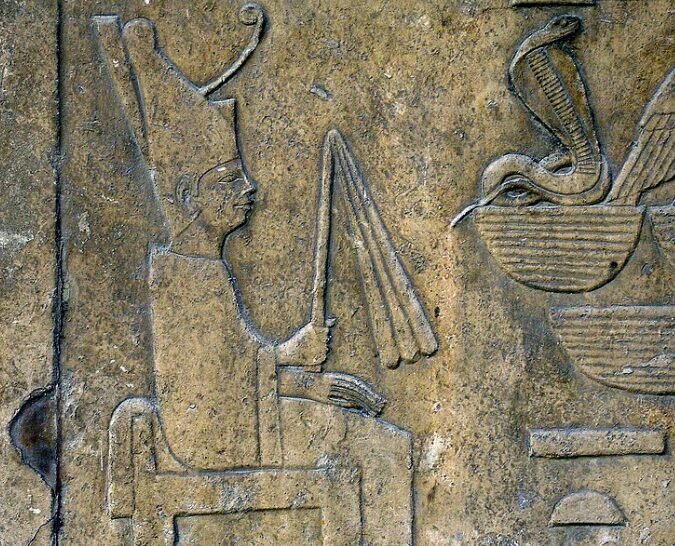
Relief detail of Sneferu in the white robe of the Sed-festival, from his Dahshur funerary temple, now at the Egyptian Museum.
What does Sneferu’s name mean, and from what phrase is it derived?
Sneferu’s name means “He has perfected me,” derived from the phrase “Horus, Lord of Maat, has perfected me.”
What was Sneferu’s Greek name, and what was his primary contribution to Egyptian architecture?
His Greek name was Soris, and he was pivotal in advancing pyramid construction, setting the stage for monumental projects like his son Khufu’s Great Pyramid.
How long did Sneferu reign, according to different sources?
The Turin Canon suggests 24 years, but inscriptions and building achievements imply his reign was likely between 27 and 30 years, though some sources speculate up to 48 years.
Who was Sneferu’s predecessor, and what does the Papyrus Prisse suggest about Sneferu’s succession?
His predecessor was King Huni, and the Papyrus Prisse suggests that Sneferu ascended right after Huni’s death, describing him as a “beneficent king.”
Who were Sneferu’s primary queen and son, and what was his son known for?
His primary queen was Hetepheres I, and his son Khufu, known for constructing the Great Pyramid at Giza.
What roles did Sneferu’s children play in his legacy?
His children, including Khufu, Ankhhaf, Kanefer, and Nefermaat I, held significant positions, with some serving as viziers and others marrying within the royal family to strengthen dynastic ties.
Which pyramids are attributed to Sneferu, and what is notable about each?
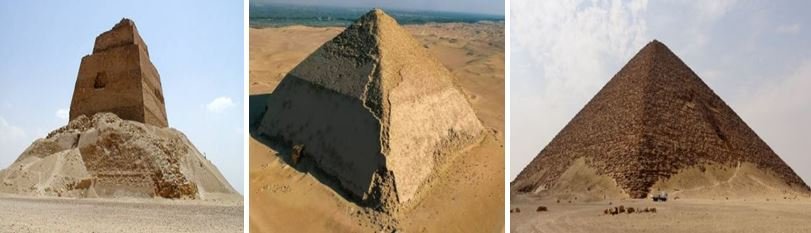
Pyramids built by Sneferu
- Meidum Pyramid: Initially started by Huni, Sneferu modified it to a true pyramid shape, though it partially collapsed.
- Bent Pyramid: Notable for its change in angle partway up, reflecting structural adjustments during construction.
- Red Pyramid: The first fully smooth-sided pyramid, marking the height of Sneferu’s architectural ambitions.
How did Sneferu’s military campaigns support his building projects?
His campaigns in Libya and Nubia provided prisoners as labor and resources like timber and turquoise, essential for his monumental construction efforts.
What was Sneferu’s ship, and why is it historically significant?
Sneferu’s ship, Praise of the Two Lands, is one of the earliest named vessels in history, reflecting his contributions to Egyptian trade and naval innovation.
What is Sneferu’s architectural legacy, and how did it impact future generations?
Sneferu’s architectural innovations laid the foundation for future pyramid construction, influencing projects like Khufu’s Great Pyramid, regarded as a pinnacle of Egyptian monumental achievements.





