Philip V of Macedon
Philip V of Macedon (238–179 BC), known for his charisma, military acumen, and tumultuous reign, was king of the ancient Greek kingdom of Macedon from 221 to 179 BC. His rule encompassed major conflicts such as the Social War (220–217 BC), the First (214–205 BC) and Second (200–196 BC) Macedonian Wars, and significant engagements with the Roman Republic and other Hellenistic powers. This article delves into his life, achievements, and challenges.

Philip V of Macedon (reign – 221-179 BC)
READ ALSO: Most Famous Kings of Macedon and their Accomplishments
Early Life and Rise to Power
Philip was born to Demetrius II of Macedon and either Phthia of Macedon or Chryseis. At nine, his father’s death left Philip under the guardianship of his great-uncle, Antigonus III Doson. Antigonus acted as regent and later king until his death in 221 BC, leaving the throne to 17-year-old Philip.
Philip’s early reign was marked by military campaigns, including repelling northern tribes such as the Dardani. Known for his charisma and military prowess, Philip drew comparisons to Alexander the Great and enjoyed widespread admiration among Greeks.
Hephaestion: Macedonian General and Alexander the Great’s Confidant
The Social War (220–217 BC)
The Social War arose from tensions among Greek states. Philip inherited leadership of the Hellenic League, formed by Antigonus III to counterbalance the Aetolian League’s influence. The war pitted the Hellenic League, led by Philip, against Aetolia, Sparta, and Elis.
Philip’s campaigns included the sack of Thermum, Aetolia’s political and religious center. He destroyed its treasures and statues, symbolizing the defeat of Aetolia. The conflict ended in 217 BC with the Peace of Naupactus, consolidating Philip’s authority and enhancing his reputation as a formidable leader.
First Macedonian War (214–205 BC)
Philip’s ambitions extended to Illyria, where he sought to curb Roman influence. He allied with Hannibal Barca of Carthage, aiming to challenge Rome. Despite initial setbacks, including the loss of his fleet, Philip captured Lissus in 212 BC, demonstrating resilience.
However, Rome’s alliance with the Aetolian League in 211 BC neutralized Philip’s advantages. The war concluded with the Peace of Phoenice in 205 BC, allowing Philip to maintain control over Macedonia while halting Roman incursions.
Expansion in the Aegean and the Cretan War
Following the First Macedonian War, Philip focused on expanding his influence in the Aegean. Collaborating with Antiochus III of the Seleucid Empire, he attacked territories under Egyptian control, including cities in Asia Minor. These actions alarmed Rhodes and Pergamum, leading to naval clashes at Chios and Lade in 201 BC.
Philip’s aggressive policies prompted appeals to Rome, which had recently defeated Carthage. While Rome initially avoided direct involvement, the growing instability in the region set the stage for renewed conflict.
Second Macedonian War (200–196 BC)
Rome declared war on Macedon in 200 BC, responding to appeals from Rhodes, Pergamum, and Athens. Philip faced a Roman force led by Titus Quinctius Flamininus, whose demands included the withdrawal of Macedonian garrisons from Greek cities.
The decisive Battle of Cynoscephalae in 197 BC marked the end of the war. Roman legions outmaneuvered Philip’s phalanx, forcing him to sue for peace. The treaty stripped Macedon of its Greek territories, effectively ending its dominance in the region.

Artwork depicting Philip V with his sons.
Collaboration with Rome
Despite his losses, Philip adapted to the new geopolitical landscape. He supported Rome in its campaigns against Sparta (195 BC) and Antiochus III (192–188 BC). His assistance earned limited territorial gains, allowing him to stabilize his kingdom temporarily.
Internal Reforms and Economic Recovery
Philip undertook significant reforms to rebuild Macedonia. He restructured the kingdom’s finances, reopened mines, and minted new currency. Taxation and resource exploitation boosted revenues, aiding military and economic recovery. These efforts strengthened Macedonia’s infrastructure but also highlighted Philip’s resilience in adversity.
Final Years and Family Struggles
Philip’s later years were marred by internal conflicts. His younger son, Demetrius, gained favor with Rome, creating tensions with his elder son and heir, Perseus. In 180 BC, Philip reluctantly executed Demetrius for alleged treason, a decision that devastated him personally.
Encouraged by Roman interference, Demetrius, Philip’s younger son, sought to succeed him, leading to conflict with his elder brother Perseus. In 180 BC, Philip reluctantly executed Demetrius for treason.
Philip died in 179 BC at Amphipolis, passing the throne to Perseus. His death marked the end of a reign characterized by both ambition and adversity.
READ ALSO: Hellenistic Kingdoms: What were they and what were some of their notable achievements?
Frequently Asked Questions about Philip V of Macedon
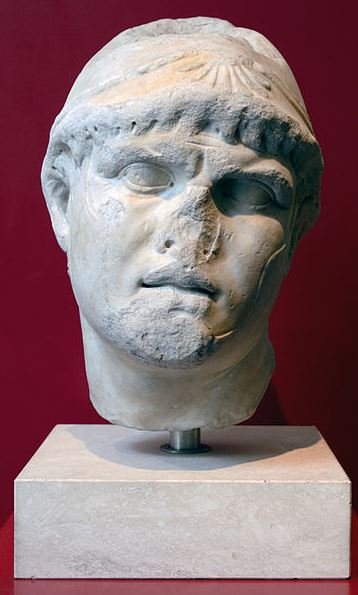
Bust of Philip V at the National Roman Museum in Italy.
What were Philip V’s early influences?
Philip was the son of Demetrius II and Phthia (or Chryseis). After his father’s death in 229 BC, he was adopted by his half-cousin Antigonus Doson, who ruled as king until Philip succeeded him in 221 BC.
What was Philip’s role in the Social War (220–217 BC)?
Philip gained renown as a leader of the Hellenic League, supporting it against Sparta, Aetolia, and Elis. His successful campaigns solidified his reputation among the Greeks.
What was the First Macedonian War (215–205 BC)?
Philip allied with Hannibal during the Second Punic War and attacked Roman client states in Illyria. Although the war was inconclusive, he forced an independent settlement with Aetolia and concluded the Peace of Phoenice in 205 BC on favorable terms.
How did Philip’s eastern ambitions lead to conflict?
Philip conspired with Antiochus III of Syria to exploit the weakening of Ptolemaic Egypt (203–202 BC). His aggression alarmed Rhodes and Pergamum, leading to a naval defeat at Chios (201 BC) and sparking Roman intervention in the Second Macedonian War.
What happened during the Second Macedonian War (200–196 BC)?
Rome declared war on Philip due to his aggressive actions. Roman campaigns destabilized Philip’s hold on Greece, culminating in his defeat at the Battle of Cynoscephalae (197 BC). This battle ended Macedonian dominance in Greece.
What were the terms of peace after the Second Macedonian War?
Philip was confined to Macedonia, forced to pay an indemnity of 1,000 talents, surrender most of his fleet, and send hostages, including his son Demetrius, to Rome.
How did Philip interact with Rome after his defeat?
From 196 to 189 BC, Philip aided Rome in wars against its enemies in Greece. As a reward, his tribute was remitted, and his son Demetrius was released in 190 BC.
What reforms did Philip implement in his later years?
Philip focused on consolidating his kingdom, reorganizing finances, reopening mines, and issuing new currencies. These efforts strengthened Macedonia’s economy and administration.
What were Philip’s final years like?
Convinced Rome intended to destroy him, Philip attempted to extend his authority in the Balkans through campaigns. He died in 179 BC while planning to use the Bastarnae against the Dardanians.





