Hephaestion, son of Amyntor, was one of the most prominent figures in the court of Alexander the Great. He is best known for serving as both a general in the Macedonian army and the king’s closest confidant.
Born around 356 BC, the same year as Alexander, Hephaestion shared his formative years, education, and military career with the future conqueror. His unwavering loyalty, intellectual abilities, and alignment with Alexander’s vision of empire-building positioned him as a key player in the Macedonian campaign that reshaped the ancient world.
His untimely death in 324 BC profoundly affected Alexander and marked a significant moment in the history of the Macedonian Empire.
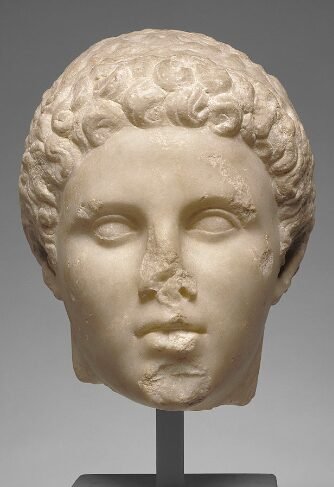
Hephaestion (c. 356 BC – October 324 BC), son of Amyntor, was a Macedonian nobleman, general, and close companion of Alexander the Great. Image: Head of Hephaistion sculpted in marble. Statue is at the Getty Museum in California, U.S.
Early Life and Education
Hephaestion’s early life is not well-documented, but he likely hailed from a noble Macedonian family. As a member of the aristocracy, he would have undergone rigorous training in the martial and intellectual disciplines necessary for leadership.
By 343 BC, he became a page in the Macedonian court, a position that allowed young nobles to serve and learn under the tutelage of King Philip II. This role also brought Hephaestion into close contact with Alexander, fostering a bond that would last throughout their lives.
Hephaestion is believed to have joined Alexander in studying under Aristotle at Mieza. Aristotle’s instruction in philosophy, science, and literature left a profound mark on the young men, equipping them with a shared intellectual foundation.
Hephaestion’s name appears in Aristotle’s correspondence catalog, suggesting that he maintained an intellectual relationship with the philosopher, highlighting his academic abilities and importance within Alexander’s circle.
READ MORE: Most Renowned Ancient Greek Philosophers
Rise to Prominence
Hephaestion’s rise within Alexander’s ranks can be attributed to both his competence and his personal relationship with the king. Unlike other generals who gained their positions through family influence or battlefield accomplishments alone, Hephaestion’s closeness to Alexander afforded him unique responsibilities early on.
His first recorded mission occurred after the Battle of Issus in 333 BC, when Alexander entrusted him with selecting a new king for the city of Sidon. Demonstrating wisdom and sound judgment, Hephaestion chose Abdalonymus, a gardener of noble lineage, who proved to be a capable ruler.
During the siege of Tyre in 332 BC, Hephaestion commanded the fleet, overseeing naval operations and logistics. This task required strategic insight and the ability to manage diverse groups of sailors from various regions. These missions showcased Hephaestion’s versatility, balancing military duties with diplomatic and administrative roles.
Role in the Persian Campaign
As Alexander embarked on his campaign against the Persian Empire, Hephaestion became increasingly central to his operations. He played a critical role in bridging the Euphrates River during Alexander’s advance, a task that facilitated the movement of the Macedonian army into Persian territory.
At the Battle of Gaugamela in 331 BC, Hephaestion fought as commander of the somatophylakes (bodyguards), a position of great trust and responsibility. He sustained injuries during the battle, reflecting his frontline involvement and courage.
Hephaestion’s loyalty extended beyond the battlefield. When Alexander began integrating Persians into the Macedonian administrative and military framework, a policy that faced resistance from many Macedonian officers, Hephaestion emerged as one of its staunchest supporters. His tact and diplomacy were evident when Alexander tasked him with verifying the noble lineage of Persian captives in Babylon to restore their dignity.
Hephaestion played a critical role in Alexander’s campaigns, serving as a bodyguard, commander of the Companion cavalry, and later as Chiliarch, the empire’s second-in-command.
After the execution of Philotas in 330 BC, Hephaestion was appointed joint commander of the Companion cavalry alongside Cleitus. This dual appointment reflected Alexander’s effort to balance the opposing factions within his army, with Hephaestion representing those who supported the king’s progressive policies and Cleitus embodying traditionalist Macedonian views. Under their leadership, the cavalry adapted to new tactics, showcasing Hephaestion’s strategic acumen.
Campaigns in India
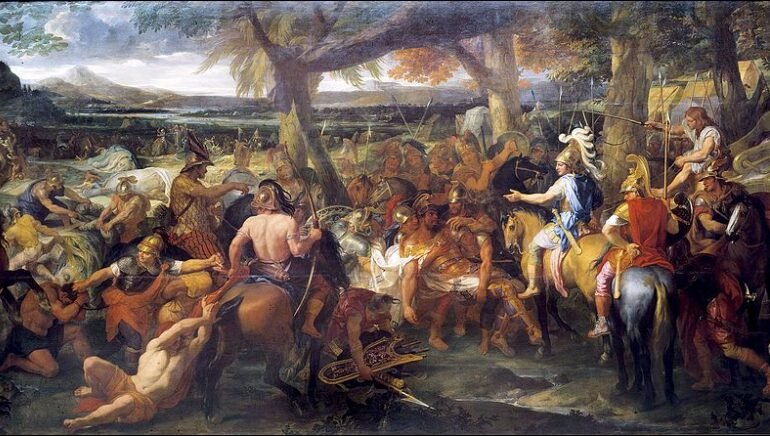
Hephaestion played a crucial role in the Macedonian Empire’s expansion and was known for his military leadership, diplomatic skills, and deep personal bond with Alexander. Image: A painting by French painter Charles Le Brun depicting Alexander and Hephaestion (in red cloak), facing Porus, during the Battle of the Hydaspes.
Hephaestion’s role expanded further during the Indian campaign. In 327 BC, he and Perdiccas led a contingent through the Khyber Pass, tasked with subduing territories and preparing for the army’s advance.
Hephaestion’s ability to operate independently and handle logistical challenges underscored Alexander’s trust in his capabilities. He participated in the Battle of the Hydaspes River in 326 BC, a significant victory against King Porus, and later oversaw the army’s march down the Indus River, ensuring smooth coordination and supply lines.
Hephaestion also demonstrated his ability to manage infrastructure projects. He supervised the construction of bridges and fortifications, such as the fortress and harbor at Pattala, which facilitated the army’s return journey. His role in these endeavors highlighted his engineering skills and capacity to execute Alexander’s broader vision of empire-building.
Personal Relationship with Alexander the Great
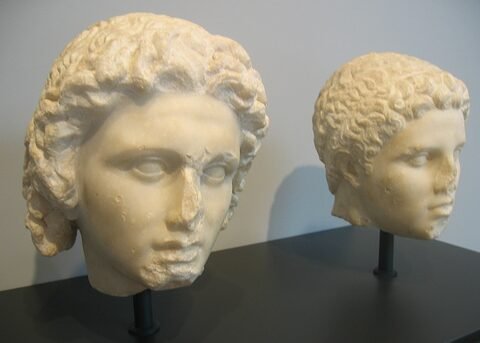
Hephaestion and Alexander the Great’s lifelong bond, often compared to that of Achilles and Patroclus, underscored their deep mutual affection. Image: Alexander (left) and Hephaestion (right). Getty Villa, J. Paul Getty Museum
Hephaestion’s relationship with Alexander was unparalleled in its closeness. Ancient sources likened their bond to that of Achilles and Patroclus, emphasizing their mutual affection and trust. This comparison was not merely symbolic; Alexander and Hephaestion reportedly honored these Homeric heroes at Troy by laying garlands on their tombs. Such acts reinforced the depth of their connection.
The nature of their relationship has been the subject of much speculation. While some modern scholars interpret their bond as romantic or homoerotic, ancient sources largely emphasize their companionship and shared ideals. Regardless of its nature, their relationship was central to Alexander’s life and governance. Hephaestion was both confidant and advisor, privy to Alexander’s ambitions and instrumental in executing them.
In 324 BC, Hephaestion married Drypetis, the sister of Alexander’s second wife, Stateira. This marriage strengthened his ties to Alexander’s royal family and symbolized the king’s policy of integrating Macedonian and Persian elites. Hephaestion’s elevation to Chiliarch, effectively the empire’s second-in-command, reflected his unparalleled status within Alexander’s court.

Married to Drypetis, sister of Alexander’s wife, he became part of the royal family. Hephaestion’s sudden death at 32 left Alexander grief-stricken, prompting divine honors for his memory. Image: The weddings at Susa; Alexander to Stateira (right), and Hephaestion to Drypetis (left). Late 19th-century engraving.
Death and Mourning
Hephaestion’s sudden death in 324 BC at Ecbatana was a devastating blow to Alexander. Sources suggest that Hephaestion succumbed to typhoid fever, although some speculate about the possibility of poisoning. His death occurred during a festival, and despite initial signs of recovery, a relapse after a heavy meal proved fatal. Hephaestion was around 32 years old at the time of his death.
Alexander continued planning monuments to commemorate Hephaestion until his own death eight months later.
Alexander’s grief was profound and public. He fasted, cut his hair, and ordered empire-wide mourning. The sacred flame in the temple of Amun at Siwa was extinguished, a gesture reserved for the death of a great king. Alexander sought divine honors for Hephaestion, petitioning the oracle at Siwa to grant him hero status. The funeral games held in Hephaestion’s honor were unprecedented in scale, involving thousands of competitors and vast expenditures.
Legacy
Hephaestion’s death left a void in Alexander’s life and administration. The king’s refusal to appoint a successor to command Hephaestion’s cavalry unit ensured that his memory remained central to the army’s identity. Alexander continued to plan tributes to Hephaestion, including monumental shrines and statues, until his own death eight months later.
Beyond military achievements, Hephaestion supported Alexander’s vision of integrating Greek and Persian cultures.
Hephaestion’s legacy endures as a symbol of loyalty, friendship, and competence. His contributions to Alexander’s campaigns, his support for the integration of cultures, and his intimate bond with the king highlight his importance in the Macedonian Empire. While his life was cut short, Hephaestion’s influence on Alexander and their shared vision of a unified empire remains a testament to their extraordinary partnership.
Did you know…?
During Alexander the Great’s Asian campaign, he and Hephaestion visited Troy, publicly honoring the tombs of Achilles and Patroclus. Alexander placed a garland on Achilles’ tomb while Hephaestion did the same for Patroclus, symbolizing their close bond.
This act was widely interpreted as a declaration of their relationship, likening themselves to the Homeric pair. The gesture emphasized the cultural and symbolic significance of Achilles and Patroclus in antiquity, reinforcing the deep personal and public connection between Alexander and Hephaestion in the context of their military and historical legacy.
Frequently Asked Questions

Hephaestion, son of Amyntor, was a close companion and general of Alexander the Great. His contributions to Alexander’s campaigns and his status as Chiliarch solidified his place as one of the empire’s most influential figures. Image: The Battle of Issus by German painter Albrecht Altdorfer, 1529
What do we know about Hephaestion’s early life and education?
Little is known about Hephaestion’s early life, but he was likely born around 356 BC and became a page in the Macedonian court in 343 BC. He shared his education with Alexander under Aristotle at Mieza, where he gained intellectual training. His inclusion in Aristotle’s correspondence catalog suggests his education was significant and valued.
What was Hephaestion’s first documented mission?
After the Battle of Issus in 333 BC, Alexander tasked Hephaestion with appointing a new king of Sidon. Hephaestion chose Abdalonymus, a gardener of noble lineage, demonstrating his sound judgment and ability to make significant decisions.
What roles did Hephaestion play during the Persian campaign?
Hephaestion was pivotal during the Persian campaign, notably bridging the Euphrates River to facilitate Alexander’s advance. He fought at the Battle of Gaugamela in 331 BC, where he commanded the bodyguards (somatophylakes) and sustained injuries. He also supported Alexander’s policies of integrating Greek and Persian elites, showcasing his diplomatic and military leadership.
What were Hephaestion’s contributions during the Indian campaign?
Hephaestion led forces through the Khyber Pass, subdued regions, and constructed bridges to advance the army. He participated in the Battle of the Hydaspes River in 326 BC and oversaw logistics during the march down the Indus, demonstrating his competence in independent command.
How was Hephaestion’s relationship with Alexander characterized?
Hephaestion’s bond with Alexander was deeply personal and political. Ancient sources likened their relationship to that of Achilles and Patroclus, symbolizing their mutual trust and closeness. Although some speculate about a romantic dimension, the nature of their relationship remains debated. Hephaestion’s loyalty and alignment with Alexander’s goals made him a trusted confidant and ally.
How did Hephaestion’s marriage strengthen his political position?
In 324 BC, Hephaestion married Drypetis, the sister of Alexander’s second wife, Stateira. This marriage integrated him into the royal family, aligning him with Alexander’s vision of Greek and Persian unity. His appointment as Chiliarch further reinforced his status as Alexander’s second-in-command.
What were the circumstances surrounding Hephaestion’s death?
Hephaestion died suddenly in 324 BC in Ecbatana, possibly from typhoid fever, though some theories suggest poisoning. His death deeply affected Alexander, who mourned publicly and ordered empire-wide mourning. Alexander sought divine honors for Hephaestion and planned monumental tributes to his memory.
How did Alexander honor Hephaestion after his death?
Alexander demonstrated profound grief for Hephaestion by fasting, cutting his hair, and ordering extensive mourning rites across the empire. He sought and obtained hero status for Hephaestion from the oracle at Siwa. Funeral games were held, and no successor was appointed to Hephaestion’s cavalry command, ensuring his memory endured.
What is Hephaestion’s legacy in Alexander’s empire?
Hephaestion’s legacy lies in his contributions to Alexander’s military and political successes, his alignment with Alexander’s vision of integration, and his enduring influence through their partnership. His death symbolized a significant personal and political loss for Alexander, marking him as one of the most important figures in the empire.





