
A sculpted bust of a female figure—possibly representing Tanit or perhaps Demeter—was discovered in the Carthaginian necropolis at Puig des Molins.
Who Was Tanit?
Tanit—sometimes spelled Tinnit or even Tannou—wasn’t just some obscure goddess tucked away in a dusty temple. She was the headliner of ancient Carthage, a central figure in the spiritual life of a powerful Mediterranean civilization. Known as the consort of Baal Hammon, Tanit came to embody the feminine, protective, and nurturing face of divinity for the Carthaginians. But here’s the fascinating part: she likely evolved from a much older Berber or Libyan deity, meaning her worship began long before the rise of Carthage.
She was no ordinary goddess either. Tanit was associated with wisdom, fertility, craftsmanship, and even war—but only in defense of her people. Unlike Astarte, who embodied more aggressive wartime qualities, Tanit was seen as the “defender of homes and families.” Her role was deeply maternal and civic, the divine heart of her community.
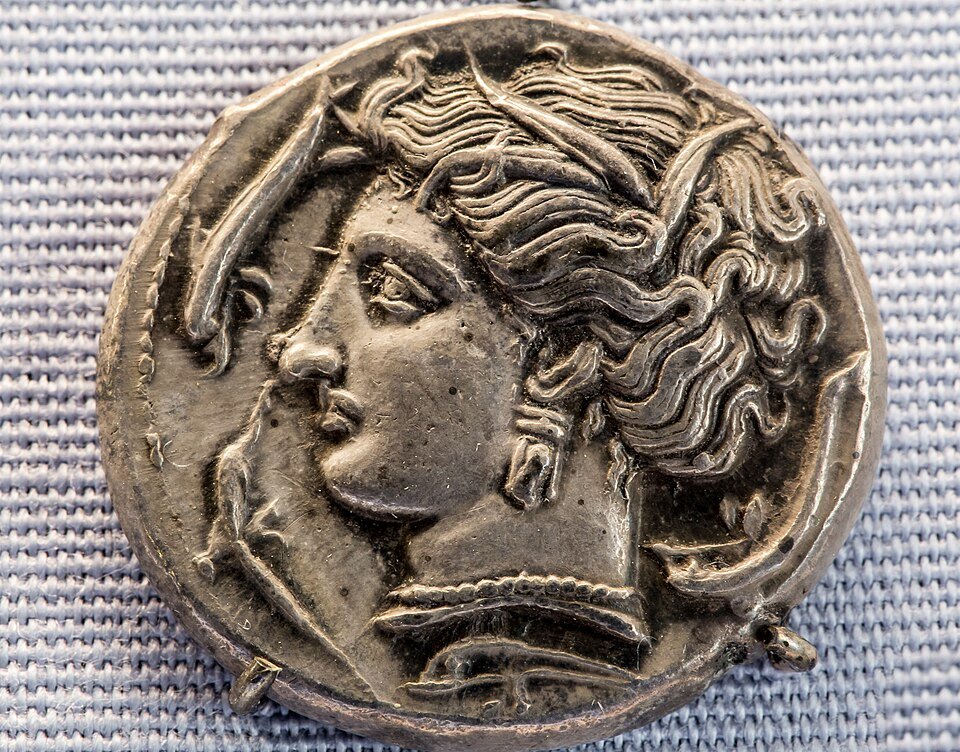
A coin from Carthage displays the goddess Tanit’s image on one side, while the other side shows her associated symbols: a horse and a date palm tree.
READ ALSO: Fertility Goddesses in World History
The Matriarchal Roots: From Neith to Athena
Many scholars believe Tanit was originally a local North African goddess tied to the matriarchal aspects of ancient Numidian or Berber society. The Egyptians identified her with Neith, their goddess of war and wisdom, while the Greeks saw her as a local counterpart to Athena.
In fact, Herodotus himself noted the similarities between Libyan women’s attire and that of Athena, suggesting that even the iconic Greek goddess had North African roots. According to him, the Libyan women’s cloaks—made of leather, adorned with tassels—resembled the aegis worn by Athena. For Herodotus, this wasn’t a coincidence. It was cultural borrowing in action.
A Berber Heart
Tanit’s name is as revealing as her symbolism. In Berber languages, feminine names often start and end with a “t” and contain an “n.” “Tanit” fits the mold perfectly. Some believe it may mean “spring” or “stream,” a nod to fertility and life-giving water—especially significant in a region where drought was a regular concern.
Early references to her name were written in Punic, a language that didn’t use vowels. So you’d see it as “TNT” or “TNNT.” The actual pronunciation, based on Greek transcriptions like Θινιθ (Thinith), was likely something like Tinnīt. Despite this, the name “Tanit” stuck and is still commonly used.
Her Worship Across the Mediterranean
Though she rose to prominence in Carthage, Tanit wasn’t confined there. Her worship spread widely across the western Mediterranean. You’ll find signs of her cult in Malta, Sardinia, Sicily, and southern Spain—particularly in places like Cádiz (then Gadir), where Carthaginian colonies flourished.
Over time, her role expanded. She wasn’t just Baal Hammon’s consort; she became the main event. From the 5th century BCE onward, she often appeared before Baal Hammon in inscriptions. This reversal tells us something big—Tanit wasn’t just tagging along. She had massive popular appeal.
The Roman Makeover: Dea Caelestis
Even after Carthage fell to Rome, Tanit didn’t disappear. Instead, she morphed into Dea Caelestis or Juno Caelestis. Roman worshipers rebranded her, as they often did with foreign deities, blending her with their own goddesses like Juno, Diana, and even Minerva. Her main temple in Roman Carthage became one of the biggest pilgrimage centers in North Africa.
She retained many Punic traits—especially her protective maternal nature—and became a unifying divine symbol for both Roman settlers and indigenous North Africans.

Symbols and Imagery: Reading Her Signs
Tanit’s symbol is one of the most instantly recognizable among ancient religions. It’s essentially a triangle (representing the body), topped with a circle (the head), and intersected by a horizontal bar (the arms). Think of it as a stick figure with a distinctly feminine flair. Some scholars believe this image represents a woman raising her arms in prayer or blessing.
You’ll find this symbol on tombstones, house entrances, and altars throughout the region. It was a sign of protection—invoking Tanit’s safeguarding presence.
But there’s more: she’s often associated with the crescent moon, lions, doves, roses, and palm trees. Some depictions even show her riding a lion or having a lion’s head—emphasizing her fearless, guardian nature.

A stele from the Tophet of Carthage features Tanit’s symbol, topped with a crescent moon above the figure.
Tanit was more than a goddess—she was an icon of a civilization, a spiritual mother to millions across centuries, and a bridge between cultures.
Rain and Rituals: Oumouk Tannou Lives On
Tanit was also revered as a rain goddess—a vital role in a region prone to dry spells. In modern-day Tunisia and Algeria, remnants of her worship still linger in the form of folk rituals. During droughts, people call upon “Oumouk Tannou” or “Omek Tannou”—Mother Tannou—to bring rain.
One of the most vivid examples is the “Bride of the Rain” ritual. Women carry an effigy of a female figure from village to village, singing and splashing water on the “bride” as they pass homes. The collected donations are used to prepare a communal feast near a spring or a sacred hilltop—hoping to entice the rain goddess to show mercy.
The Debate Around Child Sacrifice
Now here’s the most controversial part of Tanit’s legacy—child sacrifice. The archaeological site called the Tophet of Salammbô in Carthage has yielded urns filled with the burned remains of infants and animals. Some inscriptions even mention offerings “in fulfillment of a vow.”
Many scholars argue these were indeed sacrificial victims—children offered to Tanit and Baal Hammon to gain favor or avert disaster. Others, however, suggest a less grim explanation. Maybe these were children who died naturally, and their burial in the Tophet was a special way of dedicating them to the gods.
The debate rages on. Some researchers point to the number and age of remains—many of the children were just two months old, an age where natural death rates were actually lower than the numbers found. This suggests a more ritualistic cause. Still, definitive proof of intentional sacrifice is elusive, and the topic remains one of the most haunting mysteries in ancient religious history.
READ ALSO: Meaning and Origin Story of Baal, the ancient deity in the Levant during antiquity
Syncretism and Sisterhood: Tanit and Astarte
There’s also a fascinating overlap between Tanit and Astarte (or Ishtar), a war and fertility goddess from the eastern Mediterranean. In Carthage, both were worshipped—sometimes side-by-side. While Astarte was associated with aggressive, expansionist war, Tanit remained the more restrained, protective warrior—always fighting to defend, not to conquer.
In iconography, they eventually began to look alike, likely due to Carthage’s trade network stretching from East to West. But make no mistake: Tanit was not just a renamed Astarte. She was her own figure, deeply rooted in North African soil.
Whether as protector of homes, bringer of rain, or queen of the afterlife, Tanit commanded reverence in a way few ancient deities ever did.
Archeological Surprises: Temples Beyond Africa
Believe it or not, Tanit may have even reached the Atlantic. Recent findings in the Azores Islands include shrines and hypogea (rock-cut tombs) that some archaeologists believe were dedicated to her—possibly built by early Carthaginian sailors.
This would make Tanit not just a city or regional goddess, but a maritime one—watching over seafarers far from home.
Modern Echoes and Pop Culture
Tanit’s mystique hasn’t faded. She shows up in novels like Salammbô by Gustave Flaubert, where she’s central to the plot, and even in sci-fi stories like Isaac Asimov’s The Dead Past. Her name has been resurrected in modern fiction, fantasy, and as a unique female given name—often spelled “Tanith.”
Frequently Asked Questions
What are Tanit’s origins?
Tanit likely originated as a local Berber or Libyan deity and was later merged with Phoenician and Punic religious traditions. She was identified with Egyptian Neith and Greek Athena due to shared attributes like wisdom and protective warfare.
How was Tanit worshipped?
She was worshipped across North Africa and the western Mediterranean through rituals, festivals, and offerings. Her symbol appeared on tombstones and homes, and rituals like the “Bride of the Rain” invoked her during droughts.
What is the significance of her symbol?
Tanit’s symbol is a triangle with a circle and a horizontal line—interpreted as a stylized female figure raising her arms. It symbolized protection and was widely used in religious and funerary contexts.
Did Tanit’s worship continue under Roman rule?
Yes, Tanit was syncretized with Roman goddesses and worshipped as Dea Caelestis or Juno Caelestis. Her temple in Roman Carthage became a major pilgrimage site across North Africa.
What is the connection between Tanit and Astarte?
Though both were goddesses of fertility and war, Tanit focused on defense and nurturing, while Astarte represented aggressive conquest. They were often worshipped together in Carthage, but remained distinct.
Was child sacrifice part of Tanit’s cult?
Some archaeologists believe child sacrifice occurred at Tanit’s tophets, based on cremated remains and inscriptions. Others argue these were ceremonial burials of children who died naturally.





