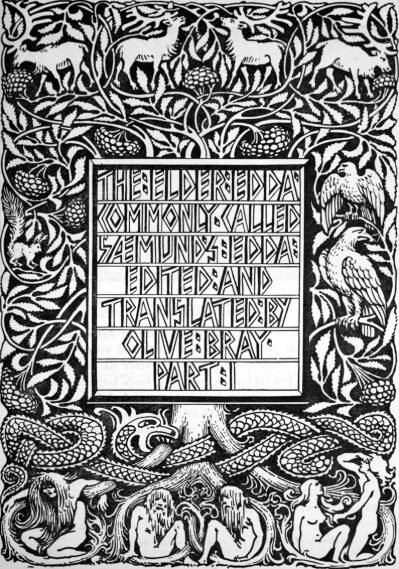
The Poetic Edda remains a cornerstone of Norse cultural and literary heritage. Its blend of mythological grandeur and human drama offers timeless insights into the beliefs and values of the Old Norse world. Image: The title page of Olive Bray’s Poetic Edda (1908) features Yggdrasil and its inhabitants, illustrated by English artist and poet W.G. Collingwood.
The Poetic Edda is a collection of Old Norse narrative poems that hold a central place in the study of Norse mythology and Germanic heroic legends. Written in alliterative verse, these works are characterized by their vivid storytelling and rhythmic poetic structures. Unlike the Prose Edda, a separate work authored by Snorri Sturluson in the 13th century, the Poetic Edda is an anonymous compilation of oral traditions that were eventually written down. Its most renowned manuscript is the Codex Regius, an Icelandic text containing 31 poems that serve as an indispensable resource for understanding the mythology, culture, and beliefs of the Norse world.
READ MORE: Arni the Bitter: The man who killed Icelandic poet Snorri Sturluson
Composition of the Poems
The poems of the Poetic Edda are composed in various forms of alliterative verse. The most common meter is fornyrðislag (“old story meter”), which features concise and direct lines suitable for narrative storytelling. Another variation, málaháttr (“speech form”), offers a slightly expanded structure, while ljóðaháttr (“song form”) is more lyrical and used in expressive, dialogic poems. Compared to the ornate kennings typical of skaldic poetry, Eddic poetry employs a simpler and more accessible language, making it easier to understand while retaining its rich imagery and symbolism.
Authorship and Oral Tradition
The Poetic Edda has no attributed authors, as it originated from a long-standing oral tradition. These poems were transmitted orally for generations before being committed to writing, likely by multiple scribes with access to varying versions of the tales. While certain poems display distinctive stylistic traits that suggest the influence of individual poets, no definitive authorship has been established. This anonymity underscores the communal and evolving nature of Old Norse storytelling, where stories were reshaped by each retelling.
Dating the Poems
Determining the dates of the poems has long been a challenge for scholars. The dating process often relies on linguistic and contextual evidence. For example, certain linguistic features, such as the use of the Old Norse particle of, suggest older origins, as this element was more prevalent in earlier poetry. Additionally, the transition from vr- to r- in western Old Norse dialects around 1000 CE provides a timeline for analyzing specific alliterative patterns.
Historical references within the poems also offer clues. Characters such as Attila the Hun provide a terminus post quem (earliest possible date), while the dating of manuscripts offers a terminus ante quem (latest possible date). For example, the title of Atlamál hin groenlenzku suggests its composition in Greenland after Norse settlements were established there in 985 CE. Despite these insights, many poems exhibit interpolations or combinations of older and newer elements, complicating precise dating.
Geographical Origins
The origins of the poems are closely linked to the settlement history of Iceland. Older poems were likely composed in Scandinavia, as Iceland was not colonized until around 870 CE. Later compositions, especially those with specific references to Icelandic geography and culture, are thought to be of Icelandic origin. Efforts to localize individual poems have used descriptions of landscapes, flora, and fauna, though these are often inconclusive. For example, while wolves do not inhabit Iceland, their presence in the poems reflects a broader cultural awareness rather than direct observation.
The Codex Regius
The Codex Regius, a 13th-century manuscript, is the most significant source of the Poetic Edda. Discovered in 1643 by Bishop Brynjólfur Sveinsson, it was sent as a gift to the Danish king, earning its Latin name, meaning “Royal Book.” For centuries, it resided in Copenhagen’s Royal Library until its return to Iceland in 1971, an event marked by careful transport via ship due to its cultural importance.
Containing 31 poems, the Codex Regius serves as the foundation for modern editions of the Poetic Edda. Scholars initially believed it to be the “Elder Edda” referenced in Snorri Sturluson’s Prose Edda, but research suggests that the two works are independent compilations that may share common sources.
Contents of the Poetic Edda
The Poetic Edda comprises two main categories of poems: mythological and heroic.
Mythological Poems
These poems recount the creation, cosmology, and eventual destruction (Ragnarök) of the Norse universe. They also include dialogues between gods and heroes, providing insight into divine wisdom and conflict.
- Völuspá (“The Seeress’s Prophecy”) describes the creation of the world, its apocalyptic end, and subsequent rebirth.
- Hávamál (“Sayings of the High One”) offers moral, philosophical, and practical advice, attributed to Odin.
- Lokasenna (“The Quarrel of Loki”) features Loki’s provocative accusations against other gods during a feast.
- Þrymskviða (“The Lay of Thrym”) humorously depicts Thor retrieving his stolen hammer by disguising himself as a bride.
Heroic Poems
The heroic lays draw from Germanic legends, focusing on mortal heroes such as Sigurð, Brynhildr, and Helgi Hundingsbani. These stories reflect themes of betrayal, vengeance, and tragic destiny.
- The Helgi Lays narrate the exploits of Helgi, a hero who overcomes great adversities.
- The Niflung Cycle centers on Sigurð’s slaying of the dragon Fáfnir, his betrayal by Brynhildr, and the downfall of the Niflung family.
- The Jörmunrekkr Lays recount the tragic events surrounding Jörmunrekkr, king of the Goths.
How Loki became the blood brother of Odin in Norse mythology
Linguistic and Stylistic Features
Eddic poetry is renowned for its unique metrical structures. The dominant use of alliteration, paired with terse and rhythmic lines, gives the poems a powerful oral resonance. Unlike skaldic poetry, which is dense with complex kennings, Eddic verse often uses straightforward language, allowing the narrative and themes to take center stage.
Influence on Later Literature
The Poetic Edda has profoundly influenced Scandinavian and global literature. Its themes, characters, and imagery have inspired numerous authors, including J.R.R. Tolkien, who drew extensively from the Edda for his works such as The Hobbit and The Lord of the Rings. The names of Tolkien’s dwarves, for instance, originate from the Dvergatal (“Roster of Dwarfs”) in Völuspá. Similarly, its metrical forms and mythological depth have left a lasting impact on poetry, drama, and fantasy literature.
Manuscripts and Editions
In addition to the Codex Regius, other manuscripts like Hauksbók, AM 748 I 4to, and Flateyjarbók contain Eddic poems or similar material. Editors often include these additional texts in modern editions, labeling them as the “Eddic appendix.” Some lesser-known Eddic-like poems, collectively referred to as Eddica minora, have also been compiled separately.
English Translations
The Poetic Edda has been translated into English multiple times, beginning in the 18th century. Translators vary in their approaches, with some using archaic language to mirror the tone of the original, while others adopt more modern prose for accessibility. Notable translators include Lee M. Hollander, Carolyne Larrington, and Henry Adams Bellows. Differences in translations often reflect the challenges of conveying the nuances of Old Norse verse into English.
Allusions and Legacy
The Prose Edda by Snorri Sturluson draws heavily on the Poetic Edda, often quoting its stanzas to illustrate mythological points. The Völsunga saga, a prose retelling of the Niflung cycle, serves as another key source for understanding the heroic legends. These texts, along with the Poetic Edda, form a triad of essential works for studying Norse mythology.
Beyond academic circles, the Poetic Edda continues to resonate in popular culture. Its themes of heroism, fate, and cosmic cycles inspire adaptations in literature, art, and media, ensuring its enduring relevance.
Frequently Asked Questions
What are the main poetic forms used in the Poetic Edda?
The poems use fornyrðislag (“old story meter”), ljóðaháttr (“song form”), and occasionally málaháttr (“speech form”), featuring relatively clear language and simpler kennings compared to skaldic poetry.
Who authored the Poetic Edda?
The poems are anonymous, passed orally for centuries. Though individual characteristics suggest personal authorship, no definitive authors are known.
When were the poems composed?
Dating is debated, with some poems possibly predating Icelandic settlement (~870 CE). Linguistic and historical evidence suggests varying ages, with some as early as the 10th century.
What is the significance of the Codex Regius?
The Codex Regius (13th century) is the most important source of Norse mythology and Germanic heroic legends. It was discovered in 1643 and later returned to Iceland in 1971.
How does the Poetic Edda differ from the Prose Edda?
The Poetic Edda is a collection of anonymous narrative poems, while the Prose Edda, written by Snorri Sturluson, is a didactic work explaining Norse mythology and poetic forms, often quoting Poetic Edda poems.
What are the mythological and heroic sections of the Poetic Edda?
The mythological poems focus on Norse gods and cosmology, such as Völuspá and Hávamál. The heroic lays include tales of Germanic legends like the Nibelungs and the Goth king Jörmunrekkr.
How has the Poetic Edda influenced modern culture?
The Poetic Edda has inspired works by J.R.R. Tolkien, Ezra Pound, and others. Its influence extends to literature, mythology studies, and modern adaptations of Norse lore.
FACT CHECK: At World History Edu, we strive for utmost accuracy and objectivity. But if you come across something that doesn’t look right, don’t hesitate to leave a comment below.





