What is the Prose Edda? – Origins, Structure, and Significance
The Prose Edda, also known as the Younger Edda or Snorri’s Edda, is a seminal work of Old Norse literature composed in Iceland during the early 13th century. The work is often attributed to the Icelandic historian, poet, and politician Snorri Sturluson around 1220 CE.
Historians generally praise the Prose Edda as one of the most comprehensive sources of Norse mythology and ancient Scandinavian poetics. It serves as a crucial repository of the myths, legends, and cultural beliefs of the North Germanic peoples, drawing from a variety of earlier sources, including poetic works that are now compiled in the Poetic Edda.
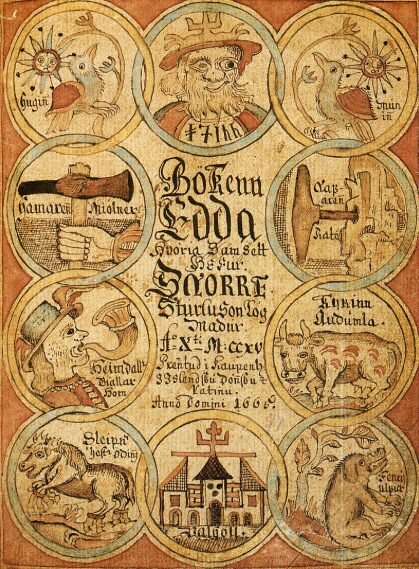
There are several translations of the Prose Edda in English and other languages. Notable English translations include those by Arthur Gilchrist Brodeur, Jesse L. Byock, and Anthony Faulkes. Image: Title page of a late manuscript of the Prose Edda written by Snorri Sturluson (13th century), showing the Ancient Norse Gods Odin, Heimdallr, Sleipnir, and other figures from Norse mythology
Authorship and Purpose
While the exact authorship of the Prose Edda has been a topic of scholarly debate, Snorri Sturluson is widely recognized as its compiler or author.
Evidence supporting his involvement comes from passages in early manuscripts, such as the Codex Upsaliensis, which attribute the work’s compilation to him.
Snorri’s motivations for creating the Prose Edda appear to be twofold: to preserve the rich tradition of Norse mythology in an era when Christianity was becoming dominant in Scandinavia, and to provide a handbook for poets to understand and craft skaldic poetry, a complex and highly stylized form of Old Norse poetry.

Snorri Sturluson by Norwegian artist and author Christian Krohg (1890s)
Etymology of “Edda”
The term “Edda” has sparked various hypotheses regarding its origin and meaning, with no consensus reached among scholars.
One theory suggests that it derives from the Old Norse word óðr, meaning “poetry” or “inspiration,” indicating the work’s poetic nature.
Another posits that it comes from the Latin word edo, meaning “I compose” or “I write,” which would align with the text’s instructional purpose.
A less accepted idea is that “Edda” is linked to the place name Oddi, a town in southern Iceland where Snorri was raised, implying it could mean “book of Oddi.”
Additionally, “Edda” can mean “great-grandmother” in Old Norse, though how this relates to the text is unclear. Regardless of its exact origin, the term “Edda” has become synonymous with the preservation of Norse mythological and poetic heritage.

Structure and Content
The Prose Edda is divided into four main sections, each serving a specific purpose in conveying mythological narratives and poetic instruction:
Prologue
This introductory section presents a euhemerized account of Norse mythology, interpreting the gods as historical figures—specifically, human warriors from the ancient city of Troy who migrated north after its fall. This approach parallels works like Virgil’s Aeneid and reflects an attempt to reconcile pagan myths with Christian worldviews prevalent during Snorri’s time.
Gylfaginning (“The Tricking of Gylfi”)
The second and perhaps most significant section, Gylfaginning recounts the creation, life, and eventual destruction of the Norse gods and the world. Presented in a question-and-answer format, it follows King Gylfi of Sweden, who, under the guise of a wanderer named Gangleri, visits the court of the Æsir gods to seek wisdom. Through his inquiries, readers are introduced to various mythological tales, cosmological concepts, and the pantheon of Norse deities. This section interweaves prose narratives with excerpts from traditional eddic poetry.

Depiction of the Aesir-Vanir War in Norse mythology
Skáldskaparmál (“The Language of Poetry”)
Serving as both a continuation of mythological storytelling and a poetic treatise, Skáldskaparmál is framed as a dialogue between the sea god Ægir and Bragi, the god of poetry. The section delves into the intricacies of skaldic poetry, explaining the use of kennings (metaphorical expressions) and heiti (poetic synonyms). It provides lists and explanations of these poetic devices, illustrating how they are derived from mythological stories and characters. This makes Skáldskaparmál an invaluable resource for understanding the metaphorical language of Old Norse poetry.
Háttatal (“List of Verse Forms”)
The final section is a detailed examination of the various meters and verse forms used in skaldic poetry. Composed primarily by Snorri himself, it showcases over 100 different poetic styles through examples, many of which are his own compositions praising King Hákon Hákonarson of Norway and Earl Skúli Bárðarson. Háttatal serves as both a descriptive and prescriptive guide, illustrating the rules and variations of poetic forms, and noting instances where earlier poets deviated from these conventions.
Manuscripts and Variations
The Prose Edda survives in several manuscripts dating from around 1300 to the 1600s. The main manuscripts include:
- Codex Regius (GKS 2367 4to): Considered one of the most important sources, it dates to the 14th century.
- Codex Upsaliensis (DG 11): An early 14th-century manuscript that provides a unique version of the text, including the attribution to Snorri.
- Codex Wormianus (AM 242 fol.): From the mid-14th century, it includes additional material not found in other manuscripts.
- Codex Trajectinus (Utrecht MS. 1374): A 17th-century copy of a now-lost manuscript.
Each manuscript exhibits variations, omissions, and additions, reflecting the oral tradition and scribal practices of the time. No single manuscript contains the complete text as it is known today. The differences among the manuscripts offer scholars valuable insights into the transmission and evolution of the work over time.
Authorship Debate
While Snorri Sturluson is commonly credited with authoring the Prose Edda, some scholars question the extent of his contribution. The primary basis for attributing the work to him comes from the aforementioned passage in the Codex Upsaliensis.
However, given that the surviving manuscripts were written decades after Snorri’s death and contain discrepancies, it’s possible that subsequent scribes and scholars modified the text. Some argue that Snorri may have been the compiler or editor rather than the sole author, especially considering that parts of the work, like the Prologue and certain sections of Gylfaginning, might have been added later or altered by others.
Despite these debates, Snorri’s influence on the work is undeniable. His effort to systematize Norse mythology and poetic forms has had a lasting impact on the preservation and understanding of Scandinavian cultural heritage.
Significance and Influence
The Prose Edda holds immense importance for several reasons:
Preservation of Norse Mythology
It is one of the most comprehensive sources of Norse myths, detailing stories of gods like Odin, Thor, Loki, and events such as Ragnarök. Without it, much of what is known about Norse cosmology and deities might have been lost, especially since the conversion to Christianity led to the decline of pagan traditions.

Image: Norse chief god Odin hurls a spear toward the Vanir forces during the Æsir-Vanir war.
Guide to Skaldic Poetry
By explaining the complex poetic devices used in skaldic verse, the Prose Edda serves as an essential resource for understanding and interpreting Old Norse poetry, which is characterized by intricate wordplay and metaphor.
Cultural Bridge
The work bridges the pagan past and the Christian present of 13th-century Iceland. Snorri’s attempt to present the myths within a framework acceptable to Christian sensibilities allowed the stories to survive in a changing cultural landscape.

Loki with a fishing net (per Reginsmál) as depicted on an 18th-century Icelandic manuscript (SÁM 66)
How Loki became the blood brother of Odin in Norse mythology
Translations and Accessibility
Over the centuries, the Prose Edda has been translated into numerous languages, making it accessible to a global audience. Notable English translations include:
- Arthur Gilchrist Brodeur (1916): His translation remains a standard reference, known for its fidelity to the original text.
- Jean I. Young (1954): Offers a more modern rendition while maintaining the essence of the original.
- Anthony Faulkes (1987, 1995): Provides extensive notes and commentary, beneficial for academic study.
Many translations focus on the Gylfaginning and Skáldskaparmál sections, occasionally abridging or omitting the more technical Háttatal due to its specialized content on poetic forms.
Legacy and Impact
The Prose Edda has had a profound influence on literature, art, and modern media. Its myths have inspired writers like J.R.R. Tolkien and have been adapted into various forms, including novels, comics, and films. The work continues to be a subject of academic interest, shedding light on the beliefs, values, and artistic expressions of medieval Scandinavia.
Conclusion
In summary, the Prose Edda stands as a cornerstone of Norse literary tradition. Whether viewed as a mythological compendium, a poetic manual, or a historical document, its contributions are invaluable. Through its preservation of myths and detailed exploration of poetic techniques, it offers a window into the minds and culture of the Norse people. Snorri Sturluson’s efforts ensured that these stories and traditions would endure beyond his time, allowing future generations to explore and appreciate the rich heritage of Norse mythology.
Frequently Asked Questions

The Prose Edda is a 13th-century Icelandic work attributed to the historian and poet Snorri Sturluson. It is a fundamental source of Norse mythology and ancient Scandinavian poetry, preserving a wealth of myths, legends, and poetic techniques. Image: Thjazi and Loki. Beginning of the myth of the abduction of Iðunn, attested in Skáldskaparmál. Manuscript NKS 1867 4to (Iceland, 1760), Copenhagen, Royal Library
Who wrote the Prose Edda?
Snorri Sturluson, an Icelandic scholar, historian, and politician, is credited with writing the Prose Edda around 1220 CE. His work aimed to preserve the traditional Norse mythology and to educate poets in the art of skaldic poetry.
Why was the Prose Edda written?
The Prose Edda was written to preserve Norse mythological stories and to serve as a manual for aspiring poets. Snorri sought to prevent the loss of traditional knowledge during a time when Christianity was spreading, potentially overshadowing pagan traditions.
What are the main sections of the Prose Edda?
The Prose Edda is divided into four main parts:
- Prologue: A euhemerized account of Norse mythology.
- Gylfaginning (“The Tricking of Gylfi”): A narrative of Norse cosmology and mythology.
- Skáldskaparmál (“The Language of Poetry”): A dialogue on poetic language and kennings.
- Háttatal (“List of Verse Forms”): A treatise on Old Norse poetry styles, exemplified by Snorri’s own compositions.
How does the Prose Edda differ from the Poetic Edda?
The Prose Edda is a narrative work by a known author, focusing on explaining myths and poetic techniques. The Poetic Edda is a collection of anonymous Old Norse poems compiled in the 13th century, containing primary poetic sources of Norse mythology without commentary.
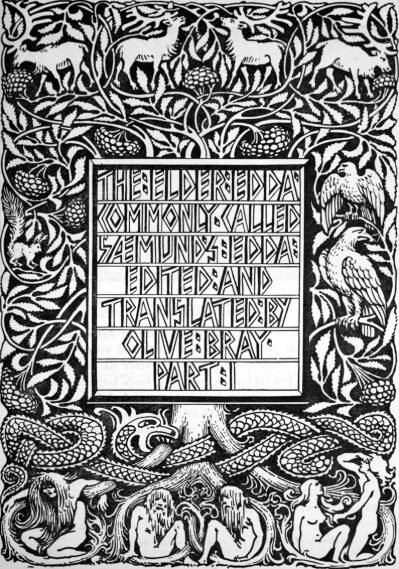
The title page of Olive Bray’s English translation of Codex Regius entitled Poetic Edda depicting the tree Yggdrasil and a number of its inhabitants (1908) by W. G. Collingwood
What myths are included in the Prose Edda?
The Prose Edda covers creation myths, tales of gods like Odin, Thor, and Loki, stories of giants and dwarfs, and events leading up to Ragnarök—the prophesied destruction and rebirth of the world.
Why is the Prose Edda important for understanding Norse mythology?
It is one of the most comprehensive sources of Norse myths and legends. Without it, much of what is known about Norse mythology, cosmology, and ancient Scandinavian culture might have been lost.
What is Gylfaginning about?
“Gylfaginning” tells the story of King Gylfi’s journey to Asgard, where he engages in a dialogue with three divine figures. Through their conversation, the work explains the creation of the world, the gods, and various mythological events.
What is Skáldskaparmál’s significance?
“Skáldskaparmál” serves as a handbook for poets, detailing the use of kennings (poetic metaphors) and heiti (poetic synonyms). It provides examples and stories behind these expressions, linking poetry with mythology.
What poetic forms are discussed in Háttatal?
“Háttatal” analyzes over 100 different verse forms used in Old Norse poetry. Snorri provides examples of each, showcasing the complexity and artistry of skaldic poetry.
How has the Prose Edda influenced modern literature and media?
The Prose Edda has inspired countless works in literature, music, and film. Authors like J.R.R. Tolkien drew upon its themes and characters. It also influences modern interpretations of Norse myths in comics, movies (like Marvel’s Thor series), and video games.
Is the Prose Edda historically accurate?
While it is a crucial source for Norse mythology, the Prose Edda was written centuries after the Christianization of Scandinavia. Snorri’s work may reflect Christian influences and his interpretations, so it should be read critically with historical context in mind.
What is the relationship between Snorri Sturluson and Norse poetry?
Snorri was deeply invested in preserving the art of skaldic poetry. By compiling the Prose Edda, he provided future generations with the tools to understand and compose traditional Norse poetry, ensuring its survival.
How does the Prose Edda portray the end of the world (Ragnarök)?
The Prose Edda describes Ragnarök as a series of events leading to the death of many gods, natural disasters, and the submersion of the world in water. It concludes with the world’s rebirth, where surviving gods return and humanity repopulates the earth.

What themes are prevalent in the Prose Edda?
Major themes include the struggle between order and chaos, the inevitability of fate, the importance of honor and bravery, and the cyclical nature of time and existence.
Are the gods in the Prose Edda portrayed as immortal?
Norse gods are not truly immortal; they can be killed and are subject to fate. This vulnerability adds depth to their stories, highlighting themes of destiny and the transient nature of life.
How does the Prose Edda contribute to our understanding of Viking culture?
It offers insights into the beliefs, values, and societal norms of the Viking Age. Through its myths and stories, readers learn about the cosmology, ethics, and worldview of the Norse people.
What role does mythology play in the Prose Edda’s explanation of natural phenomena?
Myths in the Prose Edda often serve to explain natural events, such as thunderstorms being attributed to Thor’s hammer or the changing seasons linked to the gods’ activities, reflecting how the Norse understood the world around them.

The Prose Edda remains a vital resource for scholars, enthusiasts of mythology, and anyone interested in cultural history. Its influence persists in modern storytelling, art, and our understanding of ancient Norse traditions. Image: Gylfi and High, Just-as-High, and Third. Manuscript SAM 66 (Iceland, 1765–1766), Reykjavík, Árni Magnússon Institute for Icelandic Studies.





