Polygnotus of Thasos (c. 500–440 BCE) stands as a seminal figure in ancient Greek painting, renowned for his monumental wall frescoes and significant contributions to the evolution of Classical art. Born on the island of Thasos in Thrace, Polygnotus was the son and dedicated pupil of Aglaophon, a respected painter of his time. His early education under Aglaophon laid the foundation for his artistic prowess, which would later flourish in Athens, the epicenter of Greek culture and politics.
Polygnotus’s relocation to Athens marked a pivotal chapter in his life and career. Embraced by the Athenians, he was granted citizenship, a testament to his exceptional talent and the value the city placed on his artistic contributions. This acceptance not only elevated his status but also allowed him to influence Athenian art and society profoundly.
During the leadership of the influential statesman Cimon, Polygnotus undertook several significant commissions that underscored his role in commemorating Athenian victories and cultural narratives through large-scale art.

Reconstruction of Marathon by Polygnotus 1895
Among his notable works in Athens were the “Taking of Troy,” painted on the walls of the Stoa Poikile, and the “Marriage of the Daughters of Leucippus,” located in the Anacaeum. These paintings were more than mere decorations; they served as visual storytelling mediums that celebrated heroic tales and civic pride. Plutarch records that Polygnotus painted out of a philanthropic spirit rather than for financial gain, highlighting his dedication to enhancing public spaces and contributing to the communal identity of Athens.
Polygnotus’s artistic legacy is most prominently featured in his frescoes within the Lesche of the Knidians at Delphi, a structure funded by the Cnidians. These masterpieces included the “Visit to Hades by Odysseus” and another depiction of the “Taking of Troy.”
The renowned traveler Pausanias provided detailed descriptions of these works, offering valuable insights into Polygnotus’s techniques and thematic choices. Archaeological excavations at Delphi have uncovered the foundations of the Lesche, enabling scholars to attempt reconstructions of Polygnotus’s paintings. These reconstructions reveal his innovative approach to composition, where figures were arranged in multiple rows without diminishing in size or brightness with distance, a departure from the traditional single-baseline arrangement prevalent in earlier Greek art.
Polygnotus is celebrated for his departure from conventional artistic norms. Instead of aligning figures along a horizontal baseline, he introduced irregular mounting and descending terrain lines, creating a sense of depth and movement within his compositions. This method, while innovative for Greek painting, drew inspiration from earlier Assyrian art and may have influenced contemporary vase painting techniques. His approach marked a significant shift towards a more dynamic and naturalistic representation of scenes, laying the groundwork for future advancements in perspective and spatial arrangement in Greek art.
A hallmark of Polygnotus’s style was his emphasis on the “ethos” of his subjects, a concept later lauded by Aristotle. This focus on ethical character meant that each figure in his paintings conveyed an innate disposition through their actions and appearances. Polygnotus achieved this through meticulous attention to detail, such as the delicate headdresses of women, the transparency of garments, and expressive facial features like parted lips revealing teeth. These elements combined to create figures that were not only idealized but also imbued with a sense of personality and moral character.
Technically, Polygnotus employed a limited palette of four basic colors: black, white, red, and ochre. Despite what might be considered a primitive approach by later standards, his use of color was effective in highlighting the forms and details of his figures. He utilized sharp foreshortening to enhance the realism of his subjects, giving them a three-dimensional quality that was innovative for his time. This technique, coupled with his ability to depict individual characters with grace and subtlety, set his work apart from that of his contemporaries.
Polygnotus’s influence extended beyond his own works. He is believed to have been a contemporary and possibly a teacher of Pheidias, another illustrious Greek artist known for his sculptures. This connection suggests that Polygnotus played a role in shaping the next generation of Greek art, particularly in fostering a sense of grandeur and ethical representation in visual narratives. His style, characterized by simplicity, nobility, and gentle sentiment, contrasted with the more animated and technically intricate styles that would emerge in later periods, emphasizing a balance between stateliness and delicate detail.
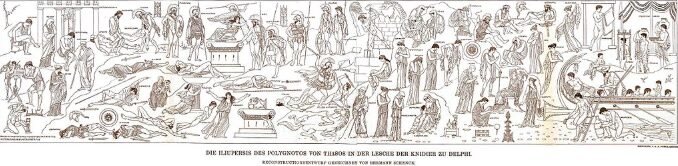
Reconstruction of Iliupersis by Polygnotus 1893
In addition to his technical and stylistic innovations, Polygnotus’s contributions were recognized by his peers and later critics. Aristotle, in his work “Poetics,” praised Polygnotus for his ability to convey ethical character through art, underscoring the intellectual and cultural significance of his work. This recognition highlights how Polygnotus’s art transcended mere aesthetics, embodying philosophical and ethical dimensions that resonated with broader Greek thought.
Despite the absence of any surviving original paintings, Polygnotus’s legacy is well-documented through historical accounts and archaeological findings. The meticulous descriptions by Pausanias and the structural remnants uncovered at Delphi provide a comprehensive understanding of his work and its impact. These sources allow modern scholars to appreciate the innovative nature of his compositions and the enduring influence he had on the trajectory of Greek art.
Polygnotus’s accomplishments extend beyond his individual works. His pioneering efforts in composition and character portrayal laid the groundwork for future developments in Greek painting and sculpture. By prioritizing individual character and ethical representation, he helped shift the focus of art from mere decorative purposes to more profound narrative and philosophical expressions. This shift not only enhanced the aesthetic quality of Greek art but also enriched its cultural and intellectual significance.
Frequently Asked Questions
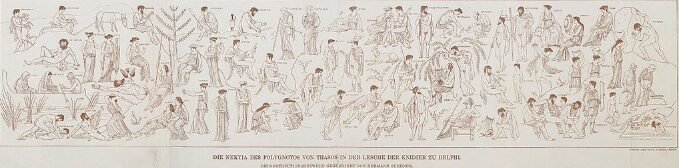
The Nekyia (Underworld Scene), another fresco from the Lesche of the Cnidians, portrays Greek hero Odysseus’s visit to the underworld. Polygnotus masterfully depicted layered figures to create depth and a sense of narrative flow.
When and where was Polygnotus born?
Polygnotus was born around 500 BCE on the island of Thasos in Thrace.
For what type of artwork is Polygnotus most renowned?
Polygnotus is most renowned for his grandiose wall paintings executed in a distinctly Classical style.
Where did Polygnotus establish his prominent career, and what significant status did he achieve there?
Polygnotus established his prominent career in Athens, where he flourished as an artist and was eventually granted Athenian citizenship, highlighting his significant contribution to the city’s artistic heritage.
Which two major paintings by Polygnotus were housed in the Cnidian hall at Delphi, and what subjects did they depict?
The two major paintings by Polygnotus housed in the Cnidian hall at Delphi were the “Iliupersis” (“Sack of Troy”) and the “Nekyia” (“Ulysses Visiting Hades”). These works depicted the dramatic events of the Trojan War and Odysseus‘s journey to the underworld, respectively.
What innovative compositional technique did Polygnotus introduce in his paintings, and how did it differ from traditional Greek methods?
Polygnotus introduced an innovative compositional technique by arranging life-sized, idealized figures freely across the composition, rather than placing them along a single baseline. This approach created a sense of depth and dynamic arrangement, departing from the traditional Greek method.
Which earlier art may have influenced Polygnotus’s innovative composition, and what subsequent art form might he have impacted?
Polygnotus’s innovative composition may have been influenced by earlier Assyrian art. Additionally, his approach likely impacted contemporary Greek vase painting techniques by introducing more dynamic and naturalistic arrangements.
How did Polygnotus emphasize individual figures in his paintings, and what specific details did he incorporate to highlight their characteristics?
Polygnotus emphasized individual figures by prioritizing their unique characteristics over a unified perspective. He incorporated intricate details such as delicate female headdresses, translucent garments, and expressive facial features like parted lips revealing teeth to highlight their regal presence and individuality.
What limited color palette did Polygnotus use in his paintings, and what technique did he employ to enhance the realism of his figures?

Portrait of Polygnotos in the Nationalmuseum Stockholm, Sweden
Polygnotus utilized a limited palette of four primary colors: black, white, red, and ochre. He employed sharp foreshortening to enhance the realism and three-dimensional quality of his figures, making them appear more lifelike within the compositions.





