Life and Major Works of Pausanias, the famed Greek traveler and geographer
Pausanias, the Greek traveler and geographer, remains one of the most significant figures in the documentation of ancient Greece’s culture, geography, and mythology. Despite the limited information about his personal life, his major work, Description of Greece, provides unparalleled insights into Greece’s monuments, temples, landscapes, and cultural traditions as they existed during the second century AD. Pausanias’s accounts have served as essential guides for archaeologists, historians, and classicists, offering a rare, firsthand perspective on Greece’s ancient heritage as it persisted during the Roman Empire.
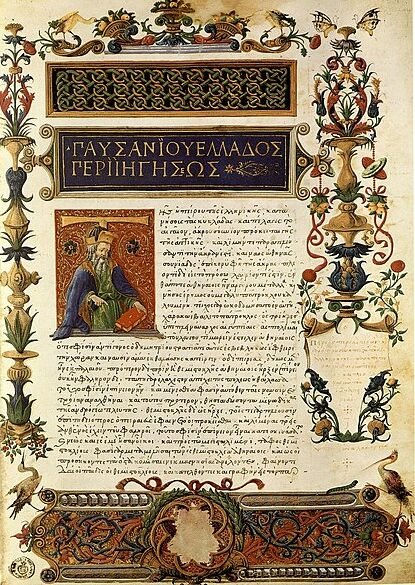
Pausanias (c. 110 – c. 180 AD) was a Greek traveler and geographer best known for his work Description of Greece (Hēlládos Periḗgēsis). Image: A page with illustrations from a 1485 manuscript of “Description of Greece” by Pausanias.
Early Life and Background
What little is known about Pausanias’s background is inferred from his writings. Scholars suggest that he was born around 110 AD, possibly in Lydia, a region of Asia Minor (modern Turkey) under Roman rule. His Greek heritage influenced his interests and his desire to document the physical and cultural landscapes of Greece, even though his home region lay in the eastern reaches of the Roman Empire. Pausanias came of age during a period when Greece was a Roman province, yet he retained a strong connection to his Greek identity. His work reflects his pride in Greece’s ancient culture, its religious customs, and its mythology.
By approximately 150 AD, Pausanias began his travels throughout the Greek mainland. His journey spanned several years, during which he meticulously documented his observations of notable Greek monuments, landscapes, and sacred spaces. He traveled through cities such as Athens, Sparta, Olympia, and Delphi, and recorded not only the physical structures he encountered but also the myths, religious practices, and historical anecdotes connected to these places.
Purpose and Influence of Description of Greece
The purpose behind Pausanias’s travels appears to have been his desire to create a comprehensive written record of Greece’s cultural and religious heritage. His work, titled Description of Greece (Ἑλλάδος Περιήγησις), was intended as a complete account of “all things Greek” (panta ta hellenika). Pausanias’s primary motivation was likely to preserve a record of Greece’s traditional culture in a time when Roman influence threatened to obscure or erase elements of Greek identity. He sought to ensure that future generations would understand and appreciate the ancient glories of Greek civilization, from its sacred rituals and myths to its architectural marvels.
Description of Greece is a travelogue that does not resemble modern travel guides. Pausanias’s descriptions of landscapes, temples, and statues are frequently interwoven with the myths, legends, and historical narratives associated with them. This approach offers a unique blend of topographical detail and cultural commentary, capturing the sacred and symbolic dimensions of the sites he visited. As a result, his work provides valuable context for readers, connecting the physical sites of Greece with their mythological and cultural significance.
Content and Structure of Description of Greece
Description of Greece is structured as a detailed account of Pausanias’s journey through Greece, organized geographically by region. It comprises ten books, each dedicated to a specific area:
- Attica (Book I): This book focuses on Athens and its surroundings, detailing the Acropolis, the Parthenon, the theater of Dionysus, and other notable monuments. Pausanias also describes Eleusis, famous for its Eleusinian Mysteries, which were among the most sacred rites in ancient Greece.
- Corinth (Book II): Pausanias explores the city of Corinth, known for its strategic location and its temple to Apollo. He also describes nearby locations like Sicyon and Troezen, adding details about their sanctuaries and mythology.
- Laconia (Book III): Dedicated to Sparta and its surrounding areas, this book covers the ancient customs of the Spartans and their religious sites. Pausanias describes the sanctuary of Artemis Orthia, significant to Spartan youth training, and discusses the hero cult of Helen and Menelaus.
- Messenia (Book IV): In this book, Pausanias explores the Peloponnesian region of Messenia, detailing its history of conflict with Sparta. He describes sites such as the temple of Messene and the cult of Heracles.
- Elis (Books V and VI): These books cover the region of Elis, home to the sanctuary of Olympia, where the ancient Olympic Games were held. Pausanias provides a detailed account of the temples, statues, and athletic structures in Olympia, emphasizing its importance as a Panhellenic center.
- Achaia (Book VII): Pausanias discusses the coastal region of Achaia, including its cities, temples, and historical landmarks.
- Arcadia (Book VIII): This book covers Arcadia, a mountainous region associated with pastoral life and rustic gods like Pan. Pausanias describes several ancient sanctuaries, including the temple of Despoina, a goddess worshiped uniquely in Arcadia.
- Boeotia (Book IX): In his exploration of Boeotia, Pausanias describes Thebes, the birthplace of Dionysus and Heracles, and other notable sites such as the sanctuary of Apollo Ismenios.
- Phocis (Book X): This book is primarily focused on Delphi, the site of the famous oracle and the sanctuary of Apollo. Pausanias provides a detailed account of the sacred precinct, the Pythian Games, and the Delphic temple.
Each book presents a combination of factual descriptions and cultural commentary, as Pausanias offers insights into the myths and historical events associated with each location. His observations extend beyond the physical landscape to encompass the intangible cultural elements that shaped Greece’s identity.
Writing Style and Approach
Pausanias’s writing is characterized by a straightforward and unembellished style. He writes in a clear and accessible language, largely avoiding literary flourishes. This simplicity reflects his intent to inform rather than entertain, as he aimed to provide an accurate record of Greece’s cultural heritage. Pausanias’s accounts are often interwoven with myths and historical narratives, which add depth to his descriptions of temples, statues, and other landmarks.
While his writing is generally direct, Pausanias occasionally uses past tense where the present might be expected, creating a sense that he is bringing his readers along on his journey. This technique may have been intended to foster a sense of immediacy, helping readers feel as if they are visiting the sites alongside him. Unlike modern travel guides, Pausanias’s work is less concerned with practical details and more focused on cultural and mythological context, offering readers a deeper understanding of each location’s historical significance.
Pausanias also demonstrates a critical approach to his sources, occasionally expressing skepticism about certain myths or historical claims. He acknowledges when he is reporting second-hand information, lending his work an air of honesty and transparency. While he respects traditional beliefs, he does not hesitate to question aspects that seem inconsistent or fantastical.
Reception and Impact on Archaeology
Initially, Pausanias’s Description of Greece was dismissed by many classicists as a primarily literary work rather than a reliable historical source. Scholars like Ulrich von Wilamowitz-Moellendorff viewed Pausanias as a compiler of second-hand information, doubting that he had actually visited many of the sites he described. For much of the nineteenth century, Pausanias’s work was regarded as a mixture of myth and hearsay, lacking the factual rigor expected in historical documentation.
However, twentieth-century archaeological discoveries began to shift scholarly perspectives on Pausanias. Archaeologists found that his accounts often aligned closely with excavated sites, temples, and monuments. Pausanias’s detailed descriptions became valuable guides for locating and interpreting ancient ruins, and his work gained credibility as a reliable source of historical and topographical information. His descriptions have assisted in uncovering sites such as the sanctuary of Olympia and the temples at Delphi, where his records provided context that helped modern researchers understand the layout and purpose of these sacred spaces.
Legacy of Description of Greece
Today, Description of Greece remains a crucial text for understanding the cultural and religious landscape of ancient Greece. Pausanias’s work bridges the gap between ancient Greek literature and modern archaeology, preserving details about monuments, rituals, and beliefs that might otherwise have been lost. His meticulous record of Greek topography, combined with his insights into mythology and history, provides a comprehensive view of Greece’s heritage as it stood under Roman rule.
Pausanias’s commitment to preserving Greece’s ancient traditions reflects his belief in the enduring value of Greek culture. His work has become an essential resource for historians, classicists, and archaeologists, offering a snapshot of Greece during the Roman period that remains relevant to this day. As both a historical and cultural preserver, Pausanias’s legacy endures in the continued study and appreciation of his unique contribution to our understanding of ancient Greece.
Frequently Asked Questions
Who was Pausanias, and when did he live?
Pausanias was a Greek traveler and geographer born around 110 AD, likely in Lydia, Asia Minor. He lived under Roman rule and is known for his work Description of Greece, which documents the monuments, sacred spaces, and landscapes of Greece.
What is Description of Greece?
Description of Greece is Pausanias’ account of his travels across Greece, detailing monuments, cultural practices, myths, and history. He aimed to create a comprehensive record of “all things Greek” to preserve Greece’s cultural heritage.
How did Pausanias view Greek culture under Roman rule?
Although he lived in the Roman Empire, Pausanias deeply valued Greek heritage. He aimed to highlight Greek culture’s enduring relevance and attempted to connect ancient Greek traditions to his own time, showing pride in Greece’s identity within the larger Roman context.
What was distinctive about Pausanias’ writing style?
Pausanias wrote in a straightforward, clear style, often lacking literary embellishments. His use of past tense at times created a sense of immediacy, drawing readers into his experiences. His accounts included not only descriptions of sites but also related myths, rituals, and natural phenomena.
How did Description of Greece differ from modern travel guides?
Rather than providing practical travel information, Pausanias focused on cultural context, myth, and ritual related to each site he visited. This approach made his work more of a cultural and historical narrative than a guide, with detailed stories and explanations that resembled later travel literature.
How did Pausanias balance myth and history in his work?
While Pausanias included myths and traditions, he occasionally questioned their accuracy, distinguishing between firsthand experiences and information from other sources. This critical approach lends credibility to his work, as he transparently differentiates what he observed from what he heard.
What was the early scholarly view of Pausanias as a source?
For a long time, scholars, led by figures like Ulrich von Wilamowitz-Moellendorff, viewed Pausanias skeptically, considering him more a literary figure than a reliable historical source. Many believed he relied heavily on second-hand accounts and might not have visited all the places he described.
How did archaeological findings change views on Pausanias’ reliability?
In the twentieth century, archaeologists found that Pausanias’ descriptions closely matched physical evidence at excavation sites, showing his accounts were grounded in firsthand observation. His writings helped locate ancient ruins and provided insights into historical and cultural details previously overlooked.
What is an example of Pausanias’ influence on modern archaeology?
Pausanias’ account of the region of Tartessos has aided archaeological research in understanding its history, geography, and culture, demonstrating his work’s continued relevance in modern archaeological investigations.
What is Pausanias’ legacy in understanding ancient Greece?
Description of Greece remains a vital resource for studying ancient Greek topography, culture, and myth. By preserving these details, Pausanias bridged the gap between ancient and modern perspectives, offering insights that guide scholars and enthusiasts in exploring Greek history and cultural identity.