Poor Richard’s Almanack
Poor Richard’s Almanack was a highly influential publication written and published by Benjamin Franklin from 1732 to 1758.
Under the pseudonym “Richard Saunders,” Franklin created a work that combined practical advice, entertainment, and cultural commentary in an accessible format. It became one of colonial America’s most popular almanacs, with annual sales reaching up to 10,000 copies.
Known for its wit, practicality, and moral lessons, Poor Richard’s Almanack remains one of Franklin’s most enduring contributions, reflecting his values and the spirit of early American society. This article explores its history, purpose, content, and impact.
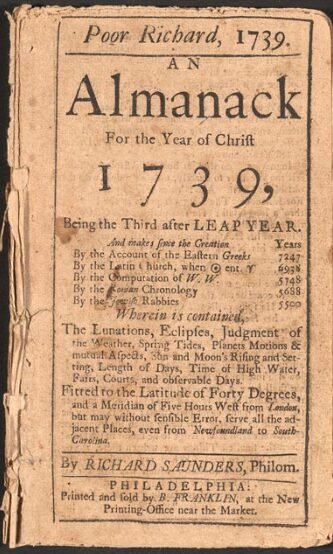
1739 Edition of Poor Richard’s Almanack
Origins and Purpose
The publication of Poor Richard’s Almanack began on December 28, 1732, with Franklin announcing its release in The Pennsylvania Gazette. At the time, almanacs were widely popular across colonial America, providing essential information such as weather forecasts, astronomical data, and calendars, along with entertaining and educational content.
Franklin, however, saw the potential to make the almanac a vehicle for conveying practical wisdom, moral advice, and social critique. Writing under the persona “Richard Saunders,” Franklin aimed to engage his readers through a relatable character whose advice combined humor, common sense, and wit.
The pseudonym “Richard Saunders” itself was a nod to a fictional writer from the popular English publication Rider’s British Merlin. Franklin’s choice of name also reflected the influence of Jonathan Swift’s fictional persona “Isaac Bickerstaff,” who had humorously predicted the deaths of real astrologers.
Following this model, Franklin created a character that felt real and distinct from himself, enabling him to infuse Poor Richard’s Almanack with both satirical humor and genuine advice. His use of a pseudonym also allowed Franklin to adopt a lighthearted, down-to-earth tone that resonated with colonial readers.
Content and Structure
Poor Richard’s Almanack offered a blend of content common to almanacs of the time, such as calendars, weather forecasts, lunar phases, and astrological predictions, with more unique elements that reflected Franklin’s diverse interests. Franklin included mathematical exercises, puzzles, and poetry, providing readers with both education and entertainment. One notable feature was the addition of demographic studies, an innovative inclusion at the time, with the 1750 almanac featuring an early example of such data.
The most memorable aspect of Poor Richard’s Almanack, however, was Franklin’s collection of aphorisms and proverbs. Franklin’s proverbs encouraged virtues like thrift, hard work, frugality, and humility. Many of these maxims are now considered classic American sayings, such as “A penny saved is a penny earned,” “Early to bed and early to rise, makes a man healthy, wealthy, and wise,” and “God helps those who help themselves.” These sayings offered straightforward moral lessons on living wisely and became Franklin’s hallmark in the almanac, distinguishing it from other publications.
In the spaces between calendar entries, Franklin would often insert proverbs that reflected his practical approach to life, influenced by thinkers like Lord Halifax, whose writings had questioned social norms and human motives.
Some of Franklin’s proverbs carried a hint of skepticism, encouraging readers to question the motives behind common social behaviors. Franklin’s Almanack thus became a guide not only for daily life but also for critical reflection on society.
The Way to Wealth
In 1757, Franklin published The Way to Wealth, a preface to the almanac that compiled some of the best-known sayings from Poor Richard’s Almanack. Framed as an address by “Father Abraham,” an elderly character who speaks to an audience at an auction, The Way to Wealth became immensely popular in America and even reached audiences in England. This piece condensed Franklin’s philosophy of frugality, hard work, and wise management of resources into a single work that appealed to both the affluent and common readers.
The Way to Wealth emphasized that success came from personal responsibility, diligence, and wise spending, values that deeply resonated in colonial America and would become cornerstones of American cultural identity. The piece’s popularity helped solidify Franklin’s influence as a moral and practical guide for Americans and remains one of his most widely read works today.
Humor, Satire, and the Poor Richard Persona
Franklin infused Poor Richard’s Almanack with humor and satire, using the persona of “Richard Saunders” to engage readers through comedic predictions, sarcastic commentary, and jokes. Early editions featured a running joke in which Saunders “predicted” the deaths of real astrologers, such as Titan Leeds, another almanac writer. Franklin humorously forecasted Leeds’s death in 1733, setting up an amusing rivalry that lasted years and kept readers entertained.
Even when Leeds did not actually die as predicted, Franklin continued to publish as though he had, jokingly suggesting that any future publications by Leeds were the work of an imposter. This humorous approach not only captured readers’ attention but also showcased Franklin’s wit and creativity in his public persona, setting Poor Richard’s Almanack apart from more serious almanacs of the time.
Over the years, the persona of “Poor Richard” became less prominent, with Franklin shifting the almanac’s focus from character-driven satire to practical wisdom. By the late 1750s, “Poor Richard” was replaced by “Father Abraham,” who, rather than engaging in comedic rivalry, offered sincere advice on leading a responsible and productive life.
Cultural Influence and Criticisms
Poor Richard’s Almanack had a profound impact on colonial America, but it also received criticism from some notable authors. Nathaniel Hawthorne and Herman Melville, for instance, viewed the emphasis on thrift and pragmatism as promoting a narrowly practical worldview, overshadowing other aspects of human experience. James Russell Lowell, in a satirical reflection on Franklin, suggested that Franklin’s achievements were overly celebrated, downplaying other intellectual pursuits in favor of his focus on frugality and practicality.
Additionally, historian Howard Zinn noted that the almanac reflected the social norms of its time, including restrictive views on social hierarchy and gender. One maxim, “Let thy maidservant be faithful, strong, and homely,” illustrated the era’s limited social expectations for women. While Franklin’s almanac was not intended as a philosophical guide to liberty, it did reinforce certain societal values that were widely accepted in colonial America.
International Reach and Legacy
Poor Richard’s Almanack enjoyed immense popularity not only in America but also overseas. It was translated into Italian, French, and even Slovene by 1812, and Franklin’s sayings became well-known across Europe. In England, clergy distributed the almanac to parishioners to promote values of discipline and hard work. Franklin’s proverbs, advocating self-reliance and thrift, aligned with emerging capitalist ideals and spread widely in both England and America.
The almanac also influenced other American publications. Noah Webster and others drew inspiration from Franklin’s model.
One tangible example of Franklin’s influence abroad was the French ship Bonhomme Richard, gifted by Louis XVI to American naval captain John Paul Jones. The name, translating to “Goodman Richard,” was a direct nod to Franklin’s “Poor Richard” and symbolized transatlantic respect for Franklin’s wisdom.
The almanac also influenced other American publications. American lexicographer Noah Webster and others drew inspiration from Franklin’s model, while the format and content of Poor Richard’s Almanack influenced publications like The Old Farmer’s Almanac, which has continued the tradition of blending practical advice with cultural insights. Since 1851, The Old Farmer’s Almanac has featured Franklin’s portrait on its cover, a testament to his lasting legacy.
Economic and Sociological Influence
Sociologist Max Weber cited Poor Richard’s Almanack as embodying the “spirit of capitalism” in The Protestant Ethic and the Spirit of Capitalism. For Weber, Franklin’s sayings reflected an ethos of discipline, personal responsibility, and economic self-sufficiency that paralleled the emerging capitalist mindset. Weber viewed Franklin’s proverbs as emblematic of a uniquely American attitude toward work and money, praising Franklin’s pragmatic, frugal approach as a model for economic success.
The almanac’s practical advice even impacted economic policy in Pennsylvania, influencing fiscal strategies related to foreign expenses. Franklin’s influence on economics and cultural values helped shape the emerging capitalist society in America, embedding his ideas in the nation’s developing identity.
Continued Legacy and Modern Recognition
Franklin’s Poor Richard’s Almanack remains a symbol of early American values, particularly those of thrift, industriousness, and self-discipline. Its proverbs continue to be quoted and referenced in American culture, and the almanac itself is recognized as an essential document of colonial life and thought. Franklin’s legacy is further honored in American military history; in 1958, the U.S. Navy used “Poor Richard” as the code name for a naval operation responding to an attack on Vice President Richard Nixon in Venezuela, underscoring Franklin’s enduring cultural influence.
Through his almanac, Franklin left an indelible mark on American culture and identity, providing practical wisdom that has continued to resonate across generations. By blending humor with moral advice, Franklin offered readers not just an almanac, but a guide to everyday life, capturing the aspirations and values of an emerging American society.
Frequently Asked Questions

Founding Father Benjamin Franklin
When was the first edition of Poor Richard’s Almanack published, and under what pseudonym did Benjamin Franklin write it?
The first edition was published on December 28, 1732, under the pseudonym “Richard Saunders, Philomath.”
What type of content did Poor Richard’s Almanack include?
It included calendars, weather forecasts, poems, wise sayings, astronomical and astrological insights, mathematical exercises, and an early demographic study.
What values did Franklin’s proverbs in the Almanack promote?
Franklin’s proverbs advocated thrift, hard work, and courtesy, values that have continued to influence American culture.
Whose writings influenced Franklin’s maxims, and what was the nature of these sayings?
Franklin borrowed from English writer Lord Halifax, whose skeptical proverbs questioned human motives and social norms.
What is The Way to Wealth, and how was it significant?
The Way to Wealth is a selection of Franklin’s sayings, framed as an address to auction attendees, which gained popularity in both America and England.
How did Franklin’s use of the pseudonym “Richard Saunders” originate?
The name was inspired by Rider’s British Merlin, a London almanac featuring a fictional writer named Richard Saunders.
What humorous tactic did Franklin use in his almanac, involving Titan Leeds?
Franklin humorously “predicted” Leeds’ death, sparking a playful feud that boosted Almanack sales.
How did some authors critique Franklin’s Almanack?
Writers like Nathaniel Hawthorne and Herman Melville saw it as promoting a limited, pragmatic worldview focused mainly on thrift.
How did Franklin’s Almanack influence other publications and thinkers?
It inspired publications like The Old Farmer’s Almanac and influenced thinkers such as Noah Webster.
How did sociologist Max Weber view Poor Richard’s Almanack in his work?
Weber saw it as exemplifying the “spirit of capitalism,” citing its emphasis on frugality and industriousness as reflective of the American capitalist ethos.