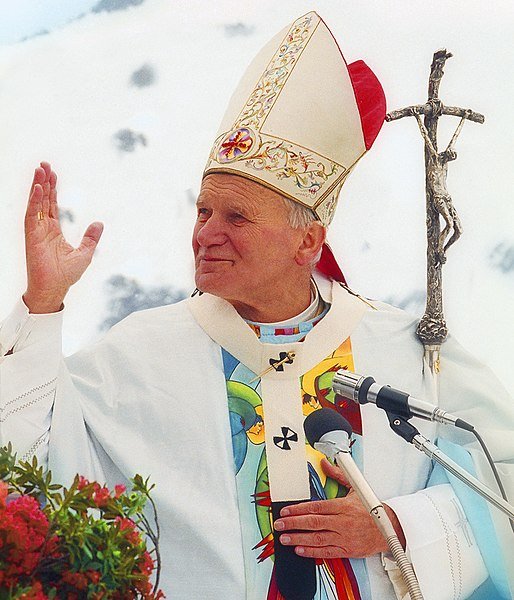
John Paul II worked to improve relations with Judaism, Islam, and the Eastern Orthodox Church, including historic gestures like visiting a synagogue and mosque. Image: Pope John Paul II
Pope John Paul II, born Karol Wojtyła, led the Catholic Church from 1978 to 2005. He was one of the most influential modern popes, shaping the Church’s global role.
Birth and Childhood
Pope John Paul II was born Karol Józef Wojtyła on May 18, 1920, in Wadowice, Poland. He was the youngest of three children born to Karol Wojtyła Sr., an officer in the Polish Army, and Emilia Kaczorowska, a schoolteacher. His mother died when he was eight, and his older brother, Edmund, passed away four years later, leaving young Karol an orphan by the age of 20.
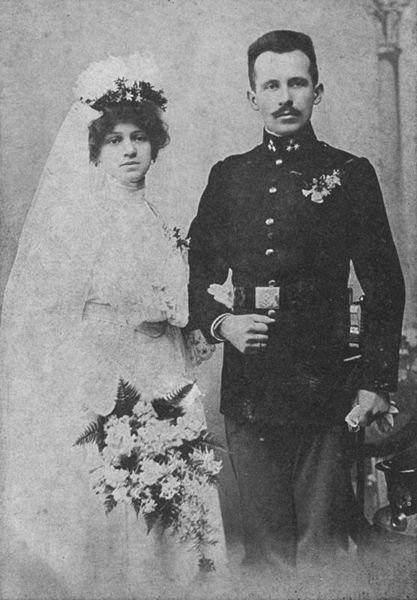
John Paul II’s parents, Emilia and Karol Wojtyła Sr., in their wedding portrait.
Education and Interests
As a youth, Wojtyła was an athlete, excelling in soccer and skiing. He was also deeply interested in literature and theater. He studied philology at Jagiellonian University in Kraków before the outbreak of World War II, during which the Nazis closed the university. To avoid deportation to a labor camp, he worked in a quarry and later at a chemical plant.
Religious Calling and Priesthood
During the war, Wojtyła felt a calling to the priesthood and began studying theology clandestinely in an underground seminary run by the Archbishop of Kraków. He was ordained a priest on November 1, 1946.
After his ordination, Wojtyła studied in Rome, earning a doctorate in theology with a dissertation on the mystical theology of Saint John of the Cross. Upon returning to Poland, he served in rural parishes and later became a professor of ethics at Catholic universities.
Rise in the Church Hierarchy
In 1958, Wojtyła was appointed auxiliary bishop of Kraków, becoming the youngest bishop in Poland at 38. He was named Archbishop of Kraków in 1964, during which he became a key participant in the Second Vatican Council, contributing to landmark documents on religious freedom and the role of the Church in the modern world.
In 1967, he was made a cardinal by Pope Paul VI. Following the sudden death of Pope John Paul I in 1978, Wojtyła was elected pope, taking the name John Paul II. He became the first non-Italian pope in 455 years and the youngest pope in over a century.
Papacy and Global Influence
John Paul II emphasized interfaith dialogue, seeking to improve relations with Judaism, Islam, and Eastern Orthodox Christianity. He became the first pope to visit a synagogue and a mosque, fostering mutual understanding between religions.
While supporting the reforms of the Second Vatican Council, John Paul II upheld traditional Catholic teachings, opposing abortion, artificial contraception, and the ordination of women. His writings, such as Theology of the Body, explored the sanctity of human life and sexuality.
John Paul II was one of the most-traveled world leaders in history, visiting 129 countries and delivering messages of faith, peace, and human rights. His 1979 trip to Poland inspired the Solidarity movement, contributing to the eventual collapse of Communism in Eastern Europe.
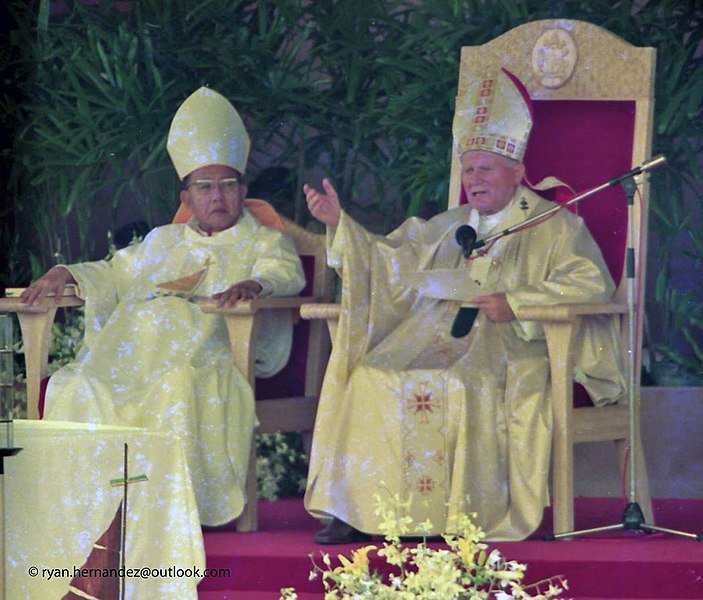
Pope John Paul II and Cardinal Jaime Sin addressing the crowd at Luneta Park, 1995.
Social and Political Impact
John Paul II’s support for the Polish Solidarity movement and his calls for freedom and human dignity played a pivotal role in the peaceful end of Communist regimes in Central and Eastern Europe. Soviet leader Mikhail Gorbachev later acknowledged his influence.
He condemned apartheid in South Africa, called for the cancellation of Third World debt, and spoke out against human rights abuses worldwide. His appeals for nonviolence and justice resonated across political divides.
John Paul II strongly opposed the 2003 Iraq War, emphasizing diplomacy over military intervention. He also denounced the Gulf War and worked for peace in the Middle East.
Canonizations and Beatifications
John Paul II canonized 483 saints and beatified 1,344 individuals, more than any of his predecessors combined. He sought to highlight examples of holiness from diverse cultures and backgrounds.
He was deeply devoted to the message of Divine Mercy, originating from Saint Faustina Kowalska. He canonized her in 2000 and established Divine Mercy Sunday as a feast day for the Church.
Health Decline and Death
In his later years, John Paul II suffered from Parkinson’s disease and other ailments but continued his papal duties with determination. His physical decline became a poignant symbol of human dignity in suffering. Pope John Paul II passed away on April 2, 2005, after serving as pope for 26 years, the third-longest papacy in history. His funeral drew millions of mourners, including numerous world leaders, highlighting his global impact.
John Paul II’s canonization in 2014 reflected his impact on the Church and the world, celebrated for his leadership, spiritual depth, and promotion of human rights.
Legacy and Canonization
John Paul II was beatified on May 1, 2011, and canonized on April 27, 2014, by Pope Francis. His life and teachings continue to inspire Catholics and others worldwide.
Remembered as a champion of human dignity and a bridge-builder between cultures and religions, John Paul II’s legacy endures as one of the most influential leaders of the 20th century.
Frequently Asked Questions
Here are important questions and answers about his life and legacy:
What made John Paul II’s papacy historically significant?
He was the first non-Italian pope in 455 years, the third-longest-serving pope, and a key figure in the fall of communism in Eastern Europe, especially in his native Poland.
How did John Paul II influence the fall of communism?
His support of Poland’s Solidarity movement and his calls for freedom and human dignity inspired resistance to communist regimes across Eastern Europe.
What were his views on social and moral issues?
He upheld traditional Church teachings on abortion, contraception, and the ordination of women while advocating for social justice, debt relief, and the dignity of all people.
How did he impact the Church’s global outreach?
John Paul II was one of the most-traveled popes, visiting 129 countries and emphasizing the universal call to holiness by canonizing over 480 saints.
What role did he play in Vatican II reforms?
While supporting the reforms of the Second Vatican Council, he interpreted them conservatively, reinforcing the Church’s traditional doctrines.
What were his notable writings?
His major works include Theology of the Body, the Catechism of the Catholic Church, and encyclicals such as Evangelium Vitae and Veritatis Splendor, addressing human dignity, morality, and faith.
What was his stance on science and evolution?
He accepted evolution as a scientific theory compatible with faith but affirmed the divine creation of the human soul.
How did he address the Church’s past mistakes?
John Paul II issued numerous apologies, including for the Crusades, the Inquisition, and the Church’s failure to act during the Holocaust.
History of the Catholic Church: How and When Did Catholicism Begin?
FACT CHECK: At World History Edu, we strive for utmost accuracy and objectivity. But if you come across something that doesn’t look right, don’t hesitate to leave a comment below





