Queen Anne’s War
Queen Anne’s War (1702–1713) was the second of four major wars fought between France, England, and their respective Indigenous and European allies in North America during the late 17th and early 18th centuries.
Known as the North American theater of the War of the Spanish Succession, Queen Anne’s War was part of a broader global conflict triggered by the European struggle for control over Spain and its vast empire.
The war had significant impacts on the colonies in North America, reshaping the balance of power between France, England, Spain, and various Indigenous nations. It also led to long-term consequences for the colonial settlements, particularly in regions like New England, the Carolinas, and Acadia.
Causes of Queen Anne’s War
The War of the Spanish Succession (1701–1714), which included Queen Anne’s War in North America, began over disputes concerning who would succeed Charles II, the childless King of Spain. Two primary candidates vied for the Spanish throne: Philip of Anjou, the grandson of King Louis XIV of France, and Archduke Charles of Austria, supported by England, the Dutch Republic, and the Holy Roman Empire. The prospect of a united French and Spanish monarchy under Philip raised fears in England and other European countries that Louis XIV would gain too much power, upsetting the balance of power in Europe.
Although the war in Europe was about the Spanish succession, the conflict in North America centered on colonial expansion, trade, and control over key territories. France and England had already been involved in several colonial skirmishes, including King William’s War (1689–1697), the North American theater of the War of the Grand Alliance. Queen Anne’s War was a continuation of these earlier hostilities, exacerbated by competing ambitions in North America.
Theaters of War
Queen Anne’s War was fought across several distinct theaters in North America: the northern colonies, particularly New England and Acadia; the southern colonies, including the Carolinas and Spanish Florida; and the interior frontier, where Indigenous groups played a crucial role.
Northern Theater: New England and Acadia
In the northern theater, the conflict was primarily between French and English colonists, along with their respective Indigenous allies. New England colonists and French settlers in Acadia (present-day Nova Scotia, New Brunswick, and parts of Maine) had long been rivals for control of the region’s lucrative fishing and fur trading industries.
One of the key points of conflict in the north was Acadia, a French colony that England sought to conquer. The English and their Indigenous allies launched several attacks on French settlements in Acadia, most notably the siege and capture of Port Royal in 1710. Port Royal was the capital of Acadia and its capture marked a turning point in the war. After the English victory, they renamed the colony Nova Scotia (New Scotland), and Port Royal became Annapolis Royal.
The French and their Indigenous allies, including members of the Wabanaki Confederacy, conducted raids on English settlements in New England. One of the most infamous raids was the attack on Deerfield, Massachusetts, in 1704, when French and Indigenous forces killed 56 villagers and took more than 100 captive. These raids were designed to weaken English control of the region and disrupt colonial expansion into areas claimed by France and Indigenous nations.
Southern Theater: The Carolinas and Spanish Florida
In the southern theater, the conflict involved England, Spain, and their respective Indigenous allies. At the time, Spain controlled Florida, while England had established the colony of Carolina, which included parts of present-day North and South Carolina, as well as Georgia.
English settlers in Carolina viewed Spanish Florida as a threat to their security and expansion, and they launched a series of attacks on Spanish settlements. One of the most significant events in the southern theater was the 1702 English attack on the Spanish town of St. Augustine in Florida. English forces, led by South Carolina’s Governor James Moore, captured and destroyed the town but failed to take the fort, Castillo de San Marcos.
In retaliation, Spanish and French forces, along with their Indigenous allies, attacked English settlements in the Carolinas. The most significant Indigenous allies of Spain in Florida were the Apalachee, who conducted raids on English settlements. However, the English also had strong Indigenous allies, including the Creek and the Yamasee, who helped to destroy several Spanish missions and Apalachee villages in northern Florida.
This series of back-and-forth raids and battles led to significant devastation in the southern colonies, particularly for the Indigenous populations who were often caught in the middle of the conflict. Many Indigenous villages were destroyed, and thousands of Indigenous people were killed or captured and sold into slavery by both English and Spanish forces.
Frontier Theater: The Role of Indigenous Nations
Indigenous nations played a critical role in Queen Anne’s War, as both the French and English relied heavily on alliances with Indigenous groups to conduct raids, defend settlements, and gain control over frontier regions. The war involved numerous Indigenous nations, including the Wabanaki Confederacy, Iroquois Confederacy, Creek, Chickasaw, and Catawba, among others.
In the northern theater, the Wabanaki Confederacy, which included groups such as the Mi’kmaq, Maliseet, and Abenaki, fought alongside the French to resist English expansion into their traditional territories. These Indigenous groups conducted raids on English settlements in New England and supported the French defense of Acadia.
In the southern theater, the Creek and Yamasee aligned with the English in their fight against Spanish Florida and its Indigenous allies, including the Apalachee and Timucua. These alliances were often fluid, as Indigenous groups sought to protect their own interests and lands in the face of encroaching European colonists.
The Iroquois Confederacy, located in the interior of New York, played a more complex role. The Iroquois had previously allied with the English in King William’s War, but during Queen Anne’s War, they largely sought to maintain a position of neutrality. The Iroquois used diplomacy to balance relations between the French and English, attempting to prevent either side from gaining too much power in the region. However, individual Iroquois warriors still participated in raids and skirmishes on both sides.

Major Events of Queen Anne’s War
Several key events shaped the course of Queen Anne’s War, particularly in the northern and southern theaters.
- 1702 Attack on St. Augustine: English forces from Carolina attacked and destroyed the town of St. Augustine in Spanish Florida, although they failed to capture the fort, Castillo de San Marcos.
- 1704 Raid on Deerfield: French and Indigenous forces attacked the English settlement of Deerfield, Massachusetts, killing dozens and taking more than 100 captives. Many of the captives were marched to Canada, where they were either ransomed or integrated into Indigenous communities.
- 1709 Failed Expedition Against Quebec: English forces attempted to launch an expedition against Quebec, the capital of New France, but the effort failed due to logistical problems, including a lack of ships and poor coordination.
- 1710 Siege of Port Royal: English forces, with support from New England militia, captured Port Royal, the capital of French Acadia. This victory marked the permanent English takeover of the colony, which was renamed Nova Scotia.
- 1711 Quebec Expedition: Another English attempt to capture Quebec ended in disaster when several ships of the fleet sank in the St. Lawrence River, and the expedition was called off.
- Raids and Counter-Raids: Throughout the war, both sides conducted numerous raids on frontier settlements, leading to widespread destruction and loss of life. These raids targeted civilian populations, causing deep fear and insecurity in the colonies.
The Treaty of Utrecht (1713)
Queen Anne’s War came to an end with the signing of the Treaty of Utrecht in 1713, which resolved the broader War of the Spanish Succession in Europe. The treaty had significant consequences for North America, particularly for France and England.
- Territorial Changes: Under the terms of the Treaty of Utrecht, France ceded control of Acadia (renamed Nova Scotia) to England, along with Newfoundland and the Hudson Bay region. However, France retained control of Île Royale (Cape Breton Island) and Île Saint-Jean (Prince Edward Island), which became important French bases in the Gulf of St. Lawrence.
- Recognition of British Sovereignty: Spain recognized British sovereignty over several Caribbean islands, including St. Kitts, and granted England valuable trade rights, including the asiento—the exclusive right to supply enslaved Africans to Spanish colonies.
- Impact on Indigenous Nations: The treaty did not address the interests or territories of the Indigenous nations who had been deeply involved in the war. Many Indigenous groups, particularly the Wabanaki Confederacy in the north and the Creek and Yamasee in the south, were left to deal with the consequences of the war without European diplomatic support. The shifting alliances and territorial losses following the war led to further conflicts between Indigenous groups and European settlers.
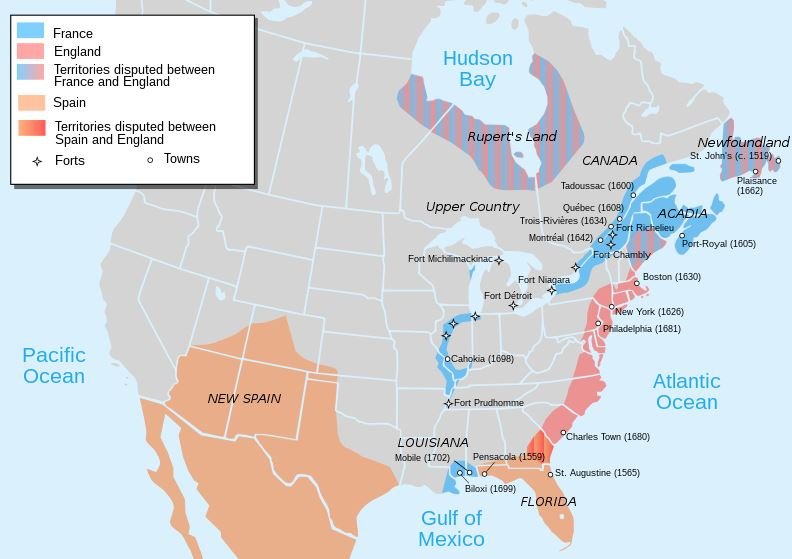
Known as the Third Indian War in the U.S., Queen Anne’s War was called the Second Intercolonial War in France. The war had significant implications for colonial territories and Indigenous alliances in North America. Image: A map showing European colonies in America during the 16th century.
Consequences of Queen Anne’s War
Queen Anne’s War had far-reaching consequences for the colonies of North America and for the Indigenous peoples who lived there.
Impact on the English Colonies
The war left the English colonies, particularly in New England and the Carolinas, devastated by years of raids and military campaigns. Many frontier settlements were destroyed, and the constant threat of attack disrupted colonial life. In New England, the capture of Port Royal and the establishment of British control over Acadia was seen as a major victory, but the French and their Indigenous allies continued to harass the region for years to come.
In the southern colonies, the war deepened the divide between English settlers and Indigenous nations. The English gained control over Spanish Florida, but the conflict also weakened relations with some of their Indigenous allies, particularly the Yamasee, who would later rise up in the Yamasee War (1715–1717) in response to English encroachment on their lands.
Impact on the French Colonies
For France, the Treaty of Utrecht marked the loss of significant territory in North America, particularly Acadia and Newfoundland. However, France retained control of important strongholds in the Gulf of St. Lawrence, including Cape Breton Island, where they built the fortified town of Louisbourg, which would become a major military and economic hub in the years to come.
The French also maintained strong alliances with Indigenous nations in the interior of North America, which would be crucial in the continuing struggle for control over the continent. The loss of Acadia, however, weakened France’s ability to project power in the region and left the remaining French settlers vulnerable to British attacks.
Impact on Indigenous Nations
Indigenous nations were profoundly affected by Queen Anne’s War. The conflict disrupted their territories, alliances, and ways of life. Many Indigenous communities were devastated by the violence, and thousands were killed, displaced, or enslaved. The war also deepened the divisions between Indigenous groups, as some allied with the English and others with the French.
The Wabanaki Confederacy in the north faced increasing pressure from English settlers moving into their traditional lands. The Creek and Yamasee in the south found themselves at odds with their English allies after the war, leading to further conflicts. The war set the stage for continued struggles between Indigenous nations and European powers as both England and France sought to expand their control over North America.
Conclusion
Queen Anne’s War was a pivotal conflict in the early history of North America, reshaping the political, territorial, and cultural landscape of the continent. The war was part of a larger global struggle between European powers, but its consequences were felt deeply in the colonies and among Indigenous nations.
The war’s conclusion with the Treaty of Utrecht marked a significant shift in the balance of power in North America, as England gained control over key territories and France consolidated its remaining strongholds.
The war also set the stage for further conflicts between France, England, and their Indigenous allies, leading eventually to the French and Indian War (1754–1763) and the complete reorganization of colonial power in North America.
Questions and Answers on Queen Anne’s War
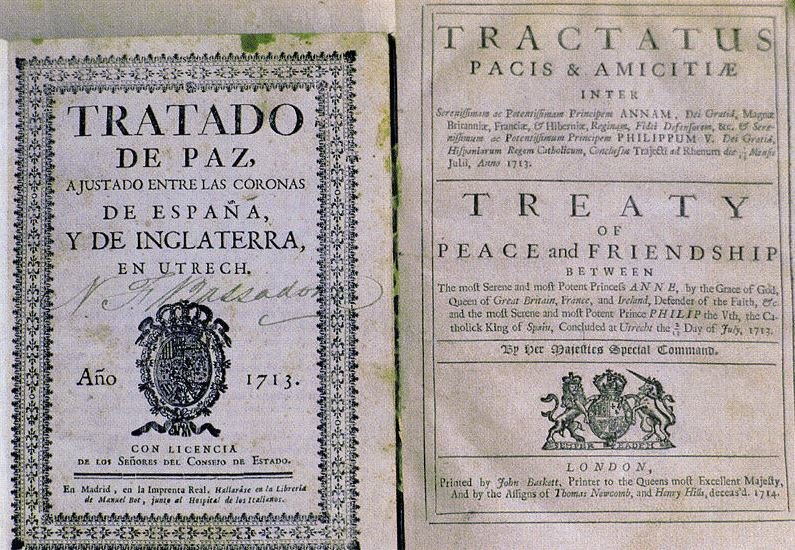
Queen Anne’s War (1702–1713) was the North American theater of the War of the Spanish Succession, where French, Spanish, and English colonists fought for control of territories, with each side allied with various Indigenous communities. Image: An image of the Treaty of Utrecht between Britain and Spain.
What were the four main fronts of Queen Anne’s War?
The four main fronts were:
- Spanish Florida versus English Carolina.
- English colonists against French settlers at Fort Louis de la Louisiane (near present-day Mobile, Alabama).
- New England, where English colonists and their Indigenous allies fought French colonists and the Wabanaki Confederacy.
- Newfoundland, where English settlers at St. John’s fought French settlers from Plaisance.
What was the impact of the southern theater of the war, particularly in Spanish Florida?
The southern theater resulted in the decimation of the Indigenous population in Spanish Florida and parts of southern Georgia. Many Spanish missions in Florida were also destroyed during the conflict.
What happened in New England during Queen Anne’s War?
In New England, English colonists and their Indigenous allies fought against French colonists and the Wabanaki Confederacy, especially in Acadia. The British captured the Acadian capital, Port Royal, in 1710, and French and Wabanaki forces conducted raids on Massachusetts Bay Province, including Deerfield (1704) and Groton (1707), taking captives for ransom or adoption.
What was the significance of the conflict in Newfoundland?
In Newfoundland, English colonists at St. John’s clashed with French settlers from Plaisance. The French briefly captured St. John’s in 1709, but the British quickly reoccupied it after the French withdrew. The conflict involved economically damaging raids on settlements.
How did French privateers contribute to the conflict?
French privateers based in Acadia and Plaisance captured many New England ships, with 102 prizes taken to Plaisance alone. The naval conflict contributed to the eventual British capture of Acadia (Nova Scotia).
What was the outcome of the Treaty of Utrecht in 1713?
The Treaty of Utrecht ended the war in 1713, with France ceding Hudson Bay, Acadia, and Newfoundland to Britain, while retaining Cape Breton Island and other islands in the Gulf of St. Lawrence. The treaty’s ambiguities and failure to address Indigenous concerns set the stage for future conflicts.





Excellent summary, thanks!