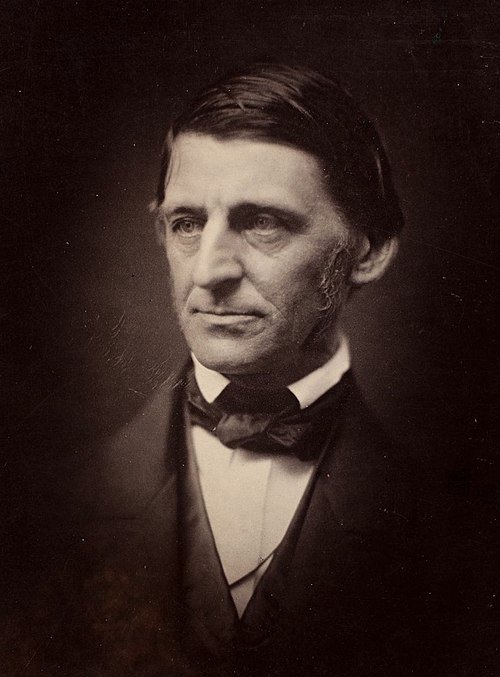
Ralph Waldo Emerson
Ralph Waldo Emerson (1803–1882) was an American essayist, philosopher, poet, and lecturer who led the Transcendentalist movement. He was known for his emphasis on individuality, self-reliance, and the interconnectedness of nature and the soul.
Early Life and Education
Ralph Waldo Emerson was born on May 25, 1803, in Boston, Massachusetts, to Ruth Haskins and William Emerson, a Unitarian minister. Emerson, named after his uncle Ralph and great-grandmother Rebecca Waldo, was the second of five sons. Tragically, three of his siblings died in childhood. Emerson’s father passed away when Ralph was just eight years old, leaving his mother to raise him. His aunt, Mary Moody Emerson, had a significant influence on his intellectual and emotional development. Her strong intellectual presence in his life, including a lifetime of correspondence, shaped Emerson’s thinking deeply.
Emerson’s formal education began at the Boston Latin School, followed by his entry into Harvard College in 1817. While at Harvard, Emerson showed a propensity for intellectual engagement, keeping journals and taking on various part-time jobs. He graduated in 1821 with mediocre academic performance, ranking in the middle of his class. However, his years at Harvard marked the beginning of his journey into literature and philosophy.
The Path to Transcendentalism
After graduating, Emerson briefly worked as a teacher before entering the Harvard Divinity School, where he trained to become a minister, following in the footsteps of his father. He was ordained in 1829 as the junior pastor of the Second Church in Boston. However, Emerson began to question the doctrines of the church, particularly after the death of his young wife, Ellen Louisa Tucker, who succumbed to tuberculosis in 1831. This loss triggered a deep personal crisis that led him to reconsider his faith and eventually resign from the ministry in 1832, as he felt that the church’s teachings no longer aligned with his personal beliefs.
Emerson’s philosophical development during this time led him to write his first significant essay, “Nature” (1836), where he articulated the core ideas of Transcendentalism—a philosophical movement that emphasized intuition, the inherent goodness of both people and nature, and the belief that society and its institutions corrupted the purity of the individual. He envisioned nature not only as a reflection of the divine but also as a means of achieving spiritual and intellectual enlightenment.
The American Scholar and Early Influence
In 1837, Emerson delivered his famous “The American Scholar” speech, often described as America’s intellectual Declaration of Independence. In this lecture, Emerson called for an American intellectual revolution, urging the nation’s scholars to break free from European influences and develop a uniquely American literary and philosophical tradition. The speech was well received, and it solidified Emerson’s place as a central figure in American intellectual life.
The 1830s and 1840s were a fertile period for Emerson, as he continued to refine and expand his ideas. His essays, including “Self-Reliance,” “The Over-Soul,” and “Circles,” became landmarks of American thought. Emerson championed the concept of self-reliance, urging individuals to trust their inner voice and resist the pressures of society. He also explored the idea of the “Over-Soul,” a divine spirit that unites all human beings and nature, reflecting his pantheistic tendencies.
Transcendentalism and the Lyceum Movement
Emerson’s role in the development of the Transcendentalist movement grew stronger during the 1830s. He, along with other intellectuals such as Henry David Thoreau, Margaret Fuller, and George Ripley, formed the Transcendental Club in 1836, which aimed to promote their shared philosophical ideals. This club became a central meeting point for like-minded thinkers and writers, and it played a significant role in shaping the direction of American literature and philosophy.
Emerson also became a key figure in the Lyceum movement, a nationwide effort to provide public lectures on various topics. This movement enabled Emerson to reach a wider audience and solidify his status as one of the leading intellectuals of his time. His lectures, often expanded into essays, covered a wide range of subjects, from nature and self-reliance to the roles of the poet and the philosopher in society.
Ralph Waldo Emerson’s life and work were a profound testament to the power of individual thought and the capacity for personal and societal transformation.
The Philosophy of Emerson: Nature and Individualism
At the heart of Emerson’s philosophy was his belief in the power and sanctity of the individual. In his famous essay “Self-Reliance,” Emerson stressed the importance of nonconformity and independent thinking. He argued that each individual possessed the capacity for greatness, and that true fulfillment could only be achieved by trusting one’s intuition and embracing the unique vision of the self. His ideas resonated deeply with the growing individualistic ethos of America.
Emerson’s transcendental philosophy also emphasized the interconnectedness of all things, which he described as the “Over-Soul.” This concept posited that a divine presence pervades all aspects of existence, linking individuals, nature, and the cosmos. Emerson’s vision of nature was more philosophical than naturalistic; he saw nature as a language through which one could access the deeper truths of existence. His idea of “Nature” thus became a foundational text for the Transcendentalist movement, inspiring generations of thinkers and writers to explore the spiritual and philosophical dimensions of the natural world.
The American Poet and Influence on Literary Tradition
Emerson’s ideas on poetry and the role of the poet were central to his intellectual legacy. In his essay “The Poet,” Emerson argued that poets are uniquely capable of revealing the truths of the human condition, connecting the spiritual and material worlds. Poets, he believed, should not merely describe the world but should illuminate the deeper meaning and unity underlying all things. His vision of poetry was one that transcended mere aesthetics, seeing it as a vital expression of the individual’s connection to the divine.
Emerson’s influence on other writers, particularly Walt Whitman, was profound. Whitman, who considered Emerson his “master,” was inspired by Emerson’s call for a new, uniquely American literary voice. Whitman’s own revolutionary style in “Leaves of Grass” echoed Emerson’s ideas of self-reliance, individuality, and the transcendental connection between humanity and nature. The two writers shared a deep commitment to the idea that the American poet should forge a new path, free from European models.
The Role of Nature and the Civil War
Throughout his life, Emerson remained deeply engaged with the natural world, both as a subject of intellectual inquiry and as a source of spiritual solace. His connection to nature was not just philosophical but also personal. Emerson’s time in the wilderness, including his well-known “Philosophers’ Camp” in the Adirondack Mountains in 1858, was an embodiment of his belief in the transformative power of nature. It was during such moments of immersion in nature that he felt closest to the divine presence he described in his work.
In the 1850s and 1860s, Emerson became increasingly involved in the national conversation about slavery and the impending Civil War. Initially hesitant to speak out publicly, Emerson eventually became a staunch abolitionist, using his platform to denounce slavery and advocate for emancipation. He saw the conflict as an opportunity for national rebirth, both in terms of human rights and the realization of American ideals. His famous speech in 1851 condemning the Fugitive Slave Act, declaring that it was a law that “no man can obey, or abet the obeying, without loss of self-respect,” marked a turning point in his activism.
Emerson also played a significant role in shaping public opinion about the Civil War. He was a strong supporter of the Union, although his early hopes for the war focused on the moral regeneration of the nation rather than its political or military outcome. His 1862 visit to Washington, D.C., and his meeting with President Abraham Lincoln marked the beginning of a more nuanced understanding of Lincoln’s leadership, although Emerson remained critical of the president’s cautious approach to abolition.

Abraham Lincoln
What were the sociocultural effects of the American Civil War?
Later Life and Final Years
In the later years of his life, Emerson’s health began to decline. He struggled with memory problems and aphasia, which affected his ability to write and lecture. Despite these challenges, Emerson continued to be an influential figure in American intellectual life. His lectures and essays, such as “The Conduct of Life,” grappled with the pressing issues of the day, including the aftermath of the Civil War and the continued challenges of racial injustice.
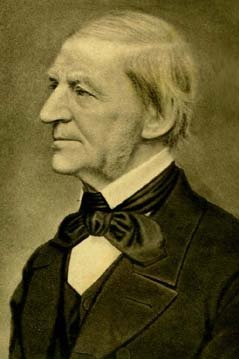
Emerson (in his later years)
Emerson’s final years were marked by a series of personal losses, including the deaths of his close friends Henry David Thoreau and Nathaniel Hawthorne. These losses, coupled with his declining health, led to a retreat from public life. Nevertheless, Emerson’s influence continued to be felt through his writings and his legacy as a champion of individualism, transcendental thought, and moral progress.
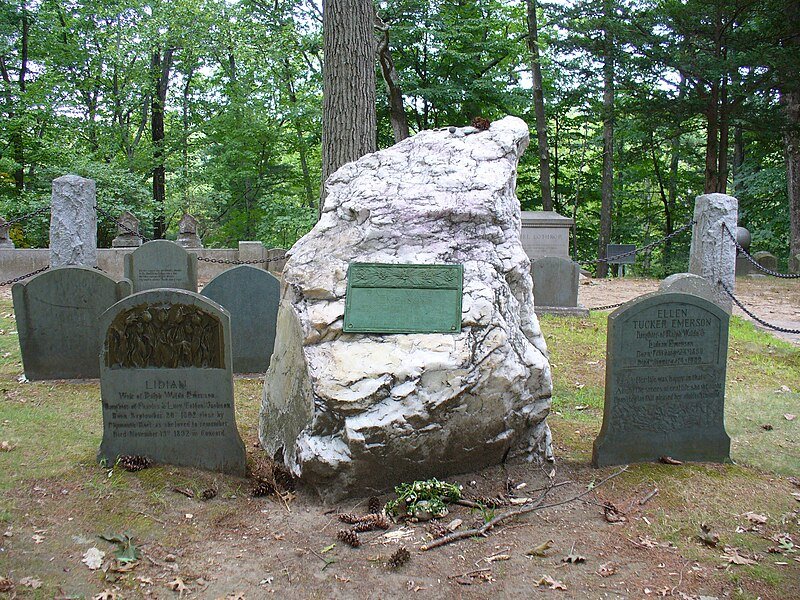
Emerson’s final resting place (Sleepy Hollow Cemetery, Concord, Massachusetts)
Legacy and Influence
Emerson’s legacy endures in the continued relevance of his ideas, particularly in the realms of philosophy, literature, and social thought. His emphasis on individualism, self-reliance, and the interconnectedness of all things remains foundational to American thought. His work inspired generations of thinkers, including Walt Whitman, Henry David Thoreau, and Friedrich Nietzsche, who hailed Emerson as “the most gifted of the Americans.”
Today, Emerson is considered one of the most important figures in the American intellectual tradition. His ideas on nature, spirituality, and the role of the individual in society continue to shape discussions on personal freedom, democracy, and the human connection to the natural world.
Timeline of Ralph Waldo Emerson
1803: Ralph Waldo Emerson is born in Boston, Massachusetts.
1821: Emerson graduates from Harvard College.
1829: He is ordained as a minister at the Second Church in Boston.
1831: Emerson’s wife, Ellen Louisa Tucker, dies, prompting his spiritual crisis.
1832: Resigns from the ministry due to disagreements with church doctrines.
1836: Publishes “Nature,” outlining the philosophy of Transcendentalism.
1837: Delivers “The American Scholar,” an influential speech in American intellectual history.
1841: Publishes “Essays: First Series,” including the famous “Self-Reliance.”
1844: Publishes “Essays: Second Series.”
1861-1865: Actively supports abolition during the American Civil War.
1871: Health begins to decline, affecting his writing.
1882: Emerson dies on April 27th, leaving a lasting legacy in American philosophy and literature.
Frequently Asked Questions
What is Transcendentalism, and how did Emerson contribute to it?
Transcendentalism was a philosophical movement that emphasized intuition, the inherent goodness of people and nature, and individual spiritual experiences. Emerson’s 1836 essay “Nature” and his later essays like “Self-Reliance” were foundational texts for the movement, promoting a break from traditional religious institutions and societal norms.
What was Emerson’s influence on American intellectual thought?
Emerson inspired a new generation of thinkers and writers, including Walt Whitman and Henry David Thoreau. He advocated for an American literary voice independent of European influences and was regarded as a leader in the intellectual development of the United States.
What were the central themes in Emerson’s essays?
Emerson’s essays focused on individualism, self-reliance, the relationship between the soul and nature, and the idea of the “Over-Soul,” a universal spirit connecting all beings. He championed nonconformity and the idea that individuals could achieve spiritual and intellectual enlightenment through intuition and personal experience.
How did Emerson’s religious beliefs evolve?
Initially a Unitarian minister, Emerson’s personal beliefs evolved away from organized religion, particularly after the death of his wife. He became critical of traditional church doctrines and eventually resigned from the ministry in 1832, embracing a more personal, spiritual connection to the divine, influenced by Transcendentalism.
What role did Emerson play in the abolitionist movement?
Although initially hesitant to speak out, Emerson became a strong abolitionist by the 1840s. He delivered speeches condemning slavery and supported the emancipation of slaves, viewing the Civil War as an opportunity for national moral regeneration.
What was Emerson’s relationship with Henry David Thoreau?
Emerson mentored and befriended Henry David Thoreau, another key figure in the Transcendentalist movement. Thoreau’s work, particularly “Walden,” was influenced by Emerson’s teachings on nature, self-reliance, and individualism.
What is Emerson’s legacy today?
Emerson’s ideas continue to influence American culture, literature, and philosophy. His advocacy for individualism, the divine in nature, and nonconformity left a lasting impact on American intellectual thought, and his works remain central in the study of American literature and philosophy.





