What were the sociocultural effects of the American Civil War?
The American Civil War (1861–1865) was a monumental event in the history of the United States that had profound sociocultural effects on the nation. These effects reverberated across all aspects of American society, shaping the national identity, redefining race relations, altering gender roles, and changing the landscape of culture, politics, and economics. As the war unfolded and eventually ended with the Union’s victory, the abolition of slavery, and the preservation of the United States, it became clear that its impact would extend far beyond the battlefield.
Below, World History Edu delves into some of the major sociocultural effects of the American Civil War:
Transformation of National Identity
One of the most significant sociocultural effects of the Civil War was its impact on the national identity of the United States. Before the war, the country was often referred to as a collection of states, with the phrase “The United States are” commonly used to emphasize the nation’s loose federation of individual states. After the Civil War, however, the country came to be viewed as a unified entity, with the phrase “The United States is” becoming more widely accepted. The war had solidified the concept of the U.S. as a single, indivisible nation rather than a collection of semi-autonomous regions.
The triumph of the Union also reinforced the idea of democracy and republicanism as central tenets of the American national identity. President Abraham Lincoln‘s famous Gettysburg Address, in which he described the war as a test of whether a nation “conceived in Liberty, and dedicated to the proposition that all men are created equal” could survive, underscored the idea that the United States was a beacon of democratic ideals.

Image: Abraham Lincoln
However, this newly unified national identity did not mean the country was free from division. The cultural and regional tensions between the North and the South would persist for many years, with the South in particular holding onto a sense of separate identity rooted in its Confederate past. This division would shape political, economic, and cultural relations between the two regions for generations to come.

Abolition of Slavery and Changes in Race Relations
The most direct and dramatic sociocultural effect of the Civil War was the abolition of slavery, an institution that had shaped American society for centuries. The Emancipation Proclamation, issued by President Lincoln in 1863, declared freedom for slaves in Confederate-held territories. The subsequent passage of the 13th Amendment to the U.S. Constitution in December 1865 formally abolished slavery nationwide, bringing an end to the institution that had fueled the South’s economy and caused deep divisions between North and South.
For African Americans, the end of slavery represented a monumental change, but it was far from the end of their struggles. While legally free, formerly enslaved people faced enormous challenges in integrating into American society as free citizens. The post-war Reconstruction era (1865–1877) was marked by significant political efforts to grant African Americans civil rights, including the passage of the 14th and 15th Amendments, which granted citizenship and voting rights to all men, regardless of race.
Despite these legal advancements, African Americans continued to face widespread racism, discrimination, and violence, especially in the South. White Southerners, resentful of their defeat and the dismantling of slavery, implemented restrictive Black Codes that sought to limit the rights and freedoms of African Americans. These codes were precursors to the Jim Crow laws that would enforce racial segregation and disenfranchise Black Americans in the South for nearly a century after the war.
Culturally, the Civil War and its aftermath also led to the formation of new African American identities and communities. Freed people established their own churches, schools, and social institutions, laying the foundation for Black communities that would play a critical role in the fight for civil rights in the 20th century. The war also gave rise to Black political leaders, educators, and intellectuals who began to advocate for equal rights and opportunities in the post-war period.
8 Ulysses S. Grant Presidential Achievements You Need To Know
Women’s Roles and Gender Relations
The American Civil War had a profound impact on women’s roles in society, both during and after the conflict. As men went off to fight, women in both the North and the South were forced to take on new responsibilities, managing households, farms, and businesses in the absence of their husbands, fathers, and brothers. Many women also became involved in the war effort directly, serving as nurses, spies, and even, in some cases, soldiers disguised as men.
One of the most notable figures in women’s involvement during the war was Clara Barton, who served as a nurse on the battlefield and later founded the American Red Cross. Women like Barton helped to professionalize nursing as a career, and their contributions to the war effort demonstrated that women were capable of performing critical roles outside of traditional domestic spheres.
In the North, women were particularly active in organizing relief efforts for soldiers, raising funds, and providing supplies. These activities helped to lay the groundwork for the post-war women’s suffrage movement, as many women who had become politically active during the war turned their attention to the fight for voting rights. Leaders like Susan B. Anthony and Elizabeth Cady Stanton, who had long been advocating for women’s rights, gained new momentum for their cause in the years after the Civil War.
In the South, the war left many women in a state of deep mourning and financial insecurity. The loss of so many men, coupled with the destruction of property and the end of slavery, meant that Southern women had to find new ways to sustain themselves and their families. The image of the “Southern belle” persisted in Southern culture, but it was increasingly at odds with the harsh realities many women faced in the post-war South.
Reconstruction and Southern Identity
The period of Reconstruction following the Civil War was marked by intense political and social efforts to rebuild the South and integrate formerly enslaved people into American society. Reconstruction brought significant changes to Southern society, including the establishment of new state governments, the introduction of public education systems, and the promotion of civil rights for African Americans.
However, Reconstruction also deepened the cultural divide between the North and South. Many white Southerners viewed Reconstruction as an occupation and resented the presence of Northern officials and “carpetbaggers” (Northerners who moved to the South during Reconstruction) in their communities. The South’s economy, which had been devastated by the war, struggled to recover, and many Southerners blamed their economic woes on the federal government’s Reconstruction policies.
In response to the social and political changes brought about by Reconstruction, white Southerners developed the “Lost Cause” narrative, which romanticized the Confederacy and downplayed the role of slavery in causing the Civil War. The Lost Cause myth portrayed Confederate soldiers as noble heroes defending states’ rights, while painting the Reconstruction era as a period of Northern aggression and misrule. This narrative became deeply ingrained in Southern culture, shaping the region’s identity for decades and contributing to the resurgence of white supremacist groups like the Ku Klux Klan.
The Lost Cause also influenced how the Civil War was remembered in American history. Monuments to Confederate leaders were erected throughout the South in the late 19th and early 20th centuries, and Confederate imagery became a central part of Southern heritage. The Lost Cause myth persisted into the 20th century, and its legacy can still be seen in debates over Confederate monuments and symbols today.
Economic Shifts and Industrialization
The Civil War accelerated economic changes that had already been underway in the United States, particularly in the North. The Union’s victory and the end of slavery paved the way for the United States to become an industrial powerhouse. During the war, the Northern economy shifted toward manufacturing and industrial production to support the war effort. Factories produced weapons, ammunition, and supplies, and the demand for these goods helped to stimulate the growth of industry in the North.
The South, on the other hand, faced economic devastation. The war had destroyed much of the South’s infrastructure, and the abolition of slavery meant the loss of the labor force that had sustained the region’s agricultural economy. While the North continued to industrialize and grow economically in the decades after the war, the South remained largely rural and agrarian, struggling to recover from the war’s destruction.
The economic divide between North and South also had cultural implications. The rise of industrial capitalism in the North created new social classes, including a growing urban working class and a wealthy industrial elite. In contrast, the South remained dominated by the planter class and small-scale farmers, who continued to wield significant social and political power despite the region’s economic struggles.
Cultural Memory and Civil War Commemoration
The Civil War left an indelible mark on American cultural memory, influencing how the nation remembered and commemorated the conflict. In the years following the war, both the North and South developed distinct ways of honoring their dead and preserving the memory of the war.
In the North, the war was remembered as a victory for freedom and democracy, with particular emphasis on the abolition of slavery and the preservation of the Union. Monuments to Union soldiers and leaders were erected throughout Northern states, and Memorial Day was established as a national holiday to honor the soldiers who had died in the conflict.
In the South, however, the memory of the Civil War was shaped by the Lost Cause narrative. Confederate monuments, cemeteries, and memorials were established to honor the fallen soldiers of the Confederacy, and Southern communities developed elaborate rituals to commemorate the war. These commemorations often ignored the role of slavery in causing the war and instead focused on themes of Southern honor, sacrifice, and states’ rights.
The differing ways in which the North and South remembered the Civil War contributed to the ongoing cultural divide between the two regions. The Lost Cause narrative, in particular, helped to perpetuate myths about the Civil War and Reconstruction, shaping how future generations of Americans understood the conflict and its legacy.
The Civil Rights Movement and the Legacy of the Civil War
The Civil War’s sociocultural effects were not limited to the 19th century; they continued to shape American society well into the 20th century, particularly in the struggle for civil rights. The legal and social structures put in place during Reconstruction, including the 13th, 14th, and 15th Amendments, laid the foundation for the civil rights movement of the 1950s and 1960s.
African Americans continued to fight for equality and civil rights in the decades after the Civil War, despite the setbacks of Jim Crow laws and racial segregation. The memory of the Civil War, particularly its association with the fight for freedom and equality, played a significant role in the rhetoric of the civil rights movement. Leaders like Martin Luther King Jr. often invoked the legacy of the Civil War and Reconstruction to call for justice and equality for African Americans.

Image: A 1964 photograph of Martin Luther King Jr.
Conclusion
The sociocultural effects of the American Civil War were vast and far-reaching. The conflict fundamentally transformed the United States, abolishing slavery, redefining national identity, and reshaping race and gender relations. The war’s legacy continues to influence American society, culture, and politics, serving as a reminder of the enduring challenges of equality, justice, and reconciliation in a nation divided by its history.
Other Questions and Answers about the American Civil War
What was the primary cause of the American Civil War?
The American Civil War (1861–1865) was primarily caused by the issue of slavery. The Southern states seceded from the Union to preserve the institution of slavery, which they saw as essential to their economy and social structure.
What role did slavery play in the cultural and economic divide between the North and South?
In the South, slavery was integral to the agricultural economy, especially for large plantations producing cash crops like cotton and tobacco. The North, being more industrialized and urbanized, had less demand for slave labor and increasingly opposed the institution, particularly on moral and economic grounds. This division fueled tensions between the two regions.

How did the abolitionist movement gain momentum in the United States?
The abolitionist movement gained momentum in the 1830s, fueled by the Second Great Awakening religious movement and Britain’s 1833 abolition of slavery. The movement sought to end slavery in the U.S., and the establishment of the Underground Railroad helped runaway slaves escape to the North.
What were the key outcomes of the Compromise of 1850 and the Fugitive Slave Act?
The Compromise of 1850 allowed new territories gained from Mexico to remain free from slavery, while the Fugitive Slave Act strengthened the rights of Southern slaveowners. The act required Northern states to return runaway slaves to their owners, even if they had reached free states.
What was the significance of the Dred Scott decision in 1857?
The Dred Scott decision by the U.S. Supreme Court in 1857 ruled that enslaved people were not U.S. citizens and had no legal standing. This decision further deepened the divide between North and South, as it dashed hopes for a federal abolition of slavery.
Why did the Southern states secede after Abraham Lincoln’s election in 1860?
Southern states seceded after Abraham Lincoln’s election because he opposed the expansion of slavery. Lincoln’s victory demonstrated that the North, with its larger population, could elect a president without Southern support, threatening the South’s ability to protect slavery.
When and how did the American Civil War begin?
The Civil War began in April 1861 when Confederate forces fired on Fort Sumter in South Carolina, a Union fort. This marked the start of the armed conflict between the Union (North) and the Confederate States (South).

What was the impact of the Emancipation Proclamation?
Issued by President Lincoln after the Battle of Antietam in 1862, the Emancipation Proclamation declared all slaves in Confederate states to be free as of January 1, 1863. It shifted the war’s focus to the abolition of slavery, gave the Union a moral cause, and discouraged European nations from supporting the Confederacy.
How did the Civil War end, and what was Juneteenth?
The Civil War ended in 1865 with the defeat of the Confederacy. Juneteenth, celebrated on June 19, 1865, marks the day Union troops arrived in Texas to enforce the emancipation of the last enslaved people in the state. That December, the 13th Amendment to the U.S. Constitution formally abolished slavery nationwide.
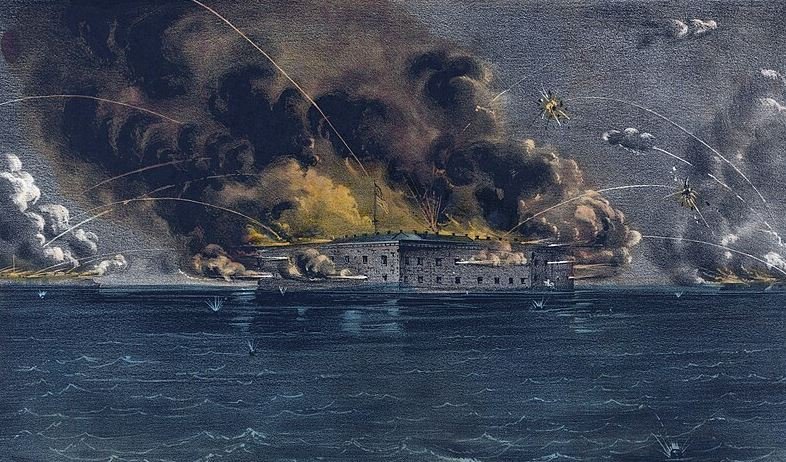
Image: An illustration of the attack on Fort Sumter.
What challenges did the U.S. face during Reconstruction?
During Reconstruction (1865–1877), the U.S. faced the challenge of rebuilding the South and integrating formerly enslaved people into society. The South resisted reforms, passing Black Codes to limit African Americans’ rights. Despite federal efforts, including the passage of the Reconstruction Amendments (13th, 14th, and 15th), Southern states eventually reasserted control, leading to the rise of Jim Crow laws.
How did the Ku Klux Klan and other groups impact Reconstruction?
The Ku Klux Klan (KKK) and other groups used violence and intimidation to maintain white supremacy and prevent African Americans from exercising their newly granted civil rights. These groups targeted African Americans and Republicans, weakening the gains made during Reconstruction.
What were the Reconstruction Amendments, and what was their significance?
The Reconstruction Amendments were the 13th, 14th, and 15th Amendments to the U.S. Constitution. The 13th abolished slavery, the 14th granted citizenship and equal protection under the law to all people born in the U.S., and the 15th guaranteed voting rights regardless of race. These amendments aimed to secure civil rights for African Americans, though enforcement was limited.
What was the Compromise of 1877, and how did it affect Reconstruction?
The Compromise of 1877 resulted in the election of Rutherford B. Hayes as president in exchange for the removal of federal troops from the South. This effectively ended Reconstruction, allowing Southern states to implement Jim Crow laws that enforced racial segregation and disenfranchised African Americans.
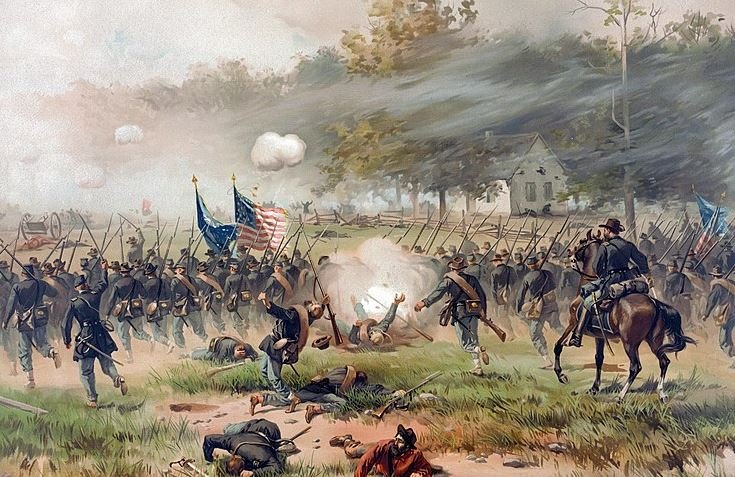
Image: A drawing portraying the Battle of Antietam.
How did the South maintain racial segregation after the end of Reconstruction?
After Reconstruction, Southern states enacted Jim Crow laws that enforced racial segregation in public facilities, schools, and other areas of life. Although slavery had been abolished, these laws denied African Americans many of the rights they had gained, maintaining white supremacy in the South.
What was the “Lost Cause” narrative, and how did it affect perceptions of the Civil War?
The “Lost Cause” narrative romanticized the Confederacy and reframed the Civil War as a struggle over states’ rights rather than slavery. This revisionist history downplayed the brutality of slavery and contributed to the South’s cultural identity, persisting until the Civil Rights Movement of the 1960s.





