Richard Arkwright – History, Inventions & Major Accomplishments
by World History Edu · July 30, 2024
Richard Arkwright was an influential figure in the early stages of the Industrial Revolution, particularly known for his role in the development of the textile industry. Born on December 23, 1732, in Preston, Lancashire, England, Arkwright’s contributions to industrial manufacturing processes, especially in spinning, were transformative and laid the groundwork for the factory system.

Richard Arkwright is credited with improving the carding machine, which combed cotton fibers to prepare them for spinning. In 1775, he patented a comprehensive series of machines designed to automate the entire cotton spinning process. These inventions collectively allowed for the mass production of textiles, reducing the cost and time required to produce fabric. Image: Sir Richard Arkwright, oil on canvas, by Mather Brown, 1790. New Britain Museum of American Art, Connecticut
Below, World History Edu explores his life, inventions, and major accomplishments:
Early Life and Background
Richard Arkwright was the youngest of thirteen children born to a humble family. His father, Thomas Arkwright, was a tailor, and his mother, Sarah Arkwright, was of equally modest means. Richard received little formal education, which was common for children of his social standing during that period. Despite these humble beginnings, Arkwright showed a keen interest in mechanical processes from an early age.
He initially trained as a barber and wig-maker, a trade that allowed him to save some money. During this time, he also engaged in various other ventures, including purchasing human hair to make wigs. His work in this trade introduced him to various kinds of people and perhaps spurred his interest in the mechanization of labor. Arkwright’s early business ventures were not highly successful, but they provided him with a foundational understanding of trade and commerce.
Inventions and Innovations
Arkwright’s most notable contribution to the Industrial Revolution was the development of the water frame, a spinning machine that could be powered by water. This invention was crucial because it significantly increased the efficiency and quality of textile production. Before Arkwright’s innovations, spinning was a labor-intensive process typically done by hand using spinning wheels. The spinning jenny, invented by James Hargreaves, was a step towards mechanization, but it still required manual operation and was limited in its output.
The Water Frame
Arkwright’s water frame, patented in 1769, was a significant advancement over existing spinning technologies. Unlike the spinning jenny, the water frame could spin stronger and finer yarn and required far less human labor. It used water power to drive the spinning process, which meant that it could operate continuously and at a much faster pace than manual labor. The machine used a series of rollers to draw out the cotton fibers, and a rotating spindle twisted them into yarn. This process produced a stronger and more consistent thread, which was essential for the production of high-quality textiles.
The water frame’s reliance on water power led to the establishment of mills near rivers and streams, which became centers of industrial activity. Arkwright’s development of the water frame not only revolutionized the textile industry but also contributed to the rise of factory-based production systems. This shift marked a departure from the traditional cottage industry model, where work was done at home, and set the stage for large-scale industrial manufacturing.
The Cotton Gin: History, Invention, Economic and Social Impact, and Other Major Facts
The Factory System
Arkwright’s establishment of the first successful water-powered cotton mill at Cromford in Derbyshire in 1771 marked the beginning of the factory system. This mill was one of the first instances where workers were brought together under one roof to work with machinery, laying the groundwork for the modern factory. Arkwright’s factory employed hundreds of workers and operated continuously, producing large quantities of yarn that could be woven into cloth.
The factory system introduced by Arkwright had several key features that distinguished it from earlier production methods. First, it centralized production, bringing together workers and machines in a single location. This centralization allowed for greater supervision and coordination, leading to more efficient production processes. Second, it introduced a division of labor, with different tasks assigned to different workers. This specialization improved efficiency and productivity, as workers became skilled in specific tasks. Finally, the factory system relied on mechanization and the use of non-human power sources, such as water or steam, to drive machinery.
Arkwright’s success at Cromford led to the establishment of similar mills across England and eventually the world. The factory system became the dominant model of industrial production, transforming economies and societies.
Major Accomplishments and Impact
Richard Arkwright’s innovations and business acumen had a profound impact on the Industrial Revolution and the development of modern industry. His contributions can be broadly categorized into technological advancements, business practices, and societal changes.
Technological Advancements
Arkwright’s inventions, particularly the water frame, were pivotal in the mechanization of textile production. His machines enabled the mass production of yarn, which was a crucial raw material for the textile industry. This mechanization greatly increased the scale and speed of production, making textiles more affordable and accessible. Arkwright also played a role in improving other aspects of textile manufacturing, such as carding and combing, which further enhanced the quality and efficiency of production.
In addition to his direct contributions to textile technology, Arkwright’s work inspired further innovations in machinery and industrial processes. His success demonstrated the potential of mechanization and the use of non-human power sources, encouraging other inventors and entrepreneurs to explore new technologies and business models.
Business Practices
Arkwright was not only an inventor but also a shrewd businessman. He understood the importance of controlling the entire production process, from raw materials to finished products. To this end, he established a network of mills and implemented strict quality control measures. He also sought to protect his inventions through patents, though this aspect of his career was marked by controversy.
Arkwright’s business practices, including his emphasis on efficiency and standardization, were influential in shaping the modern industrial enterprise. His approach to managing labor, machinery, and production processes set a precedent for future industrialists. Moreover, his success demonstrated the potential for significant profits in industrial manufacturing, attracting investment and talent to the burgeoning sector.
Societal Changes
The rise of the factory system, spearheaded by Arkwright, had profound social and economic implications. The concentration of workers in factories transformed labor relations and the structure of the workforce. Traditional artisans and cottage industry workers found themselves displaced by the new industrial order, leading to social tensions and resistance. However, the factory system also created new opportunities for employment, particularly for women and children, who made up a significant portion of the workforce in Arkwright’s mills.
The industrialization of textile production contributed to the growth of urban centers as people moved to factory towns in search of work. This urbanization brought about significant changes in living conditions, social structures, and public health. While the early factory towns often faced challenges such as overcrowding and poor sanitation, they also became hubs of economic activity and innovation.
Arkwright’s contributions to the Industrial Revolution also had a global impact. The efficient production of textiles helped make British cloth a major export, strengthening Britain’s economy and fostering trade relationships. The spread of industrial technology and practices beyond Britain laid the foundation for global industrialization and economic growth.
Controversies and Challenges
Despite his achievements, Richard Arkwright’s career was not without controversy. One of the major controversies centered around his patents. Arkwright was granted several patents for his inventions, including the water frame. However, many contemporaries and later historians questioned whether he was the true inventor of some of these technologies. There were claims that Arkwright had appropriated the ideas of others, particularly those of Thomas Highs and John Kay, who were also working on spinning technologies around the same time.
The controversy came to a head in a series of legal battles over the validity of Arkwright’s patents. In 1785, a court ruled against Arkwright, invalidating several of his patents on the grounds that they were not original. This ruling damaged his reputation and financial standing, though it did not entirely diminish his influence.
Another area of controversy was Arkwright’s treatment of workers. The factory system he pioneered often involved long hours and harsh working conditions, particularly for women and children. While such practices were not uncommon at the time, they later became a focus of social reform movements and criticism of industrial capitalism.
Legacy and Conclusion
Richard Arkwright died on August 3, 1792, but his legacy continued to shape the industrial world long after his death. He is often referred to as the “father of the factory system” for his role in developing and popularizing the mechanized factory model. His contributions to textile manufacturing were instrumental in the transition from manual labor to machine-driven production, a key aspect of the Industrial Revolution.
Arkwright’s innovations in machinery and business practices not only revolutionized the textile industry but also influenced the broader trajectory of industrialization. His emphasis on efficiency, standardization, and mechanization became defining characteristics of modern industry. Despite the controversies surrounding his patents and labor practices, Arkwright’s impact on the economy, technology, and society was profound and lasting.
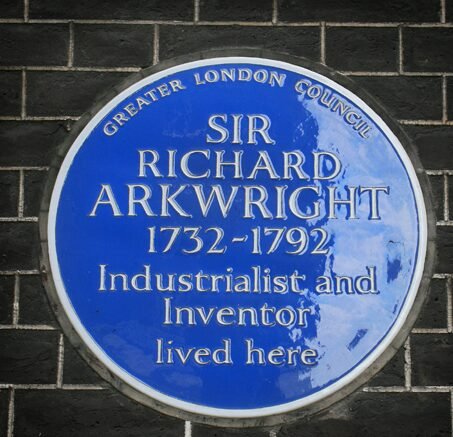
In recognition of his contributions, Arkwright was knighted in 1786 and served as the High Sheriff of Derbyshire. He continued to expand his business empire, building factories in various locations, including New Lanark, Manchester, and Matlock Bath. Image: Richard Arkwright’s Blue plaque in Adam Street, London.
Questions and Answers
While Richard Arkwright’s career was not without controversy, his contributions to industrial technology and practice were significant and far-reaching. Arkwright’s life and work exemplify the transformative potential of innovation and entrepreneurship, making him a key figure in the history of industrialization.
What significant invention is Sir Richard Arkwright credited with in the textile industry?
Sir Richard Arkwright is credited with inventing the spinning frame, a machine that could spin 128 threads simultaneously, and significantly improved the efficiency of textile production.
Where and when was Richard Arkwright born?
Richard Arkwright was born on December 23, 1732, in Preston, Lancashire, England.
What was Richard Arkwright’s early career before he became an inventor?
Richard Arkwright started his career as an apprentice to a barber and later became a wig maker.
How did Arkwright’s invention, the spinning frame, impact the textile industry?
The spinning frame allowed for the mass production of strong yarn suitable for warp threads, which greatly increased the efficiency and output of textile production.
What was the significance of the factory system established by Arkwright?
Arkwright established the first factory system that brought together a large workforce and powered machinery under one roof, paving the way for the modern factory system and the Industrial Revolution.
What was the primary power source used in Arkwright’s factories, and what machine did it power?
The primary power source used in Arkwright’s factories was water, which powered the spinning frame. He later incorporated the steam engine to enhance production.
Why was Richard Arkwright’s business practice controversial?
Arkwright’s business practices were controversial because he was accused of stealing ideas from others, paid unfair wages to his workers, and employed children as young as six years old in his factories.
What honor was bestowed upon Richard Arkwright in 1786?
Richard Arkwright was knighted in 1786 and also served as the High Sheriff of Derbyshire.
Who was his wife?
In 1755, Richard Arkwright married Patience Holt, and they had a son, Richard Junior. Patience died in 1756. In 1761, Arkwright married Margaret Biggins, with whom he had three children, though only Susannah survived to adulthood. After Patience’s death, Arkwright became interested in developing carding and spinning machinery to mechanize the conversion of raw cotton into thread.
When did Richard Arkwright die?
Richard Arkwright passed away on August 3, 1792, at the age of 59, leaving behind a substantial fortune estimated at more £500,000—a vast sum at the time.
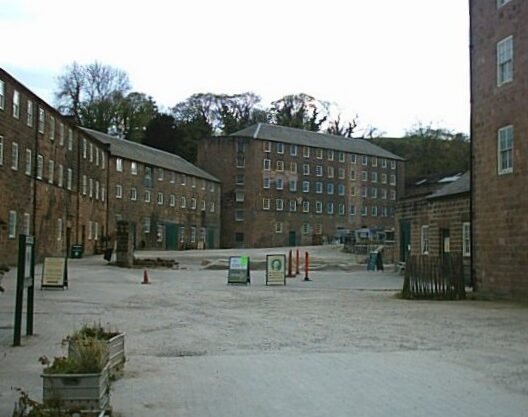
Richard Arkwright’s legacy extends far beyond the wealth he accumulated. He is often referred to as the “Father of the Factory System” for his role in developing the modern factory model. His innovations and business practices set the stage for the rapid industrialization that characterized the 19th century. Image: Richard Arkwright’s mill at Cromford
What legacy did Richard Arkwright leave behind in terms of educational support?
In 1984, a Greater London Council blue plaque was unveiled at 8 Adam Street, Charing Cross, London, to commemorate his achievements.
In 1991, the UK’s Arkwright Scholarships Trust was established to honor him and provide scholarships to deserving students studying engineering and technical design.
How did Arkwright contribute to the Industrial Revolution?
Arkwright’s innovations in textile machinery and the establishment of the factory system significantly contributed to the Industrial Revolution by enabling mass production and transforming the textile industry.





