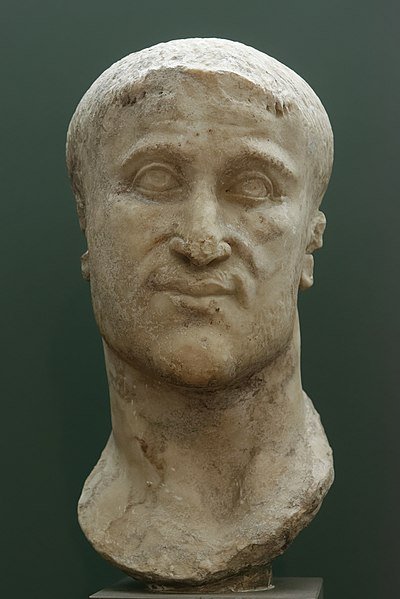
A portrait often linked to Constantius Chlorus, housed in the Ny Carlsberg Glyptotek, an art museum in Copenhagen.
Flavius Valerius Constantius (c. 250 – 25 July 306), commonly known as Constantius I Chlorus, was a Roman emperor who played a pivotal role in the formation of the Tetrarchy, a system of imperial rule initiated by Diocletian.
As Caesar from 293 to 305 and Augustus from 305 to 306, Constantius was instrumental in securing Roman frontiers, suppressing rebellions, and setting the stage for the rule of his son, Constantine the Great, the first Christian emperor of Rome. His nickname “Chlorus”, meaning “the Pale,” was popularized by later Byzantine historians but was not used during his lifetime.
Below, World History Edu explores Constantius’s origins, military accomplishments, administrative policies, and impact on Roman history.
Early Life and Career
Constantius was born on 31 March, though the exact year is debated, likely around 250 CE. His birthplace was Naissus (modern-day Niš, Serbia) in the province of Moesia Superior. His parentage is uncertain; some sources claim he was the son of Eutropius, a nobleman from Moesia, and Claudia, supposedly a niece of emperors Claudius Gothicus and Quintillus. However, modern historians suspect that this connection was a fabrication promoted by his son Constantine to enhance their dynasty’s legitimacy.
Constantius pursued a military career and served under Emperor Aurelian, participating in campaigns against the breakaway Palmyrene Empire. He rose through the ranks to become tribunus (a high-ranking officer) and later praeses (provincial governor) of Dalmatia under Emperor Carus. His loyalty to Diocletian was demonstrated during the civil wars that ended with the defeat of Carinus, the son of Carus, in 285 CE. By 288 CE, Constantius had become praetorian prefect in the West, aiding Maximian, who had been appointed Augustus by Diocletian.
Praetorian Guard: Origin Story, Formation, Influence, Assassination Plots, & Demise
Rise to Power and the Tetrarchy
In 293 CE, Diocletian, seeking to stabilize the empire, established the Tetrarchy, a system where the empire was divided among two senior rulers (Augusti) and two junior emperors (Caesares). Maximian selected Constantius as his Caesar, assigning him control over Gaul, Britain, and possibly Hispania. To solidify his alliance, Constantius divorced Helena, the mother of Constantine, and married Theodora, Maximian’s stepdaughter.
As Caesar, Constantius faced the challenge of defeating Carausius, a usurper who had declared himself emperor in Britain. In 293 CE, he recaptured Boulogne from Carausius’s forces, cutting off supplies from Britain. Following Carausius’s assassination by Allectus, Constantius launched an invasion of Britain in 296 CE, crushing Allectus’s forces and restoring Roman control.
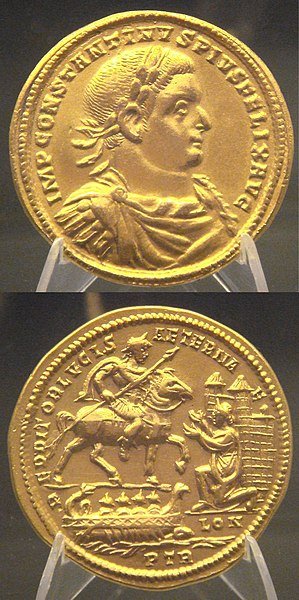
A replica of a medal depicting Constantius I capturing Londinium (inscribed as LON) after defeating Allectus. The original belonged to the Beaurains Treasure from Arras, France.
READ MORE: Difference between an Augustus and a Caesar
Military Campaigns and Governance
After reclaiming Britain, Constantius turned his attention to the Rhine frontier, where Germanic tribes threatened Roman provinces. He fought and defeated the Alamanni and Franks, securing the borders and repopulating devastated regions with settled Franks. He also fortified Hadrian’s Wall, reinforcing Roman dominance in Britain.
Emperor Constantius Chlorus’s military successes in Britain, Gaul, and along the Rhine frontier helped maintain imperial stability.
In 303 CE, Diocletian launched the Great Persecution against Christians. While his co-emperor Galerius pursued harsh measures, Constantius was relatively lenient. He ordered the demolition of churches but refrained from actively persecuting Christians. Some sources, particularly Christian writers like Eusebius, even suggest that he secretly sympathized with Christianity, although this remains speculative.
Accession as Augustus and Death
In 305 CE, Diocletian and Maximian abdicated, elevating Constantius and Galerius to the rank of Augustus. Constantius now ruled the Western Roman Empire, while Galerius controlled the East. However, a key disappointment for Constantius was the exclusion of his son, Constantine, from the line of succession. To secure Constantine’s safety, he requested his presence, leading to Constantine’s dramatic escape from Galerius’s court.
Constantius launched a campaign in Britain in 305–306 CE, leading an expedition against the Picts beyond the Antonine Wall. After a successful campaign, he retired to Eboracum (modern York, England), where he suddenly died on 25 July 306 CE. On his deathbed, he reportedly named Constantine as his successor, prompting the army to proclaim Constantine emperor, an event that would ultimately lead to the collapse of the Tetrarchy and a series of civil wars.
History of Roman Walls: What was their purpose and structure?
Did you know…?
Christian traditions, particularly those recorded by Eusebius and Lactantius, depict Constantius as sympathetic to Christianity. Later medieval legends mistakenly identified him with British figures, including King Coel and Saint Helena, portraying him as a British king who married Helena and fathered Constantine in Britain. These stories, though historically inaccurate, contributed to the medieval British claims of a Roman heritage.

Legacy and Impact
Constantius’s death sparked a power struggle. Although the official Tetrarchic system did not designate Constantine as emperor, his troops’ support allowed him to seize power, setting the stage for his eventual unification of the empire. Over the next two decades, Constantine defeated his rivals and established himself as the sole ruler, ultimately embracing Christianity and shaping the Roman Empire’s religious future.
Emperor Constantius Chlorus’s reluctance to harshly persecute Christians, though politically cautious rather than ideological, foreshadowed the pro-Christian policies of his son, Constantine the Great.
Constantius’s lineage, known as the Constantinian dynasty, ruled Rome until 363 CE, ending with the death of Julian the Apostate. His descendants played crucial roles in the transformation of the empire, with Constantine ushering in major political, military, and religious reforms.
Frequently asked questions
What was Constantius Chlorus’s role in the Tetrarchy?
Constantius was appointed as Caesar in 293 by Maximian, governing Gaul, Britain, and Hispania. His role was to maintain stability in the western provinces and support Maximian in military campaigns.
How did Constantius deal with the usurper Carausius?
He launched a military campaign against Carausius in Gaul, recapturing Boulogne in 293. After Carausius’s assassination, he invaded Britain in 296, defeating his successor, Allectus, and restoring Roman control.
What were Constantius’s key military successes?
He successfully repelled Germanic invasions, defeating the Alamanni and Franks along the Rhine frontier. His campaigns in Britain included a major victory over the Picts beyond the Antonine Wall.
What was his stance on the Diocletianic Persecution?
Unlike his eastern counterparts, Constantius limited his enforcement of the persecution, only ordering the demolition of churches without actively pursuing Christians.
How did Constantius die, and what was its impact?
He died on 25 July 306 in Eboracum (York) after a campaign in Britain. His death led to the army proclaiming his son, Constantine, as emperor, triggering the collapse of the Tetrarchy.
What was Constantius’s relationship with Constantine the Great?
Constantius was Constantine’s father but had to leave his mother, Helena, to marry Theodora for political reasons. His death allowed Constantine to claim power, eventually leading to the Christianization of the empire.
What was Constantius’s long-term legacy?
His military campaigns secured Roman borders, and his relatively lenient treatment of Christians foreshadowed Constantine’s later policies. His lineage, the Constantinian dynasty, ruled the empire until 363 CE.





