Empress Helena: The Mother of Constantine the Great
Empress Helena’s religious devotion, pivotal role in relic preservation, and patronage of Christian sites solidified her legacy as an instrumental figure in the establishment of Christian traditions.
Early Life and Origins
Flavia Julia Helena, often referred to as Saint Helena, was born around 246–248 AD. Though her exact birthplace remains a subject of debate, the city of Drepanum in Bithynia (renamed Helenopolis in her honor) is widely accepted. Other proposed locations include Naissus (modern Niš, Serbia), Edessa in Mesopotamia, and Trier in modern Germany.
While her name, Helena, was common throughout the Roman Empire, its Greek origins suggest she may have hailed from the eastern provinces. Helena’s social background was humble, as contemporary sources depict her as a stable-maid or innkeeper, a narrative that emphasizes her modest beginnings before her ascent to imperial prominence.

A sculpture of Helena displayed in the Musei Capitolini, located in Rome.
Marriage to Constantius and the Birth of Constantine
Helena entered a relationship with Constantius Chlorus, a Roman officer who later became Caesar. While the exact nature of their union—whether legal marriage or common-law partnership—is unclear, they had a son, Constantine, born in 272 AD in Naissus.
Around 289 AD, Constantius divorced Helena to marry Theodora, a move that aligned him with the ruling Tetrarchy. Helena lived in obscurity for a period, staying close to her son, who valued her deeply.
Constantine’s Rise and Helena’s Return to Prominence
After Constantine’s ascension as Augustus in 306 AD, Helena’s status transformed dramatically. Constantine brought her into the imperial court, granting her the title of Augusta in 312 AD. Her public role became significant, with depictions of her appearing in imperial imagery, such as the Eagle Cameo. She resided in Rome and renovated her palace, showcasing her elevated status within the empire.
Conversion to Christianity
Though the details of her conversion are debated, Helena embraced Christianity during Constantine’s reign. This marked a turning point for her role in history, as she became a fervent supporter of the faith, leveraging her influence to promote Christian practices and relics. Constantine’s appointment of Helena as Augusta provided her with access to imperial resources, enabling her to support significant religious endeavors.

A painting by Italian artist Lucas Cranach the Elder, entitled “Saint Helena with the Cross”
Pilgrimage to the Holy Land
In 326–328 AD, Helena embarked on a religious pilgrimage to Palestine and other parts of the Eastern Roman Empire. This journey was transformative for Christian traditions, as she sought to identify and preserve key sites associated with the life of Jesus. According to historical accounts, she was responsible for the construction or enhancement of major churches, such as the Church of the Nativity in Bethlehem and the Church of Eleona on the Mount of Olives.
Discovery of the True Cross
One of Helena’s most enduring legacies is her association with the discovery of the True Cross, believed to be the cross on which Jesus was crucified. According to later legends, Helena ordered the demolition of a Roman temple dedicated to Roman goddess Venus (Aphrodite in Greek mythology), built over the supposed site of Jesus’ tomb. During the excavation, three crosses were found, and a miraculous healing identified the True Cross. Constantine subsequently commissioned the construction of the Church of the Holy Sepulchre at the site.
Contributions to Relic Preservation
Helena’s efforts extended beyond the Holy Land. She brought numerous relics, including parts of the True Cross, back to Rome. These relics were housed in her palace chapel, now the Basilica of Santa Croce in Gerusalemme. She is also credited with founding monasteries, including Stavrovouni Monastery in Cyprus, where additional relics such as the Holy Rope and parts of the Holy Tunic are kept.
Later Life and Death
Helena spent her final years continuing her religious contributions. She returned to Rome around 327 AD, bringing with her relics and artifacts significant to Christian heritage. Helena died in 330 AD at approximately 80 years old, with Constantine at her side. She was buried in the Mausoleum of Helena on the Via Labicana in Rome. Her sarcophagus is now displayed in the Vatican Museums, while her relics have been distributed across various Christian sites.
Why did Roman Emperor Constantine the Great convert to Christianity?
Sainthood and Legacy
Helena was canonized pre-congregation and is venerated by the Catholic, Eastern Orthodox, Oriental Orthodox, Anglican, and Lutheran Churches. Her feast day varies by denomination, with the Orthodox Church commemorating her on May 21 alongside her son Constantine, and the Catholic Church observing her feast on August 18. She is regarded as the patron saint of archaeologists, converts, and difficult marriages.

A statue depicting Saint Helena situated in St. Peter’s Basilica in Rome, Italy.
Influence on Pilgrimage and Relic Traditions
Helena’s pilgrimage set a precedent for Christian devotion to holy sites. Her association with the discovery of the True Cross catalyzed a tradition of relic veneration that shaped medieval Christianity. Celebrations such as Meskel in Ethiopia commemorate her discovery with bonfires symbolizing her vision.
Cultural and Historical Impact
Helena’s life has inspired legends and literary works. In Britain, medieval folklore depicted her as a native princess, daughter of King Cole, a narrative reflected in numerous churches and sites dedicated to her. In modern times, her story has been fictionalized in works such as Evelyn Waugh’s Helena and Louis de Wohl’s The Living Wood.
Questions and Answers

Where was Saint Helena born?
Helena was likely born in Drepanum, Bithynia (later renamed Helenopolis in her honor). Other proposed birthplaces include Naissus, Trier, or Edessa, but her origins remain uncertain.
What was Saint Helena’s early life and status?
Helena came from humble origins, with some sources describing her as a stable-maid or innkeeper. Her early life contrasts with her later rise to imperial prominence through her son Constantine.
What role did Helena play in Constantine’s life?
Helena was deeply devoted to Constantine and supported his rise to power. After he became emperor, she was brought to the imperial court and granted the title of Augusta.
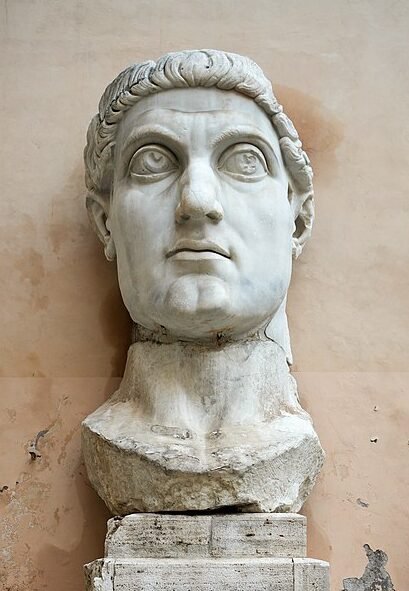
Head of the Colossus of Constantine at the Capitoline Museums in Rome, Italy.
What is Helena’s connection to the True Cross?
Helena is traditionally credited with discovering the True Cross during a pilgrimage to Jerusalem in 326–328 CE. She ordered excavations at Calvary and identified the cross through a miraculous healing.
What churches and relics are associated with Helena?
Helena funded and beautified several churches, including the Church of the Nativity in Bethlehem and the Church of the Holy Sepulchre in Jerusalem. She brought relics like the True Cross and Holy Nails back to Rome.
How is Saint Helena venerated today?
Helena is celebrated as a saint across various Christian traditions, with feast days on May 21 (Orthodox) and August 18 (Catholic). She is a patron of archaeologists, converts, and new discoveries.
What legends surround Saint Helena?
Medieval British folklore claims Helena was a British princess, the daughter of King Cole. Although historically unfounded, this legend inspired the dedication of numerous churches in her honor across England.





