Roman Emperor Valentinian III: Life, Reign, and Major Accomplishments
Valentinian III was the Western Roman Emperor from 425 to 455. His reign was one of the longest in the Western Empire but was dominated by internal power struggles and barbarian invasions.
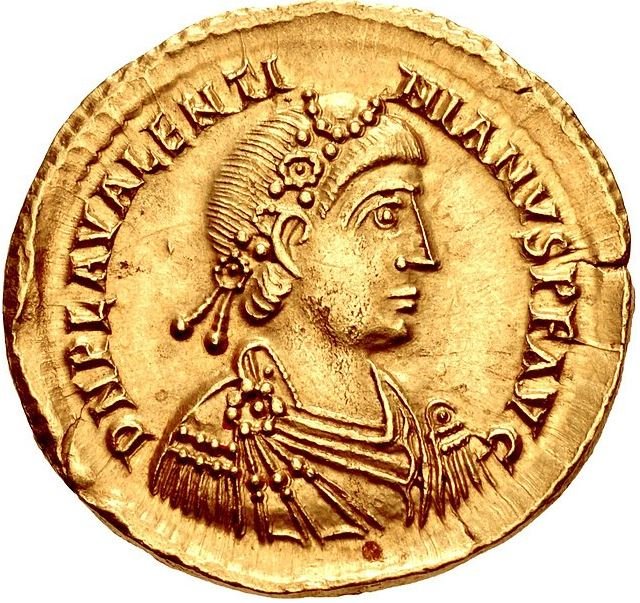
Golden coin of Valentinian III
Summary
His reign is often associated with the accelerating collapse of the Western Roman Empire. His inability to maintain control over his generals, combined with the territorial losses in North Africa, Hispania, and Gaul, significantly weakened imperial authority. His reliance on powerful figures like Aetius and Galla Placidia meant that he never exercised real independent control over the empire.
Complete List of Roman Emperors and their length of reign: From Augustus to Romulus Augustulus
Early Life and Family Background
Valentinian III was born on July 2, 419, in Ravenna, the capital of the Western Roman Empire. He was the only son of Galla Placidia and Constantius III, the latter briefly serving as emperor in 421. His lineage connected him to both the Valentinianic and Theodosian dynasties. Through his mother, he was a great-grandson of Valentinian I and a grandson of Theodosius I, ensuring his claim to the throne was deeply rooted in imperial tradition. His sister, Justa Grata Honoria, would later play a role in the political turmoil of his reign.
Following the death of his father in 421, Valentinian’s mother faced political hostility and fled with her children to Constantinople, where they were taken in by Emperor Theodosius II, Valentinian’s cousin. This period of exile played a crucial role in shaping the young prince’s early years and underscored the instability that would mark his later rule.

Rise to Power and Early Reign
In 423, Emperor Honorius died, leading to a power vacuum in the West. The primicerius notariorum Joannes seized power, but his rule was contested by the Eastern Roman court. To reinforce legitimacy, Theodosius II posthumously recognized Constantius III as augustus and elevated the young Valentinian to the rank of caesar in October 424. In 425, after Joannes was defeated by a joint Eastern-Western Roman campaign, Valentinian was officially installed as augustus in Rome.
Given his youth, Valentinian ruled under the regency of his mother, Galla Placidia. During this time, she appointed Felix as magister militum, hoping to stabilize the Western Roman Empire. Efforts were made to negotiate with the Huns, who had played a role in the previous power struggles. Valentinian’s betrothal to Licinia Eudoxia, the daughter of Theodosius II, was arranged to strengthen ties between the Eastern and Western courts.
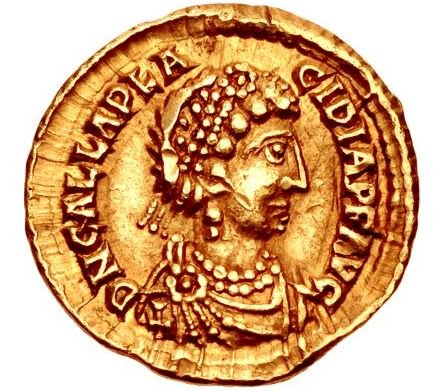
Gold coin of Galla Placidia.
Challenges and Military Conflicts
Valentinian’s early reign was fraught with internal power struggles among military leaders. A bitter rivalry developed between Felix, Aetius, and Bonifatius. In 427, Bonifatius was accused of treason and refused to return to Italy, eventually allying with the Vandals in North Africa. This decision contributed to the eventual loss of the region, as the Vandals solidified their control over key provinces, including Carthage.
Meanwhile, Aetius, a skilled general, sought power through an alliance with the Huns. By 434, he had secured his dominance in the Western Empire, effectively controlling military and political affairs. His influence grew as he repelled invasions from various Germanic tribes, including the Visigoths and Franks.
The Vandal Threat and the Loss of North Africa
One of the most devastating events of Valentinian’s reign was the fall of Carthage to the Vandals in 439. This loss was a significant blow to the empire, as Africa was a major source of grain and revenue. Aetius attempted to organize a response, but due to military constraints, he was forced to accept a treaty that acknowledged the Vandals’ territorial gains. The Vandals continued their expansion, raiding islands such as Sardinia and Corsica and disrupting Rome’s food supply.
To manage this crisis, Valentinian agreed to a diplomatic marriage between his daughter Eudocia and Huneric, son of the Vandal king Gaiseric. However, the plan failed when it was revealed that Huneric was already married, leading to continued hostilities.
The Hunnic Invasions and Attila’s Threat
During the 440s, Valentinian and Aetius faced a new threat from Attila the Hun. Initially, Attila focused on the Eastern Roman Empire, but by 450, he turned his attention to the West, partly due to a controversial message from Valentinian’s sister, Honoria, offering herself in marriage to Attila in exchange for assistance against an unwanted political union.
In 451, Attila invaded Gaul, capturing cities and posing a severe threat to Roman control. Aetius organized a coalition of Romans, Visigoths, and other Germanic allies, leading to the decisive Battle of the Catalaunian Plains. Although Attila was forced to retreat, he remained a formidable adversary. In 452, he launched an invasion of Italy, sacking Aquileia and advancing southward. Unable to stop him militarily, Valentinian sent Pope Leo I to negotiate. Attila ultimately withdrew, possibly due to disease, supply shortages, and pressure from the Eastern Roman Empire.

Relief Possibly Depicting Aetius, Though Also Attributed to Stilicho (d. 408 AD), Dating Between 387–390 AD.
The Fall of Aetius and Valentinian’s Assassination
Despite his military successes, Aetius’ growing power made him a target of suspicion. Valentinian, influenced by his chamberlain Heraclius and the senator Petronius Maximus, decided to eliminate his top general. In 454, during a court meeting, Valentinian personally assassinated Aetius, an act that shocked many contemporaries. One of his advisors reportedly told him, “You have cut off your right hand with your left.”
A year later, Valentinian met a similar fate. On March 16, 455, he was assassinated by two Scythian bodyguards of Aetius, likely acting under orders from Petronius Maximus. This assassination marked the end of the Valentinianic dynasty. Shortly after, Maximus declared himself emperor, but he failed to secure the loyalty of the army or the people. Within weeks, Rome was sacked by the Vandals, a direct consequence of the power vacuum left by Valentinian’s death.

FAQs about Valentinian III
What was Valentinian III’s dynastic background?
Valentinian III was the son of Galla Placidia and Constantius III, making him a member of both the Valentinianic and Theodosian dynasties. His wife, Licinia Eudoxia, was also from the Theodosian dynasty.

Bust of Valentinian III at the Louvre in France.
How did Valentinian III come to power?
Following the death of Emperor Honorius in 423, Theodosius II, the Eastern Roman Emperor, recognized Valentinian as caesar in 424 and later as augustus in 425 after defeating the usurper Joannes.
What role did Aetius play during Valentinian III’s reign?
Flavius Aetius was the dominant general of Valentinian’s reign, leading Roman forces against the Visigoths, Franks, and Huns, notably defeating Attila at the Battle of the Catalaunian Plains in 451.

How did Valentinian III handle the threat of Attila the Hun?
Attila invaded Gaul and later Italy, but his advance was stopped through military resistance, diplomacy, and intervention by Pope Leo I, which led him to withdraw from Italy in 452.
Why did Valentinian III assassinate Aetius?
Valentinian, influenced by advisors, feared Aetius’s growing power and personally killed him in 454. This act destabilized the empire and led to his own assassination.

How did Valentinian III die?
He was assassinated in 455 by two followers of Aetius, likely instigated by Petronius Maximus, who then seized power. His death marked the rapid decline of the Western Roman Empire.

Coinage of Petronius Maximus
What was Valentinian III’s legacy?
His reign saw the loss of significant Roman territories, including North Africa to the Vandals. He is often remembered as a weak ruler whose empire crumbled under internal and external pressures.





