
1st-century BC marble bust, commonly referred to as the “Marius.”
Gaius Marius (c. 157 BC – 86 BC) was a transformative Roman general and statesman, remembered for his military prowess and unprecedented seven consulships. Rising from humble origins in Arpinum, he reshaped Roman politics and military organization, playing a pivotal role in Rome’s transition from Republic to Empire. His victories in the Jugurthine and Cimbric Wars earned him enduring fame, but his later years were marked by political strife, civil conflict, and the seeds of Rome’s ultimate decline.
Early Life and Origins
Born in the small village of Cereatae near Arpinum, Marius’s family belonged to the equestrian class, holding local significance but lacking influence in Rome. Contrary to later claims of humble origins, his family’s wealth likely derived from extensive landholdings, enabling Marius to pursue a public career. Early setbacks, such as difficulties in gaining office, underscored the challenges faced by a “novus homo” (new man) in Roman society.
Military Beginnings
Marius’s military career began under Scipio Aemilianus during the Siege of Numantia in 134 BC. His leadership abilities quickly garnered attention, with Scipio reputedly identifying him as a future leader. Rising through the ranks, Marius’s early service established his reputation as a capable soldier and ambitious leader.
Political Ascension
Elected tribune of the plebs in 119 BC, Marius passed reforms limiting aristocratic interference in elections, signaling his populist leanings. As praetor in 115 BC, he governed Hispania Ulterior, engaging in minor campaigns against bandits. His marriage to Julia of the patrician Julii family solidified his social standing, linking him to future luminaries like Julius Caesar.
Jugurthine War and First Consulship
In 107 BC, Marius achieved his first consulship, leveraging dissatisfaction with aristocratic generals in the Jugurthine War. Taking command in Numidia, he reformed recruitment practices, drawing from the capite censi (property-less citizens), and secured victory by capturing Jugurtha. His triumph marked the beginning of his dominance in Roman politics.
Cimbrian War and Consecutive Consulships
Faced with the existential threat of the Cimbri and Teutones, Marius was repeatedly elected consul from 104 to 100 BC. He decisively defeated the Teutones at Aquae Sextiae (102 BC) and the Cimbri at Vercellae (101 BC), securing Rome’s safety. His success cemented his status as Rome’s savior, but his extended tenure also disrupted traditional norms of office-holding.
The Marian Reforms
Marius is traditionally credited with reforms that professionalized the Roman army, though modern historians challenge the scope of these changes. He recruited soldiers from the landless poor, reorganized the legion into cohorts, and standardized equipment and training. These reforms increased military efficiency but also tied soldiers’ loyalties directly to their generals, sowing seeds of civil strife.
Later Political Challenges
Marius’s sixth consulship in 100 BC coincided with turbulent reforms led by the tribune Saturninus. Supporting land grants for his veterans, Marius distanced himself from Saturninus’s radicalism when violence erupted. The resulting senatus consultum ultimum (emergency decree) authorized the use of force against Saturninus, tarnishing Marius’s reputation among the plebeians.

The Social War
From 91 to 87 BC, Rome faced the Social War, a revolt by Italian allies seeking citizenship. Marius commanded Roman forces with mixed success, overshadowed by younger generals like Sulla. The war’s resolution through the lex Julia granted citizenship to Italians, but it exposed Rome’s weakening central authority and foreshadowed further conflict.
Conflict with Sulla
The rivalry between Marius and Sulla escalated over the command against Mithridates VI of Pontus. After political maneuvers transferred the command from Sulla to Marius, Sulla responded by marching on Rome—a shocking breach of tradition. Marius fled to Africa, marking a dramatic fall from grace.
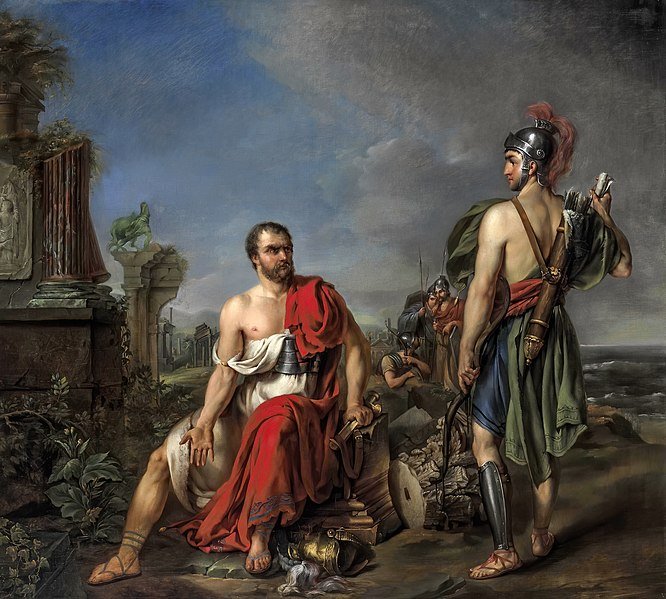
Gaius Marius in exile, seated amidst the ruins of Carthage, as depicted by Joseph Kremer.
Return to Power
In 87 BC, during Sulla’s absence, Marius returned to Rome, allied with Cinna, and seized power through violence. A reign of terror ensued, targeting Sulla’s allies. Marius declared himself consul for the seventh time in 86 BC, but he died weeks later, leaving a legacy of ambition and brutality.

Frequently Asked Questions
What was Marius’s early life and rise to power?
Born to a locally influential family in Arpinum, he gained military experience under Scipio Aemilianus at Numantia. Rising as tribune and praetor, he achieved fame in Spain and through marriage to Julia, Julius Caesar’s aunt.
What were Marius’s key military achievements?
He ended the Jugurthine War (107 BC), defeated the Teutones at Aquae Sextiae (102 BC), and crushed the Cimbri at Vercellae (101 BC), protecting Rome from external threats.
What were the Marian reforms?
Attributed reforms included transitioning from militia to professional soldiers and standardizing equipment like the pilum. Modern scholars question the extent of these reforms’ long-term impact.
Why is Marius significant in Roman political history?
He broke traditional barriers by being a novus homo (new man) in Roman politics, using popular support to bypass senatorial authority and secure commands.
What was Marius’s role in the Social War (91–88 BC)?
As a commander, he had limited success against Rome’s Italian allies. The conflict rekindled his political ambitions, leading to a rivalry with Sulla.
Why did Marius clash with Sulla?
He sought command of the Mithridatic War, bypassing Sulla, who responded by marching on Rome, initiating Rome’s first civil war.
What led to Marius’s downfall and death?
After seizing Rome with Cinna in 87 BC, he initiated purges. Elected consul for a seventh time in 86 BC, he died shortly after, leaving a legacy of political turmoil and the erosion of Republican norms.





