Rumi: Life, Major Works, & Accomplishments of the Islamic Scholar and Sufi Mystic
Jalāl al-Dīn Muḥammad Rūmī, widely known as Rumi, was a 13th-century Persian poet, Islamic scholar, Hanafi jurist, theologian, and Sufi mystic. His works, primarily written in Persian, have had a profound impact on literature and spirituality across many cultures and languages.
Below, WHE explores Rumi’s life, his major works, teachings, and his lasting legacy.
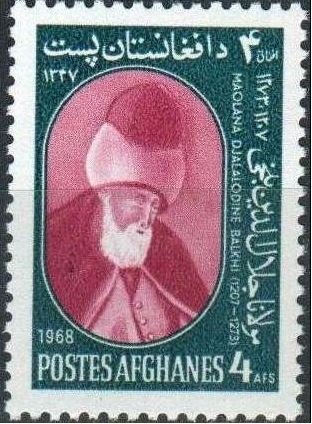
A 1968 Afgan stamp featuring Rumi
Early Life and Background
Rumi was born on 30 September 1207 in Balkh (present-day Afghanistan) or Wakhsh (present-day Tajikistan) in Greater Khorasan, a cultural and intellectual hub of the time. His father, Bahā’ uddīn Walad, was a prominent theologian, jurist, and preacher. The family was forced to flee from their homeland due to the Mongol invasions between 1215 and 1220. They traveled through Nishapur, where Rumi met the renowned Persian poet Attar, who recognized his spiritual potential. The family then moved through Baghdad, Hejaz, Damascus, and Anatolia before settling in Konya (in present-day Turkiye), part of the Seljuk Sultanate of Rum.
Education and Early Career
Following the death of his father in 1231, Rumi inherited his position as the head of a madrassa in Konya. Under the mentorship of Sayyed Burhan ud-Din Muhaqqiq Termazi, he deepened his knowledge of Islamic law, theology, and Sufism. Over the years, Rumi became a respected Islamic scholar, issuing fatwas and giving sermons. However, his encounter with the wandering dervish Shams-e Tabrizi in 1244 drastically altered his spiritual and intellectual life.
Encounter with Shams-e Tabrizi
Shams-e Tabrizi played a pivotal role in Rumi’s transformation. Their intense spiritual connection led Rumi away from orthodox scholarship and toward a deep mystical path. Shams mysteriously disappeared in 1248, leaving Rumi heartbroken. His grief gave birth to a prolific period of poetic expression, captured in the “Dīwān-e Shams-e Tabrīzī.”

Bust of Shams-e Tabrizi in the Iranian city of Khoy.
Major Works
Masnavi-ye Ma’navi
Often referred to as the “Quran in Persian,” the Masnavi is Rumi’s magnum opus. Comprising six volumes, it contains over 26,000 rhyming couplets that explore themes of divine love, unity, and spiritual awakening. The Masnavi combines fables, allegories, and moral teachings inspired by Islamic traditions.
Dīwān-e Shams-e Tabrīzī
A collection of over 34,000 Persian couplets, interspersed with Arabic, Turkish, and Greek verses, this work reflects Rumi’s intense devotion to Shams and his exploration of divine love. It remains one of the most celebrated lyrical works in Persian literature.
Rumi’s poetry transcends time and place, offering insights into the human soul’s journey toward unity and enlightenment.
Prose Works
Rumi also produced several prose works, including:
- Fihi Ma Fihi (In It What’s in It): A compilation of discourses and reflections on spiritual matters.
- Majāles-e Sab’a (Seven Sessions): A collection of sermons interpreting the Quran.
- Makatib (The Letters): Correspondences that reveal Rumi’s administrative, social, and spiritual concerns.
Philosophy and Teachings

A depiction of Rumi by Hossein Behzad, an Iranian painter.
Rumi’s philosophy centers on divine love, unity, and the journey of the soul toward God. His teachings emphasize:
- Tawhid (Oneness of God): Rumi saw all religious traditions as manifestations of a single divine truth.
- Love as a Spiritual Path: He believed that love, expressed through poetry, music, and dance, is the means to reach God.
- Sama (Whirling Dance): Rumi’s practice of ecstatic dance led to the formation of the Mevlevi Order (Whirling Dervishes), symbolizing spiritual ascent.
- Transcendence Beyond Dogma: While rooted in Islamic tradition, his messages extend beyond sectarian divides.
The Mevlevi Order, also known as the Whirling Dervishes, was founded by Rumi’s followers after his death and is known for its ritual dance (Sama).
Later Years and Death
Rumi continued to teach and compose poetry until his death on 17 December 1273 in Konya. His funeral was attended by people of diverse faiths, reflecting his universal appeal. He was buried beside his father, and his mausoleum, the “Green Tomb,” remains a significant pilgrimage site.
Legacy and Influence
Rumi’s poetry has profoundly influenced Persian, Turkish, Urdu, Pashto, and Bengali literature. His works have been translated into numerous languages, making him one of the most widely read poets worldwide.
The Mevlevi Order, established by Rumi’s followers, continues to practice his teachings. His ideas on love and unity resonate across cultures and religions, making him a bridge between the East and the West.
In recent decades, Rumi has become one of the best-selling poets in the United States. His poems, translated by scholars like Coleman Barks, have found a global audience. UNESCO declared 2007 as “International Rumi Year” to commemorate his 800th birth anniversary.
Timeline of Jalāl al-Dīn Muḥammad Rūmī
- 1207 – Born in Balkh (modern-day Afghanistan or Tajikistan) into a family of scholars.
- 1212 – Family moves to Samarkand due to political instability.
- 1215-1220 – Mongol invasion prompts the family’s migration westward.
- 1225 – Marries Gowhar Khatun in Karaman; has two sons, Sultan Walad and Ala-eddin Chalabi.
- 1228 – Settles in Konya, Anatolia, under Seljuk rule.
- 1231 – Becomes head of the madrassa after his father’s death.
- 1240-1241 – Completes Sufi training under Burhan ud-Din.
- 1244 – Encounters Shams-e Tabrizi, transforming his spiritual journey.
- 1248 – Shams disappears, deeply affecting Rumi’s poetry.
- 1260s-1270s – Dictates the Masnavi to his student Hussam-e Chalabi.
- 1273 – Falls ill and passes away in Konya; his shrine becomes a pilgrimage site.
- 13th-14th century – Mevlevi Order founded by his followers, continuing his teachings.

An Ottoman-era manuscript portrays Rumi alongside Shams-e Tabrizi.
Frequently asked questions
What languages did Rumi write in?
Rumi primarily wrote in Persian but also used Arabic, Turkish, and Greek in some of his poetry.
What is Rumi’s most famous work?
His most famous work is the Masnavi (Mathnawi), a six-volume spiritual and mystical poem considered a masterpiece of Persian literature.
How did Rumi influence literature?
Rumi’s poetry significantly impacted Persian, Turkish, Pashto, Urdu, Bengali, and Kurdish literary traditions, influencing both classical and modern works.
What was Rumi’s relationship with Shams-e Tabrizi?
Shams-e Tabrizi was a wandering dervish who profoundly influenced Rumi, transforming him from a scholar into a passionate Sufi poet.

Where is Rumi buried?
Rumi is buried in Konya, Turkey, where his mausoleum, the Mevlâna Museum, remains a major pilgrimage site.
How does Rumi describe love?
Rumi saw love as the central force connecting humans with the divine, often symbolizing it through metaphors of longing, wine, and the beloved.
What role did music play in his teachings?
Rumi believed music and dance could lead to spiritual enlightenment, inspiring the musical traditions of the Mevlevi Order.
Why is he popular worldwide today?
Rumi’s poetry, emphasizing love, unity, and spirituality, has been widely translated and remains influential, making him one of the best-selling poets in the U.S.
Did he adhere to a specific religious school?
Yes, Rumi followed the Hanafi school of Islamic jurisprudence and the Maturidi theological tradition while embracing a universalist mystical perspective.
What is the significance of Rumi’s Masnavi?
The Masnavi is often called “the Quran in Persian” and is considered one of the greatest mystical and spiritual works in Islamic literature.
Top Scholars of the Islamic Golden Age and their Major Achievements





