Soviet occupation zone in Germany
The Soviet Occupation Zone in Germany (Sowjetische Besatzungszone, SBZ) was a pivotal region in the aftermath of World War II. Established under the terms of the Potsdam Agreement on August 2, 1945, this area was governed by the Soviet Union and laid the foundation for the establishment of the German Democratic Republic (GDR), commonly known as East Germany, on October 7, 1949.

A map highlighting the Soviet occupation zone (in red).
The Creation of the Occupation Zones
At the conclusion of World War II, the Allied powers divided Germany into four occupation zones, each administered by one of the victorious nations: the United States, the Soviet Union, the United Kingdom, and France. The SBZ encompassed the central and eastern parts of Germany, as determined by the Potsdam Agreement. This agreement also stipulated that the eastern territories beyond the Oder-Neisse line, equal in size to the SBZ, would be annexed by Poland, and its German population expelled. These measures aimed to redraw Germany’s borders and set the stage for a final peace settlement.
Soviet Administration and Political Changes
The Soviet Military Administration in Germany (SMAD) was responsible for governing the SBZ. Initially, the SMAD allowed the formation of four political parties: the Communist Party of Germany (KPD), the Social Democratic Party of Germany (SPD), the Christian Democratic Union (CDU), and the Liberal Democratic Party (LDP). However, these parties were compelled to collaborate under the “Democratic Bloc,” a precursor to the National Front.

The SBZ was one of the four Allied occupation zones created in 1945. The Soviets were assigned the central portion of Germany, while territories east of the Oder-Neisse line were annexed by Poland.
In April 1946, the SMAD orchestrated the forced merger of the SPD and KPD to form the Socialist Unity Party (SED). This new party became the dominant political force in the SBZ and later in the GDR. This consolidation of political power under the SED reflected the broader Soviet strategy of centralizing control and aligning the zone with communist ideology.
Geographical and Administrative Transformations
Initially, the Soviet occupation zone included large portions of Prussia. However, in 1947, the Allied powers dissolved Prussia as a political entity. The territory of the SBZ was subsequently divided into five German states (Länder): Brandenburg, Mecklenburg, Saxony, Saxony-Anhalt, and Thuringia.
In 1952, the GDR government dissolved the Länder structure, replacing it with 14 administrative districts (Bezirke) and the separate district of East Berlin. This restructuring further centralized authority, reflecting the Soviet and GDR preference for a streamlined, centralized administrative framework.

The Line of Contact and Territorial Adjustments
By the time the Allied forces converged at the end of World War II, portions of what would later become the SBZ were under British and American control. These areas were ceded to the Soviet Union by July 1945, in accordance with the agreed-upon boundaries of the occupation zones. This territorial adjustment ensured that the Soviet Union controlled the region outlined in the London Protocol of 1944.
Detention and Special Camps
The Soviet administration established ten “special camps” for the detention of Germans within the SBZ. These camps often utilized former Nazi concentration camp facilities. Their purpose was to detain individuals considered a threat to Soviet authority, including former Nazis, political dissidents, and others deemed counter-revolutionary. This practice reflected the Soviet strategy of consolidating control and addressing perceived internal threats within the zone.
The Road to the German Democratic Republic
The establishment of the German Democratic Republic in 1949 marked the culmination of Soviet efforts to solidify their control over the SBZ. The GDR was declared on October 7, 1949, with the SED firmly in control of the government. The GDR was positioned as a socialist state aligned with the Soviet Union, in contrast to the capitalist Federal Republic of Germany (FRG) established in the western zones.
The Cold War and the “Stalin Note”
By 1952, the Cold War rivalry between the Soviet Union and the Western powers was in full swing. In this context, Soviet leader Joseph Stalin proposed the “Stalin Note,” suggesting the possibility of a unified, neutral Germany. However, the Western Allies showed little interest in the proposal, viewing it as a tactic to weaken NATO and Western influence in Europe. This lack of engagement further entrenched the division of Germany, cementing the SBZ’s transformation into the GDR for the next four decades.

Joseph Stalin
West Germany’s View of the SBZ
In West Germany, the Soviet occupation zone was commonly referred to as the “Soviet Zone” or the “so-called GDR.” These terms underscored the West German government’s refusal to recognize the GDR as a legitimate state. It was not until the 1970s, under Willy Brandt’s Ostpolitik initiative, that West Germany extended qualified recognition to the GDR, acknowledging its existence while pursuing improved relations between the two German states.
Legacy of the Soviet Occupation Zone
The Soviet Occupation Zone played a critical role in shaping the post-war order in Europe. Its transformation into the GDR established a socialist state that became a key player in the Eastern Bloc and a focal point of Cold War tensions. The policies implemented in the SBZ, including land reforms, nationalization of industry, and political consolidation under the SED, had a lasting impact on the region’s political and economic development.
West Germany commonly referred to East Germany as the “Soviet Zone” or the “so-called GDR” until 1972, when it extended limited recognition under the Ostpolitik policy.
The division of Germany into East and West, with the SBZ evolving into the GDR, symbolized the broader ideological divide between communism and capitalism. The legacy of this division persisted long after the fall of the Berlin Wall and the reunification of Germany in 1990, leaving a lasting imprint on German society and its geopolitical landscape.
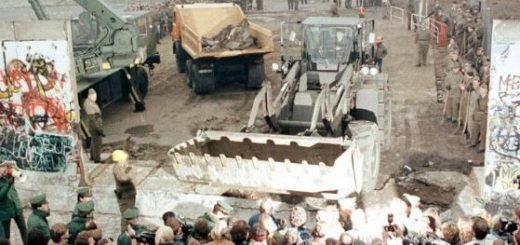
Unification of East and West Germany in 1990: History & Major Facts
Frequently Asked Questions

Flag used by the Soviet Union
What role did the Soviet Military Administration (SMAD) play?
SMAD governed the SBZ, oversaw political activities, and allowed four political parties to operate under a controlled alliance called the Democratic Bloc. It also set up detention camps using former Nazi facilities.
What happened to political parties in the SBZ?
In 1946, the Social Democratic Party (SPD) and the Communist Party (KPD) were forcibly merged into the Socialist Unity Party (SED), which became the ruling party of East Germany.
What administrative changes occurred in the SBZ and later the GDR?
Initially divided into five states (Länder), the SBZ transitioned into 14 districts (Bezirke) in 1952 as part of administrative reforms under the GDR.
What was the significance of the “Stalin Note” of 1952?
Joseph Stalin proposed a unified, neutral Germany, but Western powers rejected it, solidifying the division between East and West Germany during the Cold War.
When and why was the GDR officially established?
The GDR was proclaimed on 7 October 1949 to formalize Soviet-controlled East Germany as a socialist state during the Cold War.