Arc de Triomphe
The Arc de Triomphe, one of Paris’ iconic landmarks, stands majestically at the western end of the Champs-Élysées. It is situated at the center of the Place Charles de Gaulle, previously known as Place de l’Étoile, named after the star-like configuration of twelve avenues radiating from it. Spanning across the 8th, 16th, and 17th arrondissements, the monument is a powerful tribute to the French military efforts during the Revolutionary and Napoleonic Wars. Inscribed on its surfaces are the names of significant victories and prominent generals. Beneath its grand arches lies the Tomb of the Unknown Soldier, honoring fallen soldiers from World War I.
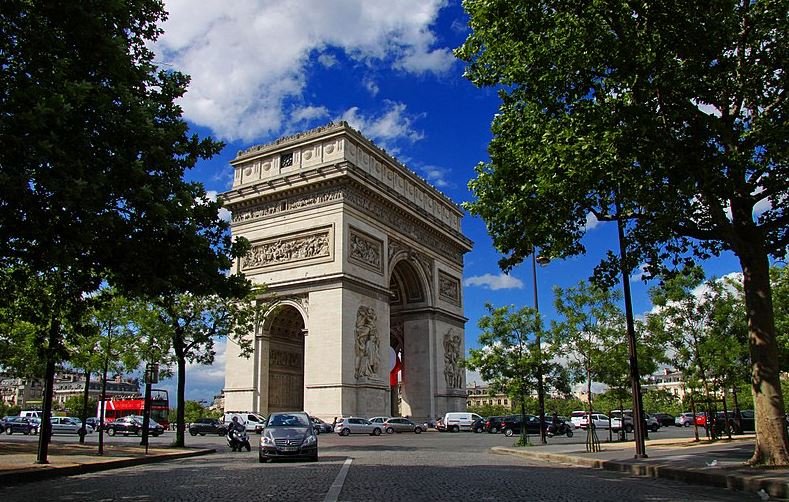
A 2012 photo of the Arc de Triomphe.
A Symbol of the Axe Historique
As a central feature of the Axe Historique, a sequence of monumental structures along a straight line stretching from the Louvre to La Défense, the Arc de Triomphe embodies historical and architectural significance. Jean Chalgrin designed it in 1806, drawing inspiration from Rome’s Arch of Titus. The Arc, with its elaborate sculptural details depicting heroic battles, measures 50 meters in height, 45 meters in width, and 22 meters in depth. The vaults are impressive in size, with the larger one soaring nearly 30 meters high.
Historical Significance
Commissioned by Napoleon Bonaparte in 1806 after his victory at Austerlitz, the Arc’s construction symbolized his military dominance. Progress was slow, with foundations taking two years, and work halted multiple times due to political changes. Architect Jean Chalgrin died in 1811, and construction resumed under Jean-Nicolas Huyot before being completed in 1836 under Louis-Philippe I’s reign.
Key Events
- Napoleon’s State Funeral (1840): The Arc witnessed Napoleon’s remains being ceremoniously returned to Paris.
- Victor Hugo (1885): The famed writer’s body was displayed under the monument during his state funeral.
World Wars and Symbolism
The Arc de Triomphe became synonymous with military parades, including victory marches by German forces (1871, 1940) and Allied troops (1919, 1944). Notably, post-World War I military processions avoided marching directly through the arch out of respect for the Tomb of the Unknown Soldier. The eternal flame, ignited in 1923, serves as a tribute to unidentified war casualties.
Modern Recognition
In 1919, a daring stunt by aviator Charles Godefroy, who flew his biplane under the monument’s central arch, captured public imagination. During France’s World Cup victory in 1998, celebratory images of the players were projected onto its surface.
Architectural and Artistic Features of Arc de Triomphe
The Neoclassical design of the Arc was a departure from traditional Roman styles, featuring bold and monumental proportions. Its base hosts four prominent sculptures:
- The Departure of the Volunteers (La Marseillaise) by François Rude.
- The Triumph of 1810 by Jean-Pierre Cortot.
- Resistance of 1814 and Peace of 1815, both by Antoine Étex.
Above these sculptures, the attic displays shields engraved with the names of notable French victories. The names of 660 military leaders are carved into the inner walls, with a mark distinguishing those who fell in battle.
The Arc de Triomphe is both a tribute to military valor and a landmark of enduring cultural significance in Paris.
The Tomb of the Unknown Soldier, installed in 1921, serves as a poignant reminder of those lost in war. Each year on November 11th, a ceremony commemorates the 1918 Armistice, with the flame at the tomb continuously burning as a symbol of eternal remembrance.
Notable Incidents and Restorations
The Arc has weathered its share of challenges, from a broken sword on its relief during World War I to vandalism during the Yellow Vests protests in 2018. Restoration efforts, particularly in the 1960s and after acts of defacement, have preserved its grandeur. In 2021, the monument was uniquely transformed as part of Christo and Jeanne-Claude’s art project, where it was wrapped in silvery-blue fabric.
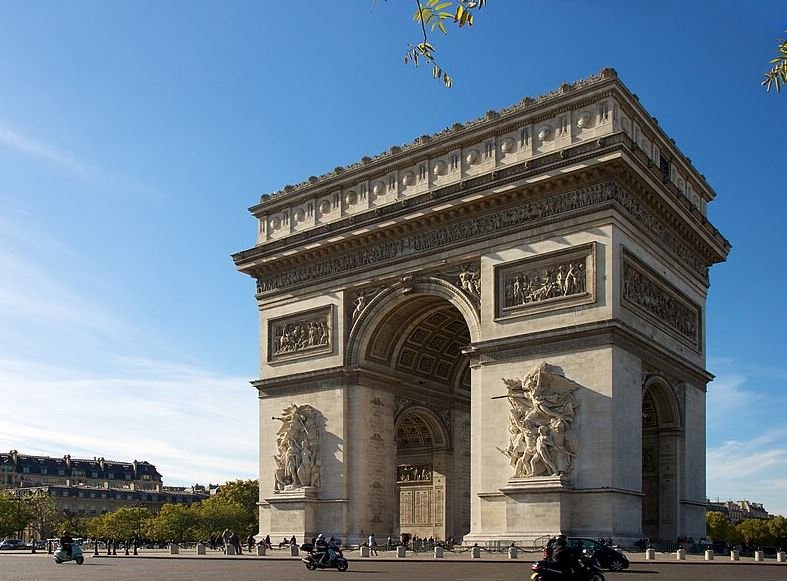
A 2010 picture of the Arc de Triomphe.
Access and Visitor Experience
Visitors can access the Arc via underpasses to avoid the busy roundabout at Place Charles de Gaulle. A lift and a staircase of 284 steps lead to the rooftop terrace, offering panoramic views of Paris. Inside, exhibits detail the history and construction of the monument.
Global Influence and Replicas
The Arc de Triomphe has inspired several structures worldwide, including:
- Rosedale Arch in Kansas City, USA.
- Arcul de Triumf in Bucharest, Romania.
- Arch of Triumph in Pyongyang, North Korea.
- A replica at the Paris Casino in Las Vegas.

Frequently Asked Questions
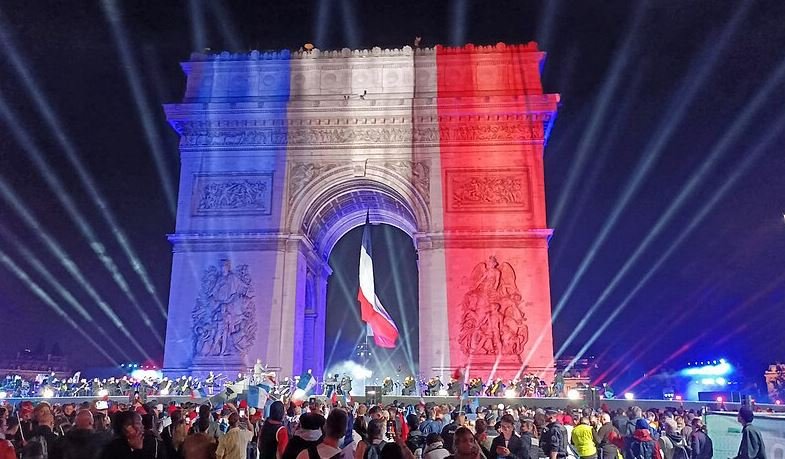
A 2024 picture of the Arc de Triomphe.
Who designed the Arc de Triomphe?
Jean Chalgrin designed it in 1806, inspired by the Arch of Titus in Rome.
What is its significance in French history?
It symbolizes military victories, houses the Tomb of the Unknown Soldier from World War I, and serves as a focal point for national celebrations and commemorations.
What are the dimensions of the Arc?
The Arc stands 50 meters high, 45 meters wide, and 22 meters deep, with its main vault reaching 29.19 meters high.

What notable sculptures adorn it?
Four main sculptures depict key events: Departure of the Volunteers (La Marseillaise), The Triumph of 1810, Resistance of 1814, and Peace of 1815, created by renowned French sculptors.
How has it been used in historical events?
Napoleon’s funeral procession, Victor Hugo’s state funeral, military parades, and Charles Godefroy’s famous 1919 flight under its arch are key moments.
What modern events have impacted the Arc?
It suffered vandalism during the 2018 Yellow Vest protests and was wrapped in 2021 as part of an art project by Christo and Jeanne-Claude.
How can visitors access it?
Accessible via the Charles de Gaulle–Étoile station, visitors use underpasses to avoid traffic. A lift and stairs lead to a panoramic terrace offering views of Paris.





