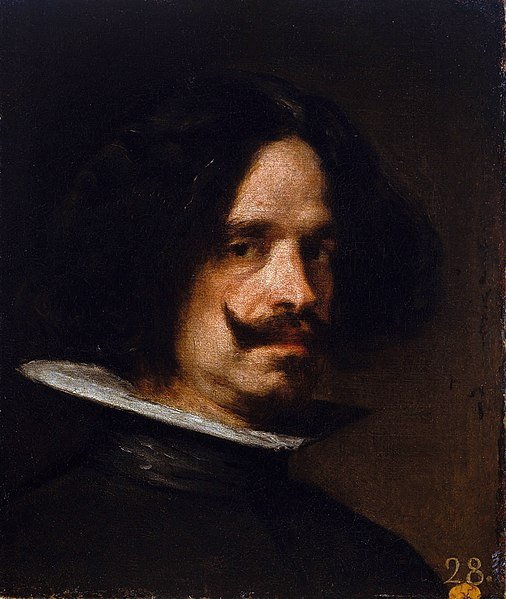
Diego Velázquez
Diego Rodríguez de Silva y Velázquez (1599–1660) is widely regarded as one of the most significant painters of the Spanish Golden Age and one of the greatest artists in Western art history. As the leading court painter for King Philip IV of Spain, Velázquez developed a distinctive style that blended realism with impressionistic techniques, influencing generations of artists. His work ranged from royal portraits to historical scenes, culminating in his masterpiece, Las Meninas (1656). His impact continued beyond his time, inspiring 19th and 20th-century artists like Pablo Picasso, Salvador Dalí, and Francis Bacon.
Early Life and Training
Born in Seville, Spain, Velázquez was baptized on June 6, 1599. His father, Juan Rodríguez de Silva, was a notary, and his mother, Jerónima Velázquez, belonged to a family of modest means. Although his paternal grandparents were of Portuguese descent, some scholars suggest possible Jewish or Morisco ancestry.
Displaying artistic talent at a young age, Velázquez was apprenticed to Francisco Pacheco in 1611. Pacheco, though not a remarkable painter, was an influential teacher who introduced Velázquez to classical studies, proportion, and perspective. He also facilitated connections with Seville’s literary and artistic circles. In 1618, Velázquez married Pacheco’s daughter, Juana, further cementing his ties to the artistic community.
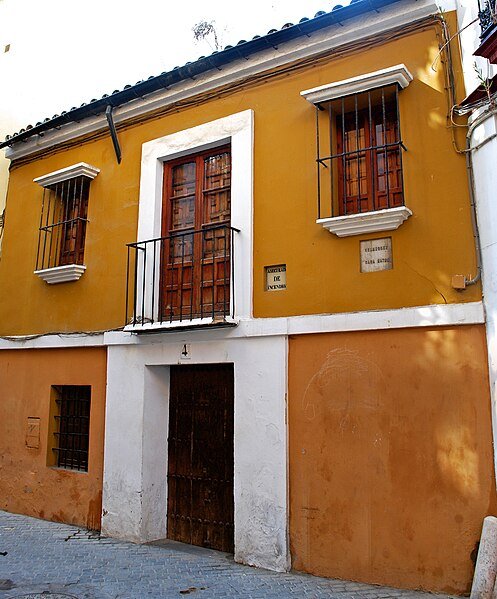
The birthplace of Velázquez in Seville, located in the Spanish autonomous community of Andalusia and the province of Seville.
Early Works and Influences
Velázquez’s early paintings were largely bodegones (kitchen scenes with still-life elements), characterized by meticulous realism and dramatic use of light. Works like Old Woman Frying Eggs (1618) and The Water Seller of Seville (1618–1622) demonstrate his mastery of texture, volume, and shadow. These paintings reveal the influence of Caravaggio, whose naturalism and tenebrist lighting Velázquez adapted to his style.
His early religious paintings, such as The Adoration of the Magi (1619) and Saint John the Evangelist on the Island of Patmos (1618–19), reflected a more personal and realistic approach compared to the idealized religious imagery of his teacher Pacheco. His ability to blend naturalism with religious themes became a defining characteristic of his work.
Move to Madrid and Royal Patronage
By the early 1620s, Velázquez’s reputation had grown, prompting a move to Madrid in 1622. Though his first visit was brief, he gained an introduction to influential figures at court. In 1623, the Count-Duke of Olivares, Philip IV’s chief minister, summoned Velázquez back to Madrid. The young painter created a portrait of the king, which so impressed Philip that he appointed Velázquez as an official court painter, effectively securing his position for life.
At court, Velázquez painted numerous portraits of Philip IV and other members of the royal family. His early royal portraits, such as Philip IV in Brown and Silver (1632), depict the king with an austere elegance that would define the Habsburg portrait tradition. He also produced mythological and allegorical works, such as The Triumph of Bacchus (1629), demonstrating his versatility beyond portraiture.
READ MORE: 10 Most Famous Spanish Monarchs and their Reigns
First Italian Journey (1629–1631)
Velázquez’s first trip to Italy in 1629 marked a turning point in his career. Exposed to Renaissance and Baroque masters like Titian, Veronese, and Rubens, he absorbed new techniques that enriched his palette and composition. Works like Apollo in the Forge of Vulcan (1630) showcase his evolving style, blending Spanish naturalism with Italian dynamism.
During this period, he visited major art centers like Venice, Rome, and Naples, refining his ability to depict complex narratives and human expressions. His time in Italy deepened his understanding of classical themes, which he later integrated into his court commissions.
Return to Madrid and Court Prestige
Returning to Madrid in 1631, Velázquez resumed his court duties, painting an extensive series of royal portraits and historical works. Among his most significant pieces from this period is The Surrender of Breda (1634–35), a monumental painting depicting Spain’s victory over the Dutch. Unlike traditional war paintings that glorify conquest, Velázquez humanized both the victors and the defeated, emphasizing chivalry and diplomacy.
Throughout the 1630s and 1640s, Velázquez continued to refine his portraiture, producing masterful depictions of court figures, jesters, and dwarfs. His paintings of court jesters, such as Pablo de Valladolid (1635), offer psychological depth and dignity, rather than mere caricatures.
Second Italian Journey (1649–1651)
In 1649, Velázquez embarked on a second trip to Italy, this time to acquire artworks for the Spanish court. During his stay in Rome, he painted Portrait of Pope Innocent X (1650), a strikingly realistic and psychologically intense portrait that remains one of his most acclaimed works. He also painted Juan de Pareja (1650), an extraordinary depiction of his assistant, which showcases Velázquez’s mastery of texture and tonal variation.
This period also saw Velázquez experimenting with landscapes, producing studies like View of the Garden of the Villa Medici that foreshadowed Impressionist techniques with their loose, vibrant brushstrokes.
Final Years and Las Meninas
Upon his return to Spain in 1651, Velázquez was appointed Aposentador Mayor (chamberlain), responsible for organizing royal accommodations. This administrative role limited his painting time but elevated his court status.
In 1656, Velázquez created his magnum opus, Las Meninas, a complex, enigmatic composition that revolutionized portraiture. The painting features the young Infanta Margaret Theresa surrounded by her attendants, while Velázquez himself is included, painting a large canvas. The presence of a mirror reflecting King Philip IV and Queen Mariana raises questions about perspective, reality, and viewer participation.
Las Meninas has been extensively analyzed for its intricate composition and illusionistic depth. It remains one of the most studied and revered paintings in art history.
Later Works and Death
In his final years, Velázquez continued to paint royal portraits, including Infanta Margarita Teresa in a Blue Dress (1659) and Prince Felipe Próspero (1659), both characterized by delicate textures and expressive depth. He also painted Las Hilanderas (c. 1657), a mythological scene rich in movement and layered meaning.
Whether through his intimate royal portraits or complex historical narratives, Velázquez left an indelible mark on the evolution of European art.
In 1660, Velázquez oversaw the decoration of the royal pavilion for the wedding of Maria Theresa and Louis XIV. Shortly after returning to Madrid, he fell ill and died on August 6, 1660. He was buried in the church of San Juan Bautista, which was later destroyed, leaving his final resting place unknown.
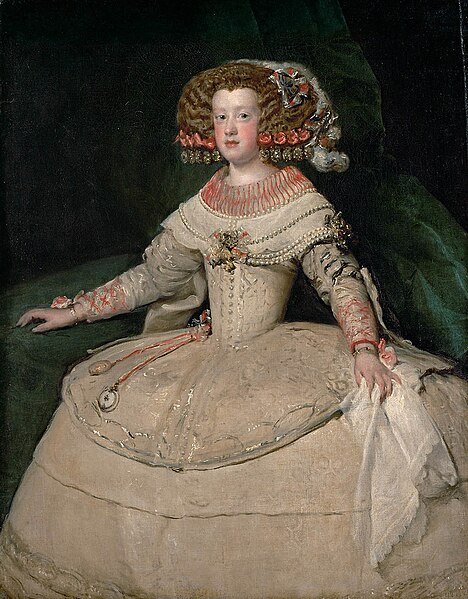
A portrait of Infanta Maria Theresa
Legacy and Influence
Velázquez’s impact on art endured long after his death. In the 19th century, artists like Édouard Manet admired his bold brushwork, calling him the “painter of painters.” His loose, expressive technique influenced Impressionists like Claude Monet and John Singer Sargent.
In the 20th century, Pablo Picasso and Salvador Dalí paid tribute to Velázquez, with Picasso producing a series of reinterpretations of Las Meninas. Francis Bacon also reimagined Portrait of Innocent X in his haunting, distorted versions.
Today, Velázquez’s works remain central to the study of Western painting, with the Museo del Prado housing the most extensive collection of his masterpieces.
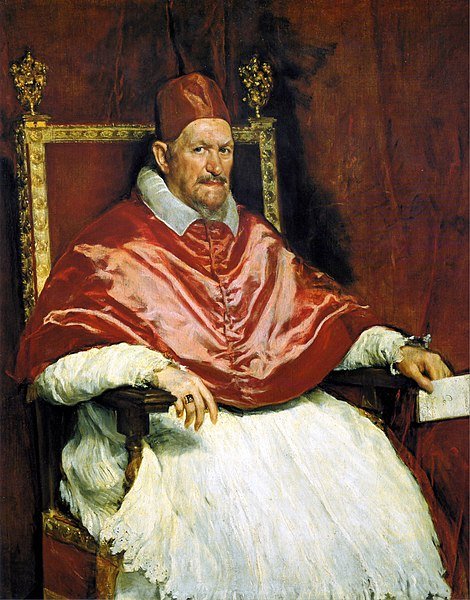
Portrait of Pope Innocent X
Frequently Asked Questions about Diego Velázquez
What were Diego Velázquez’s early influences?
His early works were influenced by Caravaggio’s use of dramatic lighting and realism, as well as his teacher Francisco Pacheco’s academic training in proportion and perspective.
How did Velázquez secure his position as court painter?
He impressed King Philip IV with a portrait in 1623, after which he became the exclusive royal painter, securing lifelong patronage and influence at court.
What impact did his first trip to Italy have on his art?
It broadened his style, introducing greater dynamism and luminosity inspired by Renaissance masters like Titian and Rubens.
Why is Las Meninas considered a masterpiece?
It showcases innovative composition, perspective, and illusionism, blending reality and art with Velázquez’s self-portrait and reflections of the royal family.
What themes did Velázquez explore in his paintings?
His works ranged from royal portraits and historical scenes to mythological subjects and depictions of court jesters with psychological depth.
How did Velázquez influence later artists?
His expressive brushwork and mastery of light influenced 19th-century realists and impressionists like Manet, and later artists like Picasso and Dalí.





