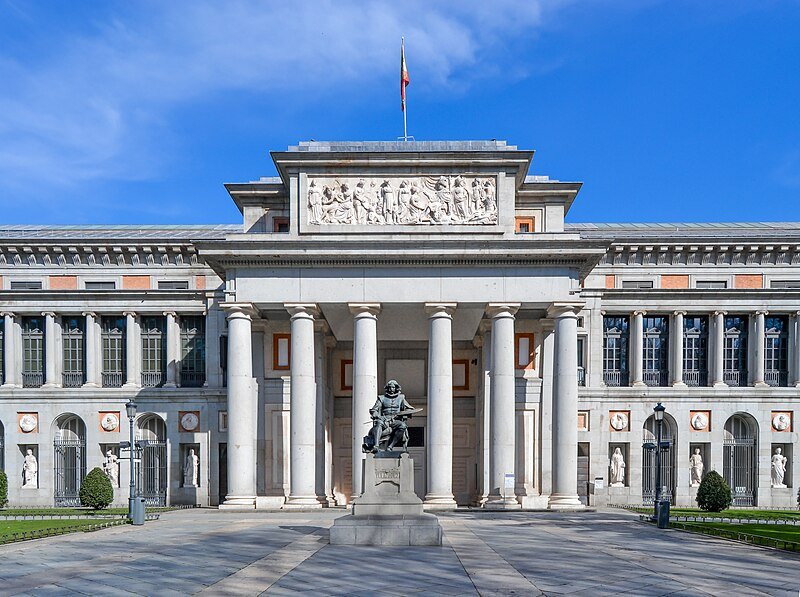
Front façade of the Velázquez entrance in 2016.
The Museo del Prado, officially known as the Museo Nacional del Prado, is Spain’s premier national art museum, located in Madrid. Renowned for housing one of the world’s finest collections of European art, the Prado boasts works spanning from the 12th to the early 20th century. Based on the former Spanish royal collection, the museum is particularly famous for its impressive selection of Spanish masterpieces and is widely regarded as a cornerstone of European cultural heritage. The museum officially opened in 1819 as a repository for paintings and sculptures, but today it also houses drawings, prints, and decorative arts.
Origins and Historical Development
The origins of the Museo del Prado trace back to the reign of King Charles III of Spain, who commissioned architect Juan de Villanueva in 1785 to design a building intended for the Natural History Cabinet. However, it was King Ferdinand VII, influenced by his wife Queen María Isabel de Braganza, who repurposed the structure into the Royal Museum of Paintings and Sculptures. The museum opened its doors to the public in 1819, featuring 311 Spanish paintings from royal collections, despite already holding more than 1,450 artworks.
During the 16th century, Spain’s Habsburg and Bourbon monarchs actively acquired art, enriching the royal collection significantly. Masterpieces by Titian, Velázquez, El Greco, Rubens, and Goya became part of Spain’s cultural legacy. Over time, the museum’s scope expanded beyond Spanish art, incorporating works by Hieronymus Bosch, Rogier van der Weyden, and Raphael.
READ MORE: 5 Most Famous Paintings by Raphael
In 1868, following the deposition of Queen Isabella II, the museum became a national institution and was officially renamed the Museo del Prado. By the late 19th century, the collection had grown extensively through acquisitions and donations. The Museo de la Trinidad (1872) and the Museo de Arte Moderno (1971) contributed additional works, enriching the Prado’s holdings with Renaissance and Baroque masterpieces. Donations from collectors like Pablo Bosch and Ramón de Errazu further solidified its status.
During the Spanish Civil War (1936–1939), the museum faced a severe crisis. To safeguard its treasures, officials moved 353 paintings and 168 drawings to Valencia, Girona, and finally Geneva. After World War II, the artworks were returned safely to Madrid. Throughout Francisco Franco’s dictatorship, many paintings were relocated to embassies, diminishing public access to some of Spain’s most prized artistic treasures.

Architectural Expansion
The museum’s original Villanueva building underwent multiple expansions to accommodate its growing collection and increasing number of visitors. Between 1900 and 1960, new exhibition pavilions were added. In 1993, a proposed expansion led by Felipe Garín was abandoned following criticism.
A major turning point came in 2007, when a €150 million expansion, designed by architect Rafael Moneo, significantly increased the museum’s gallery space. A 16th-century cloister from the Monastery of San Jerónimo was carefully dismantled and reconstructed within the new complex. Additional underground sections were created to improve infrastructure while preserving the building’s historical integrity.
In 2016, British architect Norman Foster, in collaboration with Carlos Rubio Carvajal, was chosen to renovate the Hall of Realms, a structure acquired in 2015. With an estimated budget of €36 million, the project aims to provide 61,500 square feet of additional space, enhancing visitor experience and storage capabilities.
Collection and Masterpieces
Spanish Art and the Golden Age
The Prado is often celebrated for its unparalleled collection of Spanish paintings, particularly works from the Golden Age (16th–17th centuries). Some of the most iconic paintings include:
- Las Meninas (1656–1657) by Diego Velázquez
- The Third of May 1808 (1814) by Francisco Goya
- The Surrender of Breda (1635) by Diego Velázquez
- The Nobleman with his Hand on his Chest (c. 1580) by El Greco
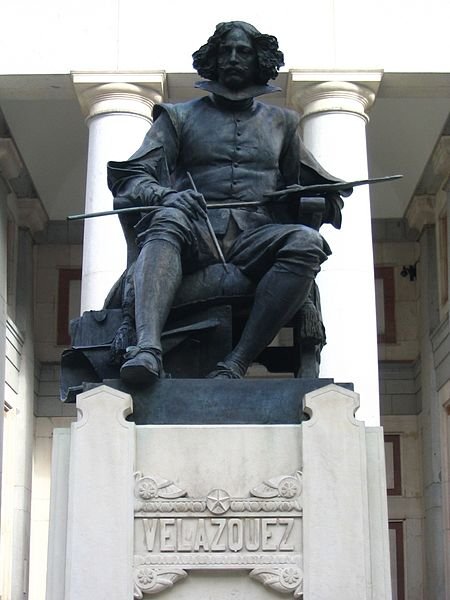
Statue of Diego Velázquez, sculpted by Spanish artist Aniceto Marinas in 1899, prominently displayed at the Velázquez entrance.
Flemish and Italian Influence
The Spanish monarchy’s patronage of Flemish and Italian artists brought significant works from these schools into the collection. Key Flemish works include:
- The Garden of Earthly Delights (c. 1500–1505) by Hieronymus Bosch
- The Three Graces (c. 1635) by Peter Paul Rubens
Notable Italian works include:
- Equestrian Portrait of Charles V (1548) by Titian
- The Pearl (1518–1520) by Raphael
- David and Goliath (1600) by Caravaggio
Drawings, Prints, and Sculptures
Beyond paintings, the Prado houses a vast collection of drawings, prints, and sculptures, including about 8,000 drawings, 4,700 prints, and 1,000 sculptures. Works by Goya, Dürer, and Rembrandt are particularly significant in the print collection. The museum also contains Greek and Roman antiquities and medieval religious sculptures.
Visitor Experience and Global Recognition
The Prado remains one of the most-visited museums in the world. In 2019, it attracted over 3.2 million visitors. However, due to the COVID-19 pandemic, attendance dropped by 76% in 2020, with almost 900,000 visitors. Despite this decline, it ranked 16th globally among the most-visited museums.
The Museo del Prado stands as a symbol of Spain’s artistic and cultural heritage, boasting an unparalleled collection of Spanish, Flemish, and Italian art.
The Prado forms part of Madrid’s Golden Triangle of Art, along with the Thyssen-Bornemisza Museum and the Museo Reina Sofía. In 2021, the Paseo del Prado, where the museum is located, was designated a UNESCO World Heritage Site.
Financial Management and Future Prospects
In 1991, collector Manuel Villaescusa left nearly $40 million in real estate to the museum, making it one of the wealthiest art institutions. By 2004, its €35 million annual budget was supported by a mix of government funds, corporate donations, and merchandising.
The Prado has embraced technology to expand its global reach. In 2009, it partnered with Google Earth to provide 14,000-megapixel images of select masterpieces, allowing virtual visitors to explore paintings in unprecedented detail.
Additionally, the museum has organized international exhibitions, such as the 2011–2012 collaboration with the Hermitage Museum in St. Petersburg, showcasing works by Rembrandt, Caravaggio, and Matisse. In 2014, the Prado loaned a collection of Italian masterpieces to the National Gallery of Victoria in Melbourne, Australia, marking its first-ever overseas exhibition.