What exactly is inside the Great Pyramid?
The Great Pyramid of Giza, also known as the Pyramid of Khufu or the Pyramid of Cheops, is a marvel of ancient engineering and has fascinated historians, archaeologists, and tourists...
World History presents some of the most frequently asked questions about Egypt’s history, culture and geography.
The construction of the pyramids in Egypt began around 2600 BC during the Old Kingdom period. These massive structures served as tombs for Pharaohs and were designed to house their remains and treasures for the afterlife. They are significant for their architectural marvel, engineering prowess, and their enduring status as iconic symbols of ancient Egypt.
Egypt’s history is divided into several dynastic periods, including the Old Kingdom, Middle Kingdom, and New Kingdom. Some notable pharaohs include Khufu (builder of the Great Pyramid), Ramses II (a prolific builder), and Hatshepsut (one of Egypt’s few female pharaohs).
The Suez Canal, completed in 1869, connected the Mediterranean Sea to the Red Sea, providing a vital maritime shortcut between Europe and Asia. It significantly boosted Egypt’s strategic and economic importance as a global trade hub and contributed to its modernization.
The Rosetta Stone, discovered in 1799, contained inscriptions in three scripts: Greek, Demotic, and hieroglyphics. This provided a key to deciphering ancient Egyptian hieroglyphs, enabling scholars to unlock the language and learn about Egypt’s history and culture.
Egypt made significant contributions to various fields. In mathematics, they developed practical geometry for construction and land measurement. In medicine, they had advanced surgical techniques, and the Edwin Smith Papyrus is one of the oldest known medical texts, documenting medical knowledge of the time.
Traditional Egyptian cuisine includes dishes like koshari (a mixture of lentils, rice, and pasta), ful medames (mashed fava beans), and dishes featuring grilled meats like kebabs. Egyptian cuisine often incorporates herbs, spices, and bread, such as flatbread known as “aish.”
Hieroglyphics were a writing system of intricate symbols used by ancient Egyptians for religious texts, monumental inscriptions, and more. They played a crucial role in preserving Egyptian culture, history, and religious beliefs through written records.
Islam is a dominant religion in Egypt, and its influence is seen in daily life, art, architecture, and traditions. Islamic holidays, like Ramadan, are widely observed. Mosques, such as the historic Al-Azhar Mosque, are important cultural and religious landmarks.
Egypt boasts numerous landmarks, including the temples of Luxor and Karnak, the Valley of the Kings (royal tombs), the Sphinx, and the ancient city of Thebes. These sites are testament to Egypt’s rich history and architectural achievements.
The Nile River has been the lifeblood of Egypt for millennia. It enabled agriculture in the fertile Nile Delta, provided transportation, and influenced Egyptian mythology. The annual flooding of the Nile deposited nutrient-rich silt, ensuring bountiful harvests.
Egypt is predominantly desert, with the Sahara Desert covering much of the country. The Nile River and its delta are fertile areas, while oases like the Siwa Oasis provide pockets of greenery in the arid landscape.
The Nile Delta is a fertile region where the Nile River divides into multiple branches before flowing into the Mediterranean Sea. Its rich soil supports agriculture, making it a densely populated and agriculturally productive area.
Egypt has a desert climate with hot, dry summers and mild winters. Coastal areas experience more moderate temperatures due to the Mediterranean Sea, while the interior deserts are extremely arid.
The Red Sea is vital for Egypt’s international trade as it provides access to the Suez Canal, a major global shipping route. The Mediterranean Sea offers another important maritime connection and is key to Egypt’s coastal tourism.
Major cities in Egypt include Cairo (the capital), Alexandria (a historic port city), Luxor (known for its ancient temples), and Aswan (famous for the High Dam and Philae Temple). Each city has its unique historical and cultural significance.

The Great Pyramid of Giza, also known as the Pyramid of Khufu or the Pyramid of Cheops, is a marvel of ancient engineering and has fascinated historians, archaeologists, and tourists...

The October 1973 War, also known as the Yom Kippur War (in Israel) or the Ramadan War (in Arab countries), was a significant conflict that pitted Israel against a coalition...

Gamal Abdel Nasser (1918–1970) was the second President of Egypt and a key political figure in the Arab world during the mid-20th century. Below, WHE presents a brief overview of...

In June 1967, the Middle East was rocked by a brief but intense conflict that saw the nation of Israel lock horns with an Arab coalition of Jordan, Egypt, and...

Al-Aziz Uthman was the second Sultan of Egypt. He reigned from March 4, 1193 to November 29, 1198. He was the son and successor of Saladin, the famed Muslim leader...

In early March of 2023, a team of archeologists in southern Egypt made a startling discovery of a miniature sphinx statue, which they named the Smiling Sphinx. The statue, which...

The ankh symbol was ubiquitous in the life of ancient Egyptians as it was often used during religious rituals and funerary ceremonies. Also, the Egyptian rulers were said to rely...
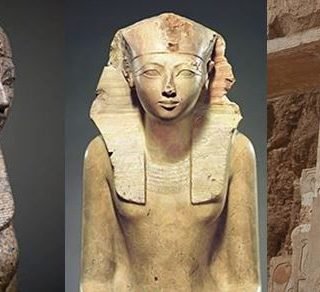
Highly regarded as one of the most renowned women of ancient history, Hatshepsut was the famed queen regent who defied all odds and went on to become the second known...

Queen Hatshepsut: Quick Facts Father: Thutmose I Mother: Ahmose Birth date: 1507 BCE Husband: Thutmose II Daughter: Neferure Most known for: longest reigning and most successful female pharaoh of Egypt;...

Connecting the Mediterranean region to the Indian Ocean, the Suez Canal is one of the most famous man-made waterways in the world. The function of the Suez Canal is to...

Considered as one of the lesser known and revered deities in ancient Egyptian religion, Seshat was seen as the goddess of wisdom, writing, libraries, and measurement. The Egyptians considered Seshat...

Ever since the dawn of civilization, we humans have pondered where everything, including life, came from. It has also been the case of why and how we and things around...

Hathor, the Egyptian cow goddess, was one of the leading goddesses in ancient Egyptian religion. She was revered as the goddess of sky that sprung out from Ra’s (the creator...

Anwar Sadat was the third president of Egypt from 1970 until his horrific assassination in 1981. He was a relatively pro-West leader. In the latter stages of his presidency, Sadat...

Who is Ra? In ancient Egyptian mythology, Ra (also known as Re) was worshiped as the god of the sun, creation, law, light, order and, fertility and growth. It was...





