Paris of Troy
Prince Paris of Troy, also known as Alexander, is one of the most significant and complex figures in Greek mythology. As a central character in the saga leading to the...
Here are some commonly asked questions about the Trojan War, followed by their answers:
The Trojan War was a legendary ten-year conflict between the city of Troy and the Achaeans (Greeks). It is best known from the epics “Iliad” and “Odyssey” by Homer.
The war’s primary cause is usually attributed to the abduction of Helen, the wife of Menelaus, King of Sparta, by Paris, a prince of Troy. However, this was likely the culmination of political, economic, and historical factors.
Major figures include Achilles, Hector, Agamemnon, Paris, Helen, Priam, Menelaus, Ajax the Great, Ajax the Lesser, and Odysseus, among others.
The gods were actively involved, taking sides and directly influencing the war’s events. For example, Athena supported the Greeks, while Aphrodite favored the Trojans.
The Greeks eventually won by deceiving the Trojans with the famous Trojan Horse. Using this subterfuge, they managed to enter the heavily fortified city and destroy it.
While the “Iliad” and “Odyssey” are works of literature, archaeological evidence suggests there was a historical basis for the war, although its exact nature and scale remain a matter of debate.
Achilles was invulnerable except for his heel, as he was dipped into the River Styx by his mother Thetis, holding him by his heel. He died from a mortal wound to this heel, hence the term “Achilles’ heel” refers to a single vulnerability in an otherwise strong or invulnerable system or person.
Achilles is often considered the most illustrious Greek hero of the Trojan War, known for his unmatched prowess in battle and his central role in the “Iliad.”
Hector was killed by Achilles in revenge for Hector killing Patroclus, Achilles’ dear friend and companion.
The Trojan Horse was a large wooden horse used as a trick by the Greeks to gain entrance into Troy. The Trojans brought the horse into their city, thinking it was an offering to Athena. At night, Greek soldiers emerged from the horse and opened the city gates, allowing the Greek army to enter and capture Troy.
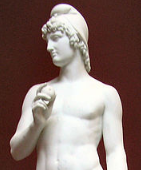
Prince Paris of Troy, also known as Alexander, is one of the most significant and complex figures in Greek mythology. As a central character in the saga leading to the...

The Mask of Agamemnon, a gold funerary artifact from the Bronze Age Aegean, is one of the most iconic discoveries in archaeology. Unearthed by German archaeologist Heinrich Schliemann in 1876...

In ancient Greek poet Homer’s Iliad, the duel between Ajax the Great, a Greek warrior of immense strength and valor, and Hector, the Trojan prince and champion, stands out as...

Aeacus, a prominent figure in Greek mythology, is celebrated as a symbol of justice, piety, and divine favor. The son of Zeus and the nymph Aegina, Aeacus’ life and legacy...

In Greek mythology, Aegina is a figure known both as a mortal princess and as a nymph associated with an island that would later bear her name. Aegina’s myth intertwines...

Patroclus, a significant figure in Greek mythology, is best known for his role in the Iliad, Homer’s epic poem about the Trojan War. As the close companion of Achilles, Patroclus’s life,...

Summary The statue of Laocoön and His Sons, also known as the Laocoön Group, is one of the most iconic and enduring pieces of ancient sculpture. Discovered in 1506 in...

In Greek mythology, Cassandra was a Trojan princess endowed with the gift of prophecy by Apollo. However, after spurning his advances, she was cursed to foretell the future accurately but...

The term “Cassandra Syndrome” or “Cassandra Complex” derives from the story of Cassandra in Greek mythology, whom I previously described. This syndrome refers to a situation where an individual’s valid...
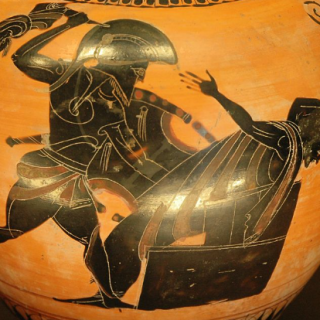
Born to Greek mythical figures Achilles and Deidamia, Neoptolemus is famed for being one of the warriors of the Trojan War. He was part of the Greek troops that covertly...

Legend has it that Dido, who was a princess of Tyre, fled her home to establish her own city named Carthage (in modern-day Tunisia) around 814/3 BC. Apart from being...

In the Iliad, a work by ancient Greek poet Homer, Sarpedon is described as the warrior and son of Zeus and Laodamia. Sarpedon’s father Zeus is the chief of the...

Hector— a fierce Greek warrior known for his exploits during the Trojan War—was a mythical Greek hero and a Trojan prince. According to the myths Hector led the Trojan army...

In many stories and legends from ancient Greece, Helen of Troy (also Helene) was seen as the most beautiful woman on earth. She was also the very character who indirectly...
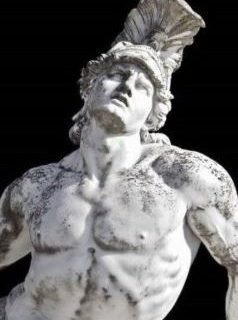
Achilles was a hero of Greek mythology depicted in an Iliad by Homer. Achilles is also the main character in this war epic. The greatest feat attributed to him was...





