Aegina in Greek Mythology
In Greek mythology, Aegina is a figure known both as a mortal princess and as a nymph associated with an island that would later bear her name. Aegina’s myth intertwines with themes of divine favor, conflict among gods, and mythological lineage. Her story is part of a larger tapestry that connects mortal families, divine beings, and Greek heroes.

Aegina’s legacy includes the loyalty and strength of the Myrmidons, her connection to the Trojan War through her descendants, and her representation of the interwoven lives of mortal and divine figures in Greek myths. Image: Jupiter and Aegina by Jan Goeree
Background and Family Connections
Aegina is traditionally depicted as the daughter of the river god Asopus and the nymph Metope, who were prominent figures in Greek mythology associated with rivers and freshwater.
Asopus and Metope had numerous daughters, many of whom became romantically involved with gods such as Zeus and Apollo, creating both mortal and divine offspring.
Aegina’s background as the daughter of a river god aligns her with the realm of water deities and natural landscapes, adding to her association with the island that would become her namesake.
Despite her connection to water, Aegina is often compared to the figure Amalthea, a goat-nymph who nurtured Zeus in his infancy.
Like Amalthea, Aegina’s name suggests an association with a protective or nurturing role, though Aegina’s narrative diverges as it centers around her relationship with Zeus and her role as a progenitor of heroes.
Relationship with Zeus and the Birth of Aeacus
The central episode in Aegina’s myth involves her abduction by Zeus, who was captivated by her beauty.
According to some versions of the story, Zeus transformed himself into a flame to carry her away, a symbol of his divine power and determination to possess her. He transported her to an island near Attica, then known as Oenone. This island was eventually renamed Aegina in her honor, signifying her lasting influence over the land.
Aegina and Zeus’s union resulted in the birth of Aeacus, who would later become one of the most revered kings in Greek mythology. Aeacus was known not only for his wisdom and piety but also for his connection to the gods. He was later called upon to assist Poseidon and Apollo in constructing the walls of Troy, marking him as a figure with divine favor and an active role in significant mythological events.
Aeacus’s legacy continued through his descendants, including his son Peleus and grandson Achilles, establishing Aegina as a direct ancestor to some of the most famous heroes in Greek mythology.
Aegina’s Other Children and Mythological Lineage
In addition to Aeacus, Aegina had another son, Menoetius, through a relationship with the mortal Actor. Menoetius became the king of Opus and was one of the Argonauts, a group of heroes who accompanied the hero Jason on his quest for the Golden Fleece. Menoetius’s own son, Patroclus, would go on to become a close companion to the hero and demigod Achilles, creating a connection between Aegina’s lineage and some of the most celebrated figures in the Trojan War.
The link between Aegina and the warrior figures of Patroclus and Achilles emphasizes the heroic qualities that pervade her lineage. The heroes in her family are often characterized by their bravery, loyalty, and tragic fates, adding depth to her role in Greek mythology as a figure of endurance and resilience.
In some accounts, Aegina is also associated with Sinope, who is sometimes depicted as her daughter by Ares, while other sources present Sinope as her sister. This fluidity in relationships is common in Greek mythology and contributes to the complex network of divine and heroic connections surrounding Aegina.

Aeacus and Telamon by Jean-Michel Moreau le Jeune
READ ALSO: What sides did the Greek gods take during the Trojan War?
The Plague and the Creation of the Myrmidons
Aegina’s myth also includes a narrative about the creation of the Myrmidons, a group of loyal and formidable warriors associated with her son Aeacus.
According to legend, the island of Aegina suffered a terrible plague, which was believed to have been sent by Hera, Zeus’s wife, who was jealous of Aegina and resentful of her relationship with Zeus. This plague decimated the population, leaving Aeacus without a people to govern.
In desperation, Aeacus prayed to Zeus, asking him to restore the population of the island. Zeus answered his son’s prayer by transforming a colony of ants on an oak tree into humans. These transformed beings, known as the Myrmidons (from the Greek word myrmex, meaning “ant”), became the inhabitants of Aegina and were renowned for their loyalty, strength, and unity. The Myrmidons would later gain fame under Achilles, Aeacus’s grandson, during the Trojan War, where they fought with unparalleled bravery and loyalty.
The story of the Myrmidons not only highlights the gods’ power to intervene in human affairs but also reflects themes of renewal, loyalty, and resilience. The Myrmidons’ reputation as disciplined warriors who follow their leader with unwavering commitment ties back to their mythological origins and underscores the impact of Aegina’s lineage on Greek heroic traditions.

Location of the Island of Aegina
The Myth of Aegina’s Abduction and Pursuit by Asopus
Aegina’s abduction by Zeus was not without resistance. In some versions of the myth, Aegina’s father, Asopus, pursued Zeus in an attempt to retrieve his daughter. Asopus’s pursuit of Zeus led him to Corinth, where he encountered the legendary figure Sisyphus. Sisyphus informed Asopus of the island where his daughter had been taken after observing a large bird, symbolic of Zeus, carrying a young woman to a nearby island.
As Asopus attempted to confront Zeus, he was repelled by Zeus’s thunderbolts, which forced him to return to his domain. This part of the myth highlights the tension between the divine and natural forces and illustrates Zeus’s dominance over other deities and mortals alike. The image of Zeus hurling thunderbolts at Asopus reinforces his role as a powerful, sometimes ruthless, figure who acts according to his desires, often with little regard for others.
READ ALSO: 9 Most Famous Sons of Zeus: From Ares to Perseus
Aegina’s Legacy and Influence in Greek Mythology
Aegina’s legacy extends beyond her role as the mother of Aeacus and the ancestor of heroes like Achilles. Her story connects several key elements of Greek mythology, including divine relationships, heroic lineage, and the interplay between mortal and immortal realms.
Her descendants’ involvement in legendary events, particularly the Trojan War, ties Aegina’s narrative to the broader epic traditions that shaped Greek cultural identity.
The Myrmidons, as the loyal followers of Achilles, represent the lasting impact of Aegina’s myth on Greek warrior culture. Their origin story, stemming from Zeus’s divine intervention in response to Aeacus’s prayer, demonstrates the gods’ influence over human affairs and the themes of loyalty and resilience.
These qualities became defining attributes of Aegina’s lineage, reflected in the loyalty of Patroclus to Achilles and the strength of Achilles himself.
Furthermore, the story of Aegina’s abduction by Zeus and the subsequent renaming of the island reflects themes of transformation and the power of divine love to alter the physical and social landscapes.
The island of Aegina, bearing her name, serves as a geographic testament to her importance in mythology. Her connection to water and her father’s status as a river god align her with natural elements, making her story one of both earthly and divine significance.

Aegina in 1845, by Carl Rottmann
Aegina’s Role in the Interconnectedness of Greek Myths
Aegina’s mythological role underscores the interconnected nature of Greek myths, where relationships between gods, heroes, and mortals shape narratives that span generations.
Her story brings together figures like Zeus, Asopus, Aeacus, Achilles, and Patroclus, showing how divine encounters influence mortal legacies. The dual aspects of her myth—as a nurturing figure tied to a land and as the origin of a heroic lineage—demonstrate the layered storytelling in Greek mythology, where one figure’s narrative branches out to shape the lives and fates of many others.
Through her descendants, Aegina became emblematic of loyalty, resilience, and the enduring impact of one individual’s actions on subsequent generations. Her story, tied to themes of divine favor, conflict, and renewal, highlights the dynamic relationship between humans and gods in Greek mythology.
Frequently Asked Questions
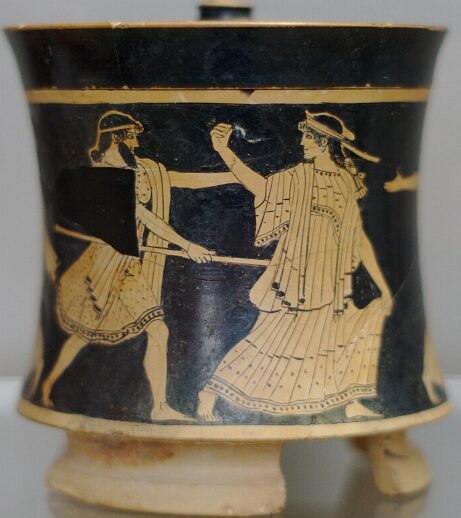
In Greek mythology, Aegina was the nymph associated with the island named after her, located in the Saronic Gulf between Attica and the Peloponnese. Image: Attic red-figure pyxis showing Zeus chasing Aegina





