The Allies of World War I
The Allies, also known as the Entente Powers or Triple Entente, represented one of the two major international coalitions during World War I (1914–1918). Comprised initially of France, the United Kingdom, and Russia, the Allies grew throughout the conflict to include the United States, Japan, Italy, and numerous other nations and colonies, opposing the Central Powers, which were led by Germany, Austria-Hungary, the Ottoman Empire, and Bulgaria.
Origins and Formation
By the early 20th century, European nations had aligned themselves into two primary blocs: the Triple Entente and the Triple Alliance. The Triple Entente originated in 1907, building upon the 1894 Franco-Russian Alliance and the 1904 Entente Cordiale between France and the United Kingdom. The agreement extended with the Anglo-Russian Convention of 1907, establishing cooperative ties between the three powers in response to the growing military and economic power of Germany and its allies.
The Triple Alliance, formed in 1882, united Germany, Austria-Hungary, and Italy. However, Italy’s participation was complicated by territorial disputes with Austria-Hungary and its initial neutrality in 1914. As World War I expanded, the alliances evolved, with Italy eventually joining the Allies in 1915 and new members being drawn to the Allied cause for various political, territorial, or strategic reasons.
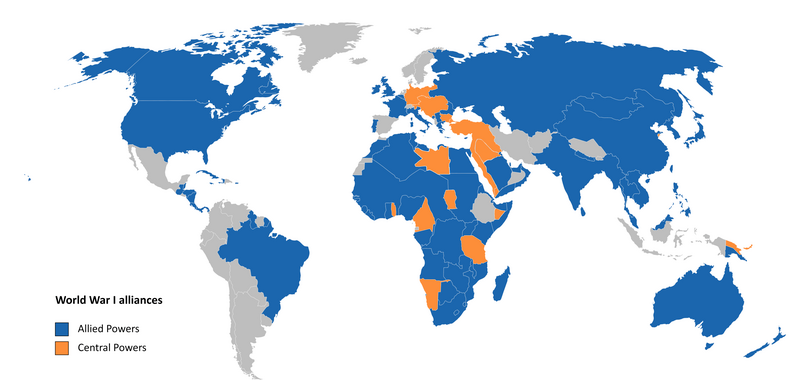
Image: A map showing Alliances during of WWI.
Membership Expansion
At the outbreak of World War I, the Triple Entente consisted of the United Kingdom, France, and Russia. Each had distinct motivations for opposing the Central Powers. France sought to reclaim Alsace-Lorraine, lost in the Franco-Prussian War, while Britain aimed to preserve Belgian neutrality and maintain the European balance of power. Russia was driven by Pan-Slavism and its interests in the Balkans.
As the conflict unfolded, the Allies expanded:
- Japan (1914): Declared war on Germany, aiming to seize German-held territories in the Pacific and China.
- Italy (1915): Joined under the Treaty of London, seeking territorial gains in Austria-Hungary’s territories.
- United States (1917): Entered as an “associated power,” motivated by unrestricted German submarine warfare and the Zimmermann Telegram.
- Other Nations: Countries like Serbia, Belgium, Greece, Romania, and Portugal joined the Allies, often due to direct threats or territorial aspirations. Non-European nations, including China, Siam, and Brazil, also aligned with the Allies for reasons ranging from economic ties to anti-German sentiment.
Role of Colonies and Dominions
The global nature of the Allied powers was evident in the involvement of colonies and dominions. British India, French North Africa, and Japanese-controlled Korea contributed vast resources and manpower. Dominions like Canada, Australia, New Zealand, and South Africa played significant roles, with troops participating in major campaigns such as Gallipoli and the Western Front. The war effort highlighted the interconnectedness of colonial empires and their importance to the Allied war strategy.
Key Events and Strategies
Initial Battles and Mobilization
The war began with Austria-Hungary’s declaration of war on Serbia, drawing in Russia and subsequently other powers. Germany’s implementation of the Schlieffen Plan violated Belgium’s neutrality, prompting British intervention.
Early battles such as the First Battle of the Marne (1914) prevented a quick German victory and set the stage for prolonged trench warfare.
Eastern Front and Russia
Russia’s early offensives in East Prussia and Galicia diverted German and Austrian forces but suffered devastating defeats, such as at Tannenberg (1914).
The 1917 October Revolution led to Russia’s withdrawal from the war, formalized in the Treaty of Brest-Litovsk (1918).
Japan and the Pacific
Japan’s entry focused on capturing German-held territories, including the Tsingtao port in China and islands in the Pacific. Its naval presence also supported Allied efforts in the Mediterranean.
Italian Front
Italy’s campaigns against Austria-Hungary were marked by costly battles in the Alps, including the disastrous defeat at Caporetto (1917) and eventual success at Vittorio Veneto (1918).
United States Involvement
The U.S. entry in 1917 brought fresh troops, financial resources, and industrial strength. American forces participated in key offensives, including the Meuse-Argonne campaign (1918).
Middle East and Colonial Campaigns
Allied forces, including British and Indian troops, engaged the Ottomans in campaigns such as Gallipoli (1915–1916) and the Arab Revolt, which weakened Ottoman control in the Middle East.
Naval Warfare
Control of sea lanes was vital. The British Royal Navy’s blockade of Germany restricted supplies, while German U-boats targeted Allied shipping, leading to the convoy system.
Final Push and Victory
The Allies launched the Hundred Days Offensive (1918), breaking through German lines and forcing the Central Powers into armistice negotiations. Germany signed the Armistice of Compiègne on November 11, 1918.
Contributions of Key Allied Powers
United Kingdom
The British Empire’s extensive resources included troops from dominions and colonies. The Royal Navy’s dominance ensured vital supply lines and blockaded Germany.
France
France bore the brunt of fighting on the Western Front. Its military, bolstered by colonial troops, played a decisive role in halting German advances and leading counteroffensives.
Russia
Despite suffering heavy losses, Russia’s involvement on the Eastern Front diverted German resources. Its withdrawal following the Bolshevik Revolution shifted the balance in favor of the Central Powers temporarily.

Image: Russian soldiers advancing toward the frontlines.
United States
The late entry of the U.S. provided a morale boost and significant reinforcements. American economic support had already been critical through loans and supplies before its military participation.
Italy
Italy’s role included significant contributions on the Southern Front and in naval operations. Despite early setbacks, its successes in 1918 proved pivotal.
Japan
Japan’s naval support and occupation of German territories expanded Allied control in the Pacific and safeguarded shipping routes.
Challenges and Divisions
The Allied coalition faced numerous challenges:
- Coordination Issues: The diverse composition of the Allies required extensive diplomacy to align objectives, strategies, and resource allocations.
- Internal Divisions: Disagreements over post-war territorial claims, such as Italy’s demands under the Treaty of London, strained relations.
- Economic and Human Costs: The prolonged war placed immense strain on Allied economies and populations, with millions of casualties and widespread devastation.
Post-War Outcomes
The Allied victory reshaped global politics and territories:
Treaties and Reparations
The Treaty of Versailles (1919) imposed harsh terms on Germany, including reparations, territorial losses, and military restrictions. Similar treaties addressed Austria-Hungary, the Ottoman Empire, and Bulgaria.
League of Nations
The Allies spearheaded the creation of the League of Nations, aiming to prevent future conflicts. However, key powers like the United States chose not to join, limiting its effectiveness.
Territorial Changes
The Ottoman Empire’s disintegration led to Allied mandates in the Middle East, while new nations emerged in Europe from former Central Power territories, including Poland, Czechoslovakia, and Yugoslavia.
Economic Shifts
The war accelerated the decline of European empires and the rise of the United States as a global economic power. The British Empire faced increased demands for autonomy from its dominions and colonies.
Legacy of the Allies
The Allies’ collaboration demonstrated the potential for international cooperation against a common enemy but also exposed the complexities of maintaining unity among diverse nations. The geopolitical and social changes stemming from their victory set the stage for future conflicts, including World War II.
In conclusion, the Allies’ success in World War I was a result of their collective resources, strategic coordination, and the gradual erosion of the Central Powers’ capacity to sustain the war. Their efforts not only determined the war’s outcome but also reshaped the 20th-century world order, leaving a legacy of both triumph and unresolved tensions.
Frequently Asked Questions
What was the Triple Entente, and who were its main members?
The Triple Entente was an alliance formed by France, the United Kingdom, and Russia to counter the Central Powers during World War I. It expanded to include nations like Italy, Japan, and the United States during the war.
Why did Italy switch sides and join the Allies?
Italy initially remained neutral despite its membership in the Triple Alliance, later joining the Allies in 1915 through the Treaty of London, enticed by promises of territorial gains.
How did the United States contribute to the Allied war effort?
The United States joined in 1917 as an associated power, providing crucial financial support, industrial production, and fresh troops, which bolstered the Allies during a critical phase of the war.
What role did colonies play in the Allied war effort?
Colonial territories provided soldiers, labor, and resources. For example, British India sent over a million troops, while African colonies contributed raw materials and labor.
What were the key goals of the major Allied powers?
France sought to recover Alsace-Lorraine, the UK aimed to protect global trade routes, Russia pursued influence in the Balkans, and the United States advocated for democracy and peace through Wilson’s Fourteen Points.
How did the Allies coordinate their military strategies?
The Allies held conferences to synchronize offensives and created a unified command in 1918 under French General Ferdinand Foch to improve coordination during critical battles.
What were the consequences of the Allied victory?
The Allies dismantled the Central Powers’ empires, imposed reparations, and redrew borders through treaties like Versailles, creating a fragile post-war order and establishing the League of Nations.
How did World War I impact the colonies and smaller Allied nations?
The war catalyzed nationalist movements in colonies due to their contributions and sacrifices, while smaller Allied nations, like Serbia and Belgium, faced disproportionate devastation but secured territorial gains post-war.





