The Battles of Lexington and Concord
The Battles of Lexington and Concord, fought on April 19, 1775, were the first major military engagements of the American Revolutionary War. These pivotal clashes between British troops and colonial militias not only marked the start of armed conflict but also symbolized the emergence of a united colonial resistance. The battles were fought in Middlesex County, within the colonial-era Province of Massachusetts Bay, and involved the towns of Lexington, Concord, Lincoln, Menotomy (present-day Arlington), and Cambridge. This confrontation ultimately resulted in an American victory, laying the groundwork for the larger conflict that would lead to the formation of the United States.
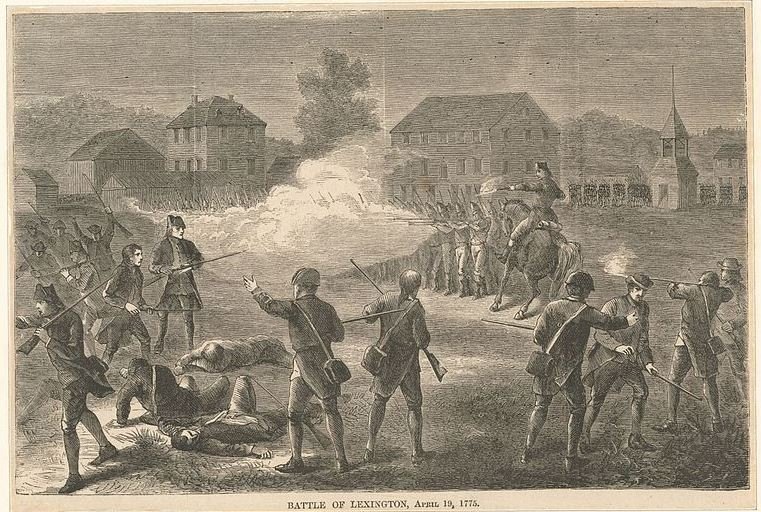
A depiction of the Battle of Lexington, at the New York Public Library
Background: Tensions Leading to the Conflict
The roots of the Battles of Lexington and Concord lie in escalating tensions between the American colonies and the British government. In late 1774, colonial leaders had strongly resisted the changes imposed by Britain on the Massachusetts colonial government, particularly after the Boston Tea Party in 1773. The British government retaliated by passing the Intolerable Acts in 1774, which aimed to punish Massachusetts and reinforce British authority over the colonies. In response, colonial leaders in Massachusetts adopted the Suffolk Resolves, a document that called for non-compliance with these acts and resistance to British authority.
The situation became even more charged when the Massachusetts Provincial Congress formed a Patriot provisional government and called on local militias to prepare for potential military conflict. The British, led by General Thomas Gage, the military governor of Massachusetts, responded by declaring the colony to be in a state of rebellion. Although Gage controlled Boston, the rest of Massachusetts was under the influence of the local militias and the provincial government, which increasingly resisted British rule.
British Plans and Colonial Intelligence
In the early months of 1775, General Gage and the British Army were aware of large stockpiles of military supplies being accumulated by the Massachusetts militias, particularly in the town of Concord. The British decided to launch a covert operation to capture and destroy these supplies, which were seen as vital to the colonial resistance. Lieutenant Colonel Francis Smith, in command of about 700 British regulars, was tasked with this mission.
However, the Patriots had already received intelligence about the British plans. Patriot leaders, including Paul Revere and Samuel Prescott, had received word of the British expedition well in advance and took steps to warn the militias. On the night of April 18, 1775, Revere and other riders set out from Boston to alert the countryside of the British movement. As part of the pre-arranged signal system, lanterns were displayed from the steeple of the Old North Church in Boston—”one if by land, two if by sea”—indicating that the British forces would be advancing by sea.
The midnight ride of Revere and Prescott alerted the militias in the surrounding areas, who began to gather and prepare for the British advance. By the time the British troops began their march, the colonists were ready to respond.
The Battle of Lexington: First Shots of the Revolution
At dawn on April 19, 1775, the British forces arrived in Lexington, where a small group of approximately 80 militiamen, led by Captain John Parker, awaited them. Parker had ordered his men to stand their ground but not to fire unless provoked. The British forces, under Major John Pitcairn, arrived on the common and ordered the militia to disperse. As tensions rose, a shot was fired—its origin remains a subject of debate—but it marked the beginning of the conflict. The British troops fired a volley into the militia, killing eight men and wounding several others. The militia, heavily outnumbered, quickly dispersed, and the British continued their march to Concord.
Although the engagement at Lexington was minor in scale, it symbolized a crucial turning point in the colonial struggle for independence. The event galvanized the local population and set the stage for further resistance. The “shot heard ’round the world,” as Ralph Waldo Emerson later immortalized it in his “Concord Hymn,” had been fired, and the American Revolution was underway.
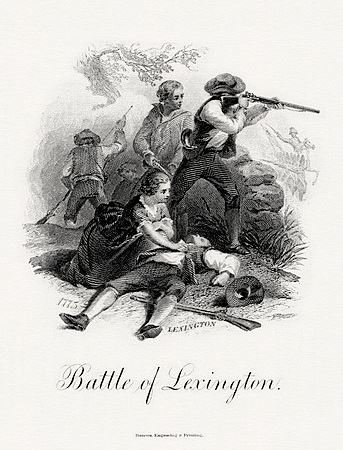
An engraving of the Battle of Lexington on the $20 Note.
The Battle of Concord: A Colonial Counterattack
Upon reaching Concord, the British forces began searching for military supplies. However, the bulk of the militia’s stockpile had been moved in anticipation of the British raid, rendering the mission largely futile. As the British forces searched the town, they encountered growing resistance from the local militias.
At the North Bridge in Concord, approximately 400 militiamen engaged around 100 British regulars. The militia, better positioned and supported by reinforcements, forced the British troops to retreat. This engagement, though relatively small in scale, marked a significant turning point, as the British forces were repelled and forced to fall back.
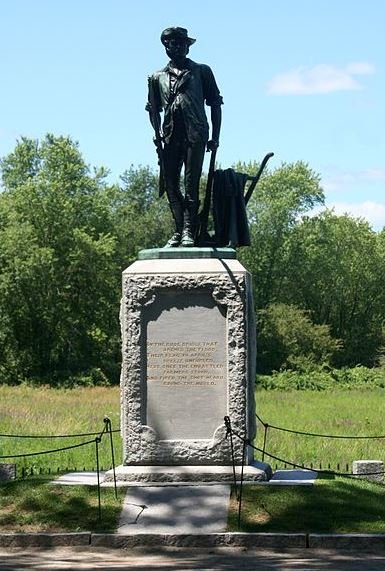
“The Minute Man” by American artist The Minute Man. This statue, located at the North Bridge, embodies the spirit of the everyday colonial soldier. While designed to reflect the common provincial fighter, the monument draws significant inspiration from Capt. Isaac Davis of Acton, who lost his life on that very ground. An excerpt from Emerson’s Concord Hymn is inscribed on the statue, commemorating the historic moment.
The British Retreat: Struggling Under Fire
After their failure to secure the supplies in Concord, the British began their retreat to Boston. However, as they marched back, they found themselves under constant fire from the increasingly larger and more organized colonial militias. Militia companies from surrounding towns joined the fight, and the British were harassed and ambushed throughout their retreat.
At Meriam’s Corner, the British rear guard was attacked by colonial forces, and as the retreat continued, the British suffered additional casualties. The regulars were exhausted, low on ammunition, and disorganized. Their retreat turned into a rout as the colonists, using guerrilla tactics, attacked from behind stone walls, trees, and buildings, preventing the British from regrouping effectively.
By the time the British forces reached Lexington, they were met by a large relief column under Brigadier General Earl Percy, which had been sent to assist them. The combined British force, now numbering around 1,700 men, began its march back to Boston, with the colonists continuing to harass them along the way. The British eventually made it back to Charlestown, where they were able to regroup and receive reinforcements.
While the Battles of Lexington and Concord themselves were small in scale, their impact was enormous, setting the stage for the larger conflict that would reshape the world.
Aftermath and Impact
The battles of Lexington and Concord were a significant early victory for the colonists. While the British forces had suffered only moderate casualties, the psychological impact was immense. The American militias had successfully resisted the British Army, and the event inspired greater participation in the colonial cause. Militiamen from New Hampshire, Rhode Island, and Connecticut quickly began to converge on the area, and by the end of the day, the British were effectively besieged in Boston.
The battles also marked the beginning of a broader conflict. Following the events of April 19, 1775, colonial leaders convened the Second Continental Congress, which would eventually lead to the formation of the Continental Army under George Washington. The American Revolution had officially begun, and the British were now faced with the challenge of suppressing a rebellion that would not easily be quelled.
Legacy and Commemoration
The Battles of Lexington and Concord hold a special place in American history. They are remembered as the moment when ordinary colonists rose up against the British Empire and began the fight for independence. The phrase “the shot heard ’round the world” has become synonymous with the American Revolution, representing the start of a conflict that would ultimately lead to the creation of the United States.
The courage and determination displayed by the colonial militias at the Battles of Lexington and Concord that day would inspire generations of Americans.
The historical significance of these battles was further cemented by the commemoration of the events in the 19th and 20th centuries. In 1837, Ralph Waldo Emerson’s “Concord Hymn” immortalized the battles, and the Minutemen, the colonial militias who had fought in the battles, became symbols of American courage and determination. Monuments and statues, including Daniel Chester French’s “The Minute Man” at the North Bridge in Concord, continue to honor the legacy of those who fought in these early engagements.
The battles were also commemorated in the 100th, 150th, and 200th anniversaries of the events. Each anniversary brought new generations of Americans to reflect on the significance of Lexington and Concord and the revolutionary spirit that these early battles embodied.
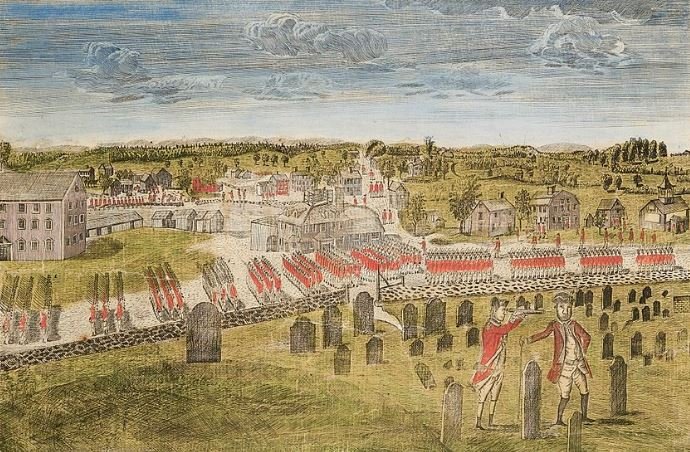
An engraving by American artist Amos Doolittle, depicting the British entering Concord.
Timeline
1768: British troops occupy Boston to enforce the Townshend Acts, increasing tensions between colonists and the British government.
1773: The Boston Tea Party takes place, where colonists protest British taxes by dumping tea into the harbor.
1774: The British Parliament passes the Coercive Acts (Intolerable Acts) to punish Massachusetts for the Tea Party, further escalating tensions.
1774: Colonial leaders adopt the Suffolk Resolves, rejecting British authority and calling for militias to prepare for potential conflict.
February 1775: General Thomas Gage declares Massachusetts in a state of rebellion, solidifying the divide between the colonies and Britain.
April 18, 1775: British forces, under Lieutenant Colonel Francis Smith, march from Boston to Concord to seize colonial military supplies.
April 19, 1775: The first shots are fired at Lexington, leading to the deaths of eight militiamen.
April 19, 1775: At Concord’s North Bridge, colonists defeat the British, forcing them to retreat back toward Boston.
April 19, 1775: The British retreat is harassed by militias, leading to significant casualties and the beginning of the siege of Boston.

A 2005 photo of the reconstructed North Bridge.
Frequently Asked Questions about the Battles of Lexington and Concord
Why did the British march to Concord?
The British aimed to seize and destroy military supplies stored by the Massachusetts militia in Concord, fearing these resources were critical for the colonial resistance.
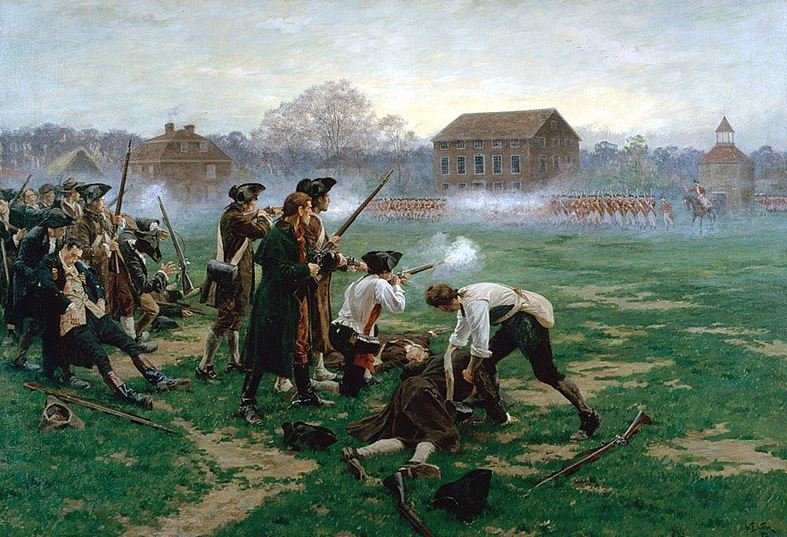
A painting portraying the Battle of Lexington. Artwork by William Barnes Wollen.
How did the colonists prepare for the British advance?
Colonial leaders, such as Paul Revere, used an established network of riders to warn militias in nearby towns about the British movements, allowing them to prepare and assemble in response.
What happened at Lexington?
In Lexington, around 80 militiamen faced the British advance, and a shot was fired, marking the beginning of hostilities. Eight militiamen were killed, and the British continued their march to Concord.
What occurred at Concord’s North Bridge?
At Concord’s North Bridge, about 400 militiamen confronted 100 British regulars, leading to the British retreat after the colonists inflicted casualties and forced them to fall back.
How did the British forces retreat from Concord?
During their retreat, the British were harassed by colonial militias, which fired on them from behind cover, causing significant British casualties and forcing a disorganized retreat back to Boston.
What was the impact of the battles on the colonies?
The battles galvanized colonial resistance, with thousands of militiamen converging on Boston, leading to the start of a siege around the city and the eventual formation of the Continental Army.
What is the legacy of the Battles of Lexington and Concord?
These battles are seen as the beginning of the American Revolution, symbolized by the “shot heard ’round the world,” and continue to be commemorated as a defining moment in American history.





