
The Bent Pyramid
The Bent Pyramid, located at the Dahshur necropolis around 40 kilometers south of modern-day Cairo, stands as one of the most enigmatic and significant architectural experiments in ancient Egypt. Commissioned by 4th Dynasty King Sneferu during the Old Kingdom period, this pyramid marked a pivotal moment in Egypt’s architectural evolution. As the second of Sneferu’s four pyramid constructions, it reflects a transitional phase from the earlier step pyramid design to the smooth-sided pyramids that would define the Egyptian skyline for centuries.

Limestone sculpture of Sneferu, housed in the Egyptian Museum.
The Bent Pyramid is especially noted for its visibly curved profile, a result of mid-construction alterations that set it apart from all others.
A Change in Architectural Philosophy
Archaeologists generally agree that the Bent Pyramid served as an evolutionary link between earlier step-sided structures and the true pyramids seen later at Giza. Its initial angle of inclination, set at about 54 degrees, was unusually steep.
Partway through construction, however, this angle was reduced to 43 degrees above a height of 47 meters, creating the distinctive “bent” appearance for which the pyramid is named. The reason for this change remains debated. While structural instability is often cited, recent research also suggests geometric and practical constraints—particularly relating to construction ramps—may have been the main reason.
Furthermore, Sneferu’s abandonment of the earlier Meidum Pyramid and its step design may indicate a broader shift in religious ideology. Rather than serving merely as a symbolic staircase to the heavens, pyramids like the Bent Pyramid began to represent solar and cosmic order. This change reflects the growing prominence of the solar cult, with the king becoming closely associated with Ra, the sun god.

Ra, the Sun God
Uniqueness in Preservation
One of the most striking features of the Bent Pyramid is the remarkable preservation of its original polished limestone casing. Among Egypt’s over 110 known pyramids, it is virtually the only one to retain so much of its outer shell. Some structural engineers have attributed this to the pyramid’s looser construction joints, which allowed the structure to accommodate thermal expansion more effectively than later pyramids with tighter stonework. These “imperfections” inadvertently protected the casing from cracking and falling away over time.
Construction Phases
The Bent Pyramid underwent three distinct construction phases. The first involved a proposed inclination of up to 60 degrees, which would have resulted in an extremely tall pyramid—estimated at about 125 meters. However, this design was likely abandoned early, possibly due to feasibility issues. Only indirect archaeological traces of this phase remain.
In the second phase, the pyramid’s base was enlarged, and the angle was modified to a still-steep 54 degrees. If completed at this gradient, the pyramid would have reached approximately 129.4 meters in height, making it one of the tallest in Egypt. Builders still used inclined masonry techniques from the step pyramid tradition, as the use of precision-cut trapezoidal stones had not yet developed.
In the third phase, construction continued with a dramatically reduced angle of 43 degrees, and workers adopted horizontal layering methods similar to those used in Sneferu’s later Red Pyramid. This final adjustment gave the structure its unique bent profile and reduced its overall height to 105 meters. The volume of the finished structure was approximately 1.44 million cubic meters, making it one of the largest pyramids ever constructed.
Engineering Considerations and Ramp Limitations
Modern theories have increasingly moved away from attributing the change in slope purely to structural issues. Instead, geometric and logistical limitations likely played a key role. In particular, the need for extended ramps during construction may have imposed constraints on the pyramid’s steepness.
As the structure rose, its horizontal surface area diminished, making it difficult to accommodate wide ramps essential for transporting heavy materials. A reduction in slope would have solved this issue, allowing construction to proceed without compromising the build’s practicality.
Interior Design and Chambers
The Bent Pyramid features two entrances: one located on the northern face and another on the western face, a highly unusual configuration. The northern entrance, now accessible via a wooden stairway for visitors, leads to a chamber beneath ground level, while the western entrance opens into a chamber constructed within the body of the pyramid.
Both chambers have corbelled ceilings, and a small, narrow passage connects the two. Interestingly, the western passage is blocked by two stone blocks, originally designed as portcullises. One of these was lowered in antiquity, while the other remains propped up by a cedar wood beam. This feature, along with the use of original cedar beams in the chambers, has prompted some to speculate they were intended to reinforce structural integrity. However, others argue these beams were part of the funerary architecture and not meant to bear structural loads.
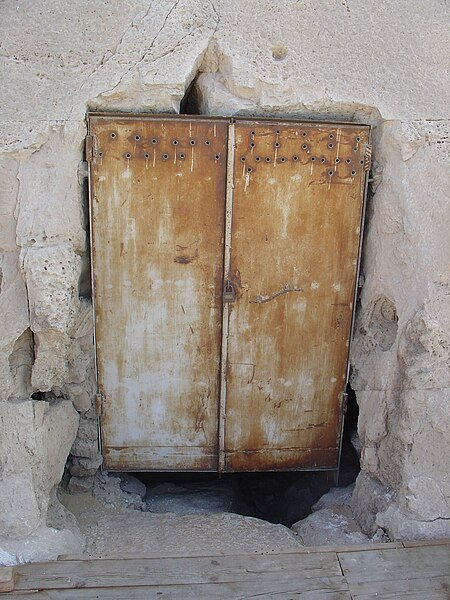
Western entrance
The Causeway and Access
The Bent Pyramid’s causeway stretches from its northeast to the pyramid’s valley temple. Paved with limestone and flanked by low walls, it extends over 700 meters and initially lacked any form of enclosure. This design flaw led to sand drifting into the causeway, eventually rendering it difficult to access without clearing. As a result, a small barrier wall with stairs was later added. This issue informed future pyramid construction, prompting later builders to cover their causeways to protect them from environmental factors.
It is also hypothesized that a second causeway may have existed, connecting the pyramid to a landing stage or harbor, although no conclusive evidence has yet been unearthed to confirm this.
Valley Temple Design
The valley temple associated with the Bent Pyramid differs significantly from other such temples in ancient Egypt. Unlike the typically rectangular structures, this temple features beveled walls and decorated pillars, except for the front-facing section. Measuring about 26 meters in width and 47 meters in length, the temple is aligned to form the northern boundary of the pyramid’s court.
Internally, the temple is divided into three sections: two enclosed chambers and a central open court. Its unique construction and orientation suggest a more intricate role in royal and religious ceremonies than previously thought.
The Pyramid Temple and Stelae
On the eastern side of the pyramid lie the remains of the main pyramid temple. Though now fragmented, it is believed to have resembled the temple at Meidum. Behind this structure stood two commemorative stelae, likely bearing inscriptions, though no readable text survives today. These stelae once stood as symbolic markers, linking the king’s eternal presence with divine powers.
The Satellite Pyramid
South of the Bent Pyramid stands a smaller satellite pyramid, believed to have been dedicated to the king’s ka, or spiritual essence. Originally standing at 26 meters in height with inclined walls at 44.5 degrees, this structure mirrors elements found in the main pyramid, including corbelled ceilings and limestone casing.
Access to the satellite pyramid’s burial chamber is granted via a descending corridor from the north face. Inside, a shaft—likely created by tomb robbers—plunges four meters into the floor. The satellite also featured its own altar and stelae, mirroring the main structure’s ritual significance.
Landscape Architecture and Symbolism
A groundbreaking interpretation of the Bent Pyramid considers it part of a vast man-made landscape rather than an isolated monument. German archaeologists Nicole Alexanian and Felix Arnold argue that the entire Dahshur site, including leveled plateaus, artificially constructed escarpments, and potential garden enclosures, was deliberately designed to emphasize the pyramid’s monumental presence.
They suggest that features such as a wadi channel leading to a harbor, the geometric arrangement of surrounding tombs, and the deliberate shaping of land contours were all expressions of royal authority and divine order. This artificial environment served not only as a sacred setting for rituals but also symbolized the king’s dominion over nature and society. The Bent Pyramid, therefore, was not merely a tomb but the centerpiece of a ritual landscape.
Material Composition of the Casing Stones
Recent scientific analysis has helped resolve longstanding debates about the composition of the pyramid’s casing stones. A multi-disciplinary study using nuclear magnetic resonance (NMR) revealed that the casing was made from natural limestone sourced from the Tura quarries. However, it was bound using a synthetic calcium-silicate mixture, possibly incorporating diatomaceous earth from the Fayum region. This evidence supports the theory that the outer casing employed an early form of stone cement, demonstrating advanced knowledge of materials engineering for its time.
From its unusual profile and preserved limestone casing to its integration into a carefully crafted landscape, the Bent Pyramid embodies both technical ingenuity and cultural sophistication.
Graffiti and Quarry Marks
Inside the Bent Pyramid, red-painted graffiti can be found in various corners of the internal structures, including the enclosure and offering temples. These markings, likely created by workers, are crucial to dating the construction phases accurately. Many of them reference Sneferu directly, helping confirm his role as the pyramid’s patron. Such inscriptions also offer rare glimpses into the labor and organization behind one of ancient Egypt’s most ambitious building projects.
Legacy and Tourism
After being closed for decades, the Bent Pyramid was reopened to the public in 2019, allowing tourists to explore its chambers via a 79-meter narrow tunnel. For the first time, the adjacent satellite pyramid—believed to be associated with Queen Hetepheres—was also made accessible. These efforts have increased public awareness of Sneferu’s architectural contributions and emphasized the pyramid’s unique place in Egyptian history.
Frequently Asked Questions about the Bent Pyramid
What makes the Bent Pyramid architecturally unique?
Its change in angle mid-construction—from 54 to 43 degrees—creates a visibly bent profile, marking a transitional phase between step pyramids and true pyramids.
Why was the angle of the Bent Pyramid altered?
The steep original angle may have caused structural concerns or posed logistical issues with construction ramps, prompting a reduction to ensure completion.
How does the Bent Pyramid reflect religious change?
It marks a shift from step pyramids symbolizing stairways to the heavens toward smooth pyramids representing solar and cosmic order aligned with the sun god Ra.
What materials contribute to the preservation of its casing?
Limestone from Tura and looser joints that acted as expansion buffers helped preserve the polished casing, unlike most other pyramids.
What is significant about the pyramid’s internal design?
It has two entrances leading to separate chambers, with unique cedar beams and portcullis blocks—features rarely seen in other pyramids.
What role does the satellite pyramid play?
Located south of the main structure, it likely served a ritual function for the king’s ka and features a similar internal layout and altar.
How does the landscape support the pyramid’s meaning?
The surrounding man-made plateau, quarry trenches, and water channels form a ritual landscape emphasizing royal power and sacred symbolism.
What did recent scientific analysis reveal about its construction?
Studies confirmed the casing stones are natural limestone bound with a man-made calcium-silicate mix, suggesting early use of synthetic stone materials.





