The Eight Kings of England that bore the name Henry
England has had eight kings named Henry, each contributing to the history of the nation in unique ways. From the Norman Conquest to the establishment of the Tudor dynasty, these kings ruled during periods of significant change, conflict, and development.
From Henry I to Henry VIII, World History Edu takes a look at the lives and reigns of the eight monarchs of England that bore the name Henry.
Henry I (r. 1100-1135)

Henry I (r. 1100-1135) is best known for strengthening royal justice and administration.
Henry I, also known as Henry Beauclerc, was the fourth son of William the Conqueror. He became king after the death of his brother, William II, in a hunting accident. Henry I is noted for his administrative reforms and efforts to strengthen royal justice.
- Background and Ascension: Henry seized the throne quickly after William II’s death, securing his position by issuing the Charter of Liberties, which promised to end the abuses of power by the crown.
- Reign: His reign saw significant legal and administrative changes. He established the Exchequer to improve royal finances and justice. Henry was known for his fairness and decisiveness in dealing with legal matters.
- Legacy: Henry I’s reign was marked by the tragic loss of his only legitimate son, William Adelin, in the White Ship disaster. This led to a succession crisis after his death, plunging England into a period of civil war known as The Anarchy.
Henry II (r. 1154-1189)

Henry II (r. 1154-1189) reformed English law and clashed with Thomas Becket. Image: A drawing depicting Henry II.
Henry II, the first of the Plantagenet kings, restored order after The Anarchy. He is often remembered for his conflicts with Thomas Becket, Archbishop of Canterbury, and his extensive legal reforms.
- Background and Ascension: As the grandson of Henry I and son of Matilda, Henry II had a strong claim to the throne. He ascended the throne after the death of King Stephen.
- Reign: Henry II’s reign was characterized by significant legal reforms, including the development of common law and the establishment of royal courts. His conflicts with Thomas Becket culminated in Becket’s murder, an event that tarnished Henry’s reputation.
- Legacy: Despite his tumultuous relationship with his sons, Henry II established a strong foundation for the Plantagenet dynasty. His legal reforms had a lasting impact on the English legal system.
Henry III (r. 1216-1272)
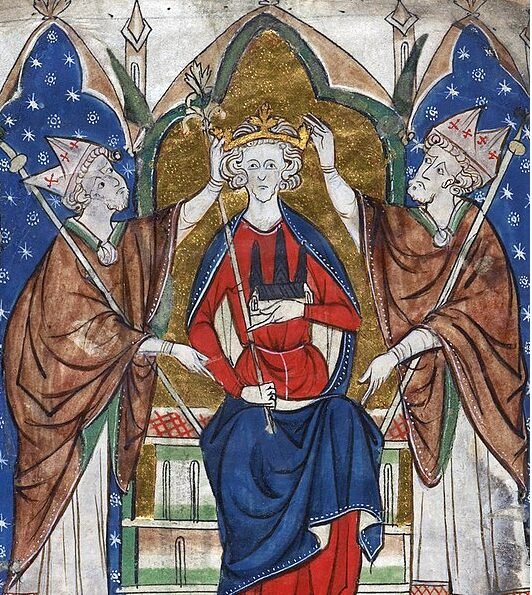
It was during the reign of Henry III (r. 1216-1272) that the English Parliament was established. Image: Henry III (center)
Henry III, the son of King John, ascended the throne during a period of political instability. His long reign saw continued conflict with the barons and the establishment of the English Parliament.
- Background and Ascension: Henry became king at the age of nine, following his father’s death. His early reign was dominated by regents and advisors.
- Reign: Henry III’s reign was marked by conflicts with the barons, leading to the Provisions of Oxford in 1258, which sought to limit royal power. These tensions culminated in the Second Barons’ War, led by Simon de Montfort.
- Legacy: Despite these conflicts, Henry III’s reign saw the foundation of Westminster Abbey and significant cultural developments. His establishment of the English Parliament laid the groundwork for a more representative government.
Henry IV (r. 1399-1413)

Reigning from 1399-1413, Henry IV faced numerous rebellions.
Henry IV, the first king from the House of Lancaster, came to power through the deposition of Richard II. His reign was marked by rebellion and efforts to solidify his claim to the throne.
- Background and Ascension: Henry IV, originally Henry Bolingbroke, seized the throne from his cousin Richard II, who was perceived as a tyrant.
- Reign: Henry faced numerous rebellions, including the Welsh uprising led by Owain Glyndŵr and the Percy Rebellion. His health deteriorated towards the end of his reign, complicating his ability to govern.
- Legacy: Henry IV’s successful establishment of the Lancastrian dynasty set the stage for his son’s more celebrated reign. His efforts to maintain control and legitimacy in the face of rebellion were notable.
Henry V (r. 1413-1422)

Among the eight English kings named Henry, Henry V is perhaps the one best known for his military prowess.
Henry V is best remembered for his military successes during the Hundred Years’ War, particularly the Battle of Agincourt, and his efforts to strengthen the monarchy.
- Background and Ascension: Henry V ascended the throne after his father’s death. He quickly proved himself as a capable and charismatic leader.
- Reign: His military campaigns in France, especially the victory at Agincourt in 1415, cemented his reputation as one of England’s greatest warrior kings. Henry also worked to stabilize the kingdom internally.
- Legacy: Henry V’s untimely death at the age of 35 left his son, Henry VI, to inherit the throne as an infant. His victories in France had a lasting impact on English and French history.
Henry V of England: 10 Notable Achievements of England’s Warrior King
Henry VI (r. 1422-1461, 1470-1471)
Henry VI’s reign was tumultuous, characterized by the ongoing Hundred Years’ War and the Wars of the Roses. He was known for his piety and scholarly interests but struggled with mental illness and ineffective governance.
- Background and Ascension: Henry VI became king as an infant, following the death of his father, Henry V. His long minority saw power struggles among the nobility.
- Reign: Henry’s reign was marked by the loss of English territories in France and internal conflict. His bouts of mental illness led to periods of regency. The Wars of the Roses erupted as rival factions vied for control.
- Legacy: Henry VI’s weaknesses as a ruler contributed to the dynastic conflicts that engulfed England. He was eventually deposed by Edward IV and briefly restored before being captured and murdered.
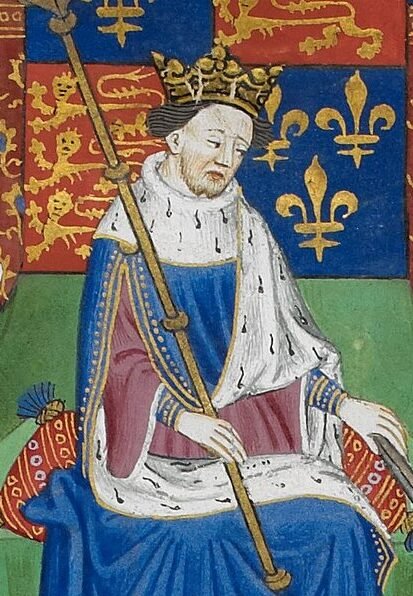
The eight kings named Henry each left a unique mark on English history. Henry VI (r. 1422-1461, 1470-1471) endured the Wars of the Roses. Image: Henry VI of England
Henry VII (r. 1485-1509)
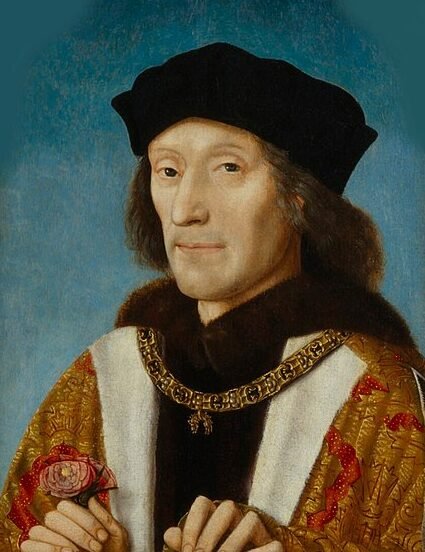
Henry VII (r. 1485-1509) founded the Tudor dynasty, ending the Wars of the Roses.
Henry VII founded the Tudor dynasty after defeating Richard III at the Battle of Bosworth Field. His reign marked the end of the Wars of the Roses and the beginning of a new era of stability and prosperity.
- Background and Ascension: Henry VII claimed the throne through his mother, Lady Margaret Beaufort, and his victory at Bosworth Field in 1485.
- Reign: Henry worked to consolidate power, reduce the influence of the nobility, and strengthen royal finances. He used strategic marriages and alliances to secure his dynasty’s future.
- Legacy: Henry VII’s reign laid the foundations for the Tudor dynasty. His careful governance and financial prudence restored stability and established a prosperous and strong monarchy.
Henry VIII (r. 1509-1547)
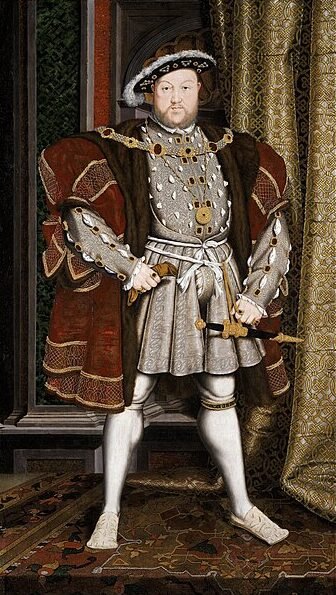
Henry VIII, infamous for his six marriages and the English Reformation, is one of the most recognized today.
Henry VIII is perhaps the most famous of the English kings named Henry, known for his six marriages and his role in the English Reformation, which led to the establishment of the Church of England.
- Background and Ascension: Henry VIII succeeded his father, Henry VII, and quickly became a larger-than-life figure in English history.
- Reign: Henry’s desire for a male heir led to his separation from the Roman Catholic Church and the creation of the Church of England. His reign saw significant religious, political, and social upheaval. He executed several of his wives and key advisors.
- Legacy: Henry VIII’s establishment of the Church of England had profound and lasting effects on English and European history. His reign is remembered for its dramatic personal and political conflicts, as well as its cultural achievements.
The Act of Supremacy and how the English Monarch became Supreme Head of the Church of England





