The Evil Spirit of Mithraic Religion
The Mithraic religion, also known as Mithraism, was a mystery cult centered around the worship of Mithras, a deity of light and truth derived from ancient Indo-Iranian traditions. Mithraism became prominent in the Roman Empire between the 1st and 4th centuries CE, flourishing particularly among soldiers and other male adherents. It was a secretive faith, steeped in complex rituals, celestial symbolism, and layers of dualistic cosmology.
Among the many figures in Mithraic iconography, one less commonly understood but deeply significant is Ariamanus (sometimes referred to as Ahriman or Arimanius). Ariamanus is an enigmatic and shadowy figure, often interpreted as the embodiment of darkness or evil within the Mithraic belief system. His discovery in Mithraic sanctuaries poses both theological and archaeological challenges, sparking questions about the role of dualism in Mithraism.
The discovery of another Ariamanus statue has reignited debates on its symbolic significance, historical context, and its connections to the Zoroastrian concept of Angra Mainyu, the evil spirit in Zoroastrianism.

Mithras killing the bull, a relief at the Louvre-Lens museum in France.
The Origins of Ariamanus
To understand Ariamanus, one must first look to Zoroastrianism, an ancient Persian religion that significantly influenced Mithraic cosmology. Zoroastrianism presents a dualistic worldview, where Ahura Mazda (the supreme god of light) is opposed by Angra Mainyu (or Ahriman), the destructive spirit of chaos and darkness. This dichotomy between good and evil, light and dark, became a foundational element of later religious systems, including Mithraism.
Ariamanus, whose name bears a linguistic resemblance to Ahriman, is thought to be a Roman reinterpretation of this malevolent spirit. In Mithraism, however, Ariamanus takes on a more ambiguous role, suggesting a reinterpretation rather than a direct adoption of Zoroastrian concepts.

Ahura Mazda
Roman Adaptation
As Mithraism spread within the Roman Empire, it absorbed local traditions and philosophical ideas. Roman Mithraists adapted Zoroastrian dualism to align with their own religious framework, resulting in figures like Ariamanus. Unlike the clear antagonism between Ahura Mazda and Ahriman in Zoroastrianism, Mithraism presents a more complex interplay between forces of light and darkness.
The exact role of Ariamanus in Mithraism remains debated. Some scholars view him as a necessary counterpart to Mithras, embodying the chaos that Mithras must overcome to sustain cosmic order. Others argue that Ariamanus represents a more nuanced principle of balance within the Mithraic universe, not inherently evil but embodying the darker aspects of existence.
Symbolism and Depictions of Ariamanus
Ariamanus is often depicted in Mithraic art with striking and ominous features. Statues and reliefs typically portray him as a serpentine or monstrous figure, emphasizing his otherworldly nature. His iconography often contrasts sharply with that of Mithras, who is usually shown as youthful and radiant.
Key Features of Ariamanus
Snakes are a recurring motif in Mithraic art, symbolizing rebirth, death, and the chthonic (underworld) forces. Ariamanus statues often incorporate serpentine elements, linking him to these themes.
His facial expressions and bodily postures are designed to evoke fear or unease, underscoring his role as a force of disruption.
In Mithraic sanctuaries (mithraea), Ariamanus statues are typically placed in shadowy or less prominent areas, suggesting his association with hidden or secret knowledge.
The Ariamanus Statue retains many of these features, offering new insights into his evolving representation across time and regions.
Archaeological Context of the Ariamanus Statue
The Ariamanus statue was unearthed in a Mithraic sanctuary in southeastern Europe, a region that was a cultural crossroads during the Roman period. The sanctuary, or mithraeum, is remarkably well-preserved, providing a rich context for understanding the statue’s placement and function.
Physical Characteristics
This particular statue stands at about 1.5 meters tall, carved from dark limestone. Its craftsmanship suggests it dates to the 3rd century CE, a period of heightened Mithraic activity in the Roman Empire. The figure is depicted with exaggerated, almost grotesque features: a snarling face, coiled serpents entwined around its limbs, and clawed hands grasping at the void.
Ritual Placement
The statue was found near the back of the mithraeum, in a recessed niche that would have been visible only during specific rituals. This placement aligns with the idea that Ariamanus served a ceremonial purpose, possibly as a focal point for initiates grappling with the darker aspects of the cosmos.
Associated Artifacts
Nearby, archaeologists uncovered a cache of ritual objects, including lamps, small animal bones, and inscriptions invoking Mithras. These artifacts suggest that the statue was part of a broader ritualistic framework, perhaps representing an initiatory challenge or a symbolic confrontation with darkness.
Implications and Significance

The prominence of Ariamanus underscores the dualistic nature of Mithraism, where light and darkness are not simply opposites but interdependent forces. This dualism reflects a worldview in which cosmic harmony is achieved through the balance and interaction of opposing principles.
Mithraic rituals were structured around a series of initiations, each corresponding to a different level of spiritual understanding. The confrontation with Ariamanus may have symbolized an essential stage in this journey, forcing initiates to face their fears and internal struggles.
Through his serpentine form and hidden placement in Mithraic sanctuaries, Ariamanus symbolizes the hidden struggles faced by initiates and the broader human condition.
The figure of Ariamanus also resonates with contemporary philosophical currents, such as Stoicism and Neoplatonism, which emphasized the necessity of overcoming inner turmoil to achieve enlightenment. His presence in Mithraic sanctuaries could thus be interpreted as a metaphor for the spiritual trials faced by adherents.
Comparative Analysis: Ariamanus and Angra Mainyu
While Ariamanus bears clear parallels to Angra Mainyu, the differences between the two highlight the adaptive nature of Mithraism.
In Zoroastrianism, Angra Mainyu is a purely destructive force, seeking to unravel the order established by Ahura Mazda. He is unequivocally evil, embodying chaos, lies, and death.
The rediscovery of the Ariamanus statue also sheds light on the broader cultural and historical context of Mithraism.
Ariamanus, by contrast, occupies a more ambiguous role. While he is associated with darkness and disruption, he is not necessarily malevolent. Instead, he may represent a necessary counterbalance to Mithras, contributing to the dynamic interplay that sustains the cosmos.
This distinction reflects the syncretic nature of Mithraism, which blended elements from different traditions to create a unique religious system.
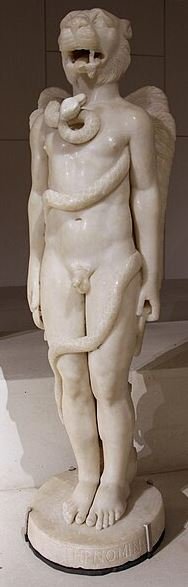
The lion-headed figure from the Sidon Mithraeum is often interpreted as a Mithraic depiction of Arimanius.
Integration into Roman Society
Mithraism thrived in the Roman Empire, particularly among soldiers, who found its themes of loyalty, strength, and cosmic struggle appealing. The inclusion of figures like Ariamanus suggests a willingness to grapple with complex and sometimes unsettling aspects of existence.
Competition with Christianity
The 3rd century CE was a time of intense religious competition, as Christianity began to emerge as a dominant force in the Roman world. Mithraism’s focus on dualism and cosmic struggle may have appealed to those seeking a more esoteric alternative to the Christian message of redemption.
Decline and Legacy
By the 4th century CE, Mithraism began to decline, overtaken by Christianity’s growing influence. However, its symbols and ideas left a lasting impression on Western esoteric traditions, where figures like Ariamanus continued to evoke fascination.
Modern Interpretations and Controversies
The figure of Ariamanus has been subject to various interpretations in modern scholarship and popular culture.
Scholars continue to debate whether Ariamanus was viewed as an adversary or a complementary force within Mithraism.
Some argue that Ariamanus represents a direct borrowing from Zoroastrianism, while others see him as a uniquely Roman creation.
In modern esoteric circles, Ariamanus is sometimes reimagined as a symbol of shadow work—the psychological process of confronting and integrating one’s darker aspects.
Popular portrayals often oversimplify Ariamanus as a “devil figure,” ignoring the nuanced role he played in Mithraic cosmology.
Questions and Answers

What is the Ariamanus Statue artifact, and what does it represent?
The artifact is a leontocephaline (lion-headed) figure associated with the Mithraic religion. It depicts a naked, lion-headed man wearing a loincloth and wings, likely eagle wings, with a serpent coiled around his body. The figure’s design and symbolism connect it to ancient Mithraic rituals and cosmology.
What are the dimensions and weight of the artifact?
The artifact measures 37 cm in height, 14 cm in width, and weighs 5.8 kg.
What features of the figure are unique to its design?
Unique features include the closed eagle-like wings, the serpent coiling five times around the figure’s body, a cylindrical object held in the right hand, and a sword handle gripped in the left hand. The serpent’s head rests atop the lion’s head, and the back has a hole, possibly for mounting on a wall or shelf.
What is the significance of the serpent in the figure’s design?
The serpent symbolizes binding, cosmic cycles, and malevolent forces. Its coils and placement align with similar depictions in Mithraic and Zoroastrian traditions, where serpents often represent chaos or evil.
What is Mithraism, and where did it originate?
Mithraism was a mystery cult centered on Mithra, an Indo-Iranian deity of contracts, oaths, light, and friendship. It originated in the Iranian sphere and spread westward, becoming a prominent religious practice in the Roman Empire.
How did Mithraism spread to Rome?
Roman soldiers stationed in Armenia, where Mithraic practices were well-established, likely brought the religion to Rome. Over time, Mithraism became the most important mystery cult in the Roman world.
What were Mithraea, and what occurred within them?
Mithraea were cave-like sanctuaries used for Mithraic rituals. Central to these spaces was the depiction of Mithras slaying a bull, symbolizing cosmic renewal. Adherents participated in sacred meals of bread and wine, echoing themes of redemption and communal worship.
What other figures are typically depicted in Mithraic iconography?
In addition to Mithras slaying the bull, Mithraic iconography includes figures such as Cautes and Cautopates (torchbearers) and the lion-headed figure, which sometimes holds keys, a staff, or a torch. These figures often include zodiac motifs.
What does the lion-headed figure symbolize in Mithraic religion?
The lion-headed figure, often bound by a serpent, symbolizes cosmic boundaries, malevolent forces, and possibly the containment of souls within the material world. Its association with Ahriman links it to the Zoroastrian concept of evil and spiritual struggle.
How does the lion-headed figure relate to Zoroastrian and Mesopotamian traditions?
The figure draws from Zoroastrian imagery of Ahriman, the Evil Spirit, and Mesopotamian depictions of lion-headed beings in Assyrian reliefs. Both traditions emphasize chaos and malevolent forces.
How does Ariamanus compare to serpent symbolism in other traditions?
Ariamanus’s coiling and destructive associations parallel similar symbols in Yazidi, Gnostic, and Zoroastrian traditions, where serpents represent chaos, creation-destruction dynamics, and malevolence.





