The Early Dynastic Period of ancient Egypt (circa 3100–2686 BCE) marked the consolidation of the Egyptian state and the establishment of its political, religious, and cultural foundations. This period spans the 1st and 2nd Dynasties, with kings whose reigns shaped Egypt’s identity. Among these rulers, five prominent kings stand out for their contributions to Egypt’s development. Here’s a detailed analysis of these rulers, their reigns, and their legacies:
Narmer (c. 3100 BCE)

Archeologists and scholars theorize that King Narmer tied the knot with Neithhotep, a royal princess from the region of Naqada, as part of his efforts to unite Lower and Upper Egypt. This would explain why she went by epithets such as “Foremost of Women” and “Consort of the Two Ladies”. Narmer, who is sometimes identified with his successor Hor-Aha, is reasoned to be the first king of the first dynasty
Narmer is traditionally regarded as the first ruler of a unified Egypt, marking the transition from the Predynastic to the Early Dynastic Period. He is often equated with Menes, a semi-mythical figure credited by later historians as the founder of the First Dynasty.
Achievements and Legacy
- Unification of Egypt: Narmer is credited with uniting Upper and Lower Egypt, symbolized by his depiction on the Narmer Palette. The palette shows Narmer wearing both the White Crown of Upper Egypt and the Red Crown of Lower Egypt, signifying his control over the two lands.
- Foundation of Memphis: He is believed to have founded Memphis, strategically located at the junction of Upper and Lower Egypt, which became the administrative and cultural capital.
- Cultural Integration: Narmer’s reign emphasized the integration of regional cultures and religious practices into a cohesive state ideology, solidified through art and ceremonial objects.
Impact
Narmer established the model for centralized kingship and divine rule, which became the cornerstone of Egyptian governance for millennia.
Hor-Aha (c. 3100–3050 BCE)

King Hor-Aha – the second king of the first dynasty. Image: Faience vessel fragment with serekh inscribed with the Horus-name Aha, on display at the British Museum.
The successor of Narmer, Hor-Aha (“Horus the Fighter”) was an active ruler who consolidated the unification and extended Egyptian influence. His name reflects his association with Horus, the falcon god, linking kingship to divine authority.
Achievements and Legacy
- Political Consolidation: Hor-Aha strengthened the central government and suppressed local rebellions, ensuring the unity established by Narmer.
- Religious Development: He promoted the cult of the god Ptah, whose temple at Memphis gained prominence during his reign.
- Economic Expansion: Evidence suggests that Hor-Aha conducted military campaigns in the Sinai Peninsula, securing trade routes and access to valuable resources like copper and turquoise.
Impact
Hor-Aha’s reign reinforced the divine nature of kingship and expanded Egypt’s territorial and economic reach, laying the groundwork for future prosperity.
Djer (c. 3050–3000 BCE)

Iti is the name of King Djer in the Abydos King List. Image – Djer’s cartouche name
Djer, the third ruler of the First Dynasty, is known for his long reign and contributions to state organization and religious traditions. His tomb at Abydos is one of the largest from the Early Dynastic Period, reflecting his power and resources.
Achievements and Legacy
- Military Campaigns: Djer conducted campaigns in Nubia and the Levant, asserting Egypt’s dominance and securing critical trade connections.
- Administrative Reforms: He expanded the administrative bureaucracy, ensuring effective governance across the growing state.
- Religious Innovations: Djer’s reign saw the formalization of burial practices, including the use of funerary offerings and grave goods, which became integral to Egyptian religion.
Impact
Djer’s contributions to statecraft and religion had lasting effects, influencing Egypt’s cultural and political systems throughout the dynastic period.
Den (c. 3000–2970 BCE)

Cartouche of Pharaoh Den
Den, one of the most celebrated kings of the First Dynasty, ruled during a period of stability and innovation. His reign is well-documented through inscriptions and artifacts, offering a detailed view of his achievements.
Achievements and Legacy
- Economic Prosperity: Den oversaw a flourishing economy, supported by advancements in agriculture, trade, and craft production. He introduced the first documented taxation system.
- Technological Innovation: His reign saw the introduction of stone architecture, as evidenced by his tomb at Abydos, which features the earliest known stairway.
- Military Success: Den conducted successful campaigns against Nubia and Libya, securing Egypt’s borders and enhancing its prestige.
- Cultural Advancements: He popularized royal titulary, adopting titles that emphasized his role as a divine ruler and protector of Egypt.
Impact
Den’s reign epitomized the strength and innovation of the Early Dynastic Period, leaving a legacy of cultural and administrative advancements.
Khasekhemwy (c. 2686 BCE)
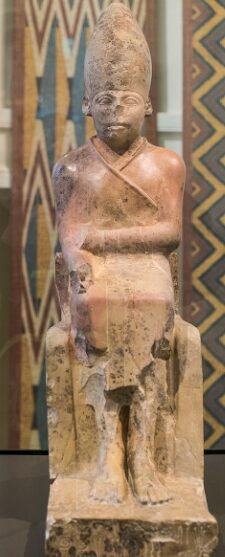
Khasekhemwy in the Ashmolean Museum
Khasekhemwy, the last king of the Second Dynasty, played a pivotal role in stabilizing Egypt after a period of internal conflict. His reign bridged the Early Dynastic Period and the Old Kingdom, ensuring continuity in Egyptian statehood.
Achievements and Legacy
- Resolution of Civil Strife: Khasekhemwy is credited with ending a prolonged civil war between Upper and Lower Egypt, as indicated by his name, which means “The Two Powers Appear in Harmony.”
- Architectural Achievements: He constructed massive mudbrick structures, including the Shunet el-Zebib at Abydos, which served as a prototype for later mortuary complexes.
- Religious Significance: His reign emphasized the duality and unity of Egypt, symbolized by his use of both Horus and Seth in his royal titulary—a unique feature among Egyptian kings.
- Military Campaigns: Khasekhemwy also conducted military campaigns in Nubia, securing Egypt’s southern border.
Impact
Khasekhemwy’s efforts to stabilize Egypt and integrate conflicting factions ensured a smooth transition to the Old Kingdom, marking the culmination of the Early Dynastic Period.
Conclusion
The Five Great Kings of Egypt’s Early Dynastic Period—Narmer, Hor-Aha, Djer, Den, and Khasekhemwy—laid the foundations for ancient Egypt’s enduring civilization. Through military conquest, administrative innovation, and cultural integration, they established the principles of kingship, governance, and religious practice that defined Egypt for centuries. Their legacies, preserved through monuments, inscriptions, and artifacts, continue to provide invaluable insights into the origins of one of history’s greatest civilizations.
Questions and answers

Detail from an ebony label of the First Dynasty pharaoh Den
What is the Early Dynastic Period of Egypt, and why is it significant?
The Early Dynastic Period (3150–2613 BCE) marked the foundation of ancient Egypt’s civilization. It saw the unification of Upper and Lower Egypt, the establishment of kingship as a divine institution, and the beginnings of monumental architecture and cultural development.
Why is it difficult to study the Early Dynastic Period?
The period is considered prehistoric, as most surviving written records come from centuries later. Archaeological evidence, such as seal impressions, tomb inscriptions, and monuments, provides valuable but incomplete information, leaving many aspects of this era speculative.
Who was Narmer, and what were his achievements?
Narmer, considered the founder of the First Dynasty, unified Upper and Lower Egypt and established a model of centralized governance. He expanded Egypt’s influence into Canaan and Nubia, increased urban development, and is famously depicted on the Narmer Palette wearing the double crown of Egypt.
What made Den an influential ruler of the Early Dynastic Period?
Den, the sixth king of the First Dynasty, ruled for 50 years, overseeing economic prosperity, military conquests, and stability. He was the first king to be depicted wearing the double crown, symbolizing unification, and introduced administrative reforms, including Egypt’s taxation system.
How did Raneb contribute to the development of kingship in Egypt?
Raneb, the second king of the Second Dynasty, was the first ruler to incorporate the name of the sun god Ra into his own, linking kingship with divinity. His reign saw the flourishing of religious practices, including the first depictions of the cat goddess Bastet.
Why is Peribsen’s reign considered significant?
Peribsen adopted the god Set’s name instead of Horus, which may indicate a political or religious shift. He encouraged literacy and administrative reforms, and his tomb contains the first complete sentence in Egyptian history, emphasizing the divine legitimacy of his rule.
What are Djoser’s most notable contributions to Egypt?
Djoser, the first king of the Third Dynasty, is renowned for the Step Pyramid at Saqqara, designed by his vizier Imhotep. This structure, the first stone pyramid in Egypt, symbolized Djoser’s eternal reign and showcased advances in architecture, stability, and cultural flourishing.
How did these rulers influence future Egyptian history?
Narmer, Den, Raneb, Peribsen, and Djoser established the foundations of Egyptian political, religious, and cultural traditions. Their achievements in unification, divine kingship, and monumental architecture set standards that later pharaohs sought to emulate, leaving a lasting legacy.





