The Great Jewish Revolt of 66 CE: History and Major Facts
The Great Jewish Revolt of 66 CE stands as one of the most significant uprisings in the Roman Empire, reflecting the collision of imperial dominance and regional identity. The revolt, known in Hebrew as מרד הגדול (Mered HaGadol), erupted in the Roman province of Judaea and lasted from 66 to 73 CE.
Its roots lay deep in the complex socio-political, economic, and religious dynamics of the region, exacerbated by heavy-handed Roman administration. Ultimately, the revolt had profound consequences, culminating in the destruction of Jerusalem and the Second Temple, a trauma that reshaped Jewish history for centuries.
Background of the Great Jewish Revolt

The Roman Rule in Judaea
Judaea had come under Roman control in 63 BCE, following the conquest of the region by Pompey the Great. Although initially allowed a degree of autonomy under client kings like Herod the Great, the province’s integration into the Roman system brought significant tension. After Herod’s death in 4 BCE, his kingdom was divided among his sons, but Roman direct rule was instituted in 6 CE under the governorship of Coponius.
Roman governance often conflicted with Jewish religious traditions. The Jews, adherents of a monotheistic faith, found certain aspects of Roman imperial culture, such as emperor worship and pagan practices, deeply offensive. This cultural rift was compounded by economic exploitation, high taxation, and corrupt administrative practices, particularly under governors like Gessius Florus.
Religious and Social Tensions
The diverse population of Judaea added to the unrest. The region housed not only Jews but also Greeks, Samaritans, and other groups. Tensions often erupted into violence, as seen in incidents in cities like Caesarea, where Greeks and Jews clashed over civic privileges.
Within the Jewish community, various sects—Pharisees, Sadducees, Essenes, and Zealots—had differing views on how to interact with Roman authority. The Zealots and their militant offshoot, the Sicarii, advocated armed resistance, which contrasted with the more moderate Pharisees and the aristocratic Sadducees.

Ruins at Caesarea, site of 66 CE riots sparked by a Greek’s provocative sacrifice.
Immediate Causes
The revolt’s immediate spark came from widespread dissatisfaction with Roman mismanagement. Gessius Florus, the Roman governor in 64–66 CE, exacerbated tensions by seizing funds from the Temple treasury and openly mocking Jewish traditions. Protests against Florus led to brutal crackdowns, further inflaming anger.
When a group of Jews refused to offer sacrifices in honor of the emperor, a symbol of allegiance to Rome, the conflict escalated. The rejection of Roman rule became more organized, with nationalist factions like the Zealots gaining influence.
Outbreak of the Revolt
In 66 CE, the revolt officially began in Caesarea, where Greek citizens desecrated a synagogue. The Roman response was seen as biased, favoring the Greeks and ignoring Jewish grievances. This sparked violent riots, which quickly spread to Jerusalem.
In Jerusalem, insurgents took control, expelling or killing Roman forces and pro-Roman Jewish elites. The rebels established a provisional government, led by figures like Simon ben Giora, John of Gischala, and Eleazar ben Simon, to oversee the revolt.
The early stages of the rebellion were marked by Jewish successes. Rebel forces defeated a Roman legion under Cestius Gallus, the governor of Syria, at the Battle of Beth Horon. This victory shocked Rome and emboldened the rebels, who began organizing their defenses in anticipation of a larger Roman response.
The Roman Counteroffensive
Vespasian’s Campaign
In 67 CE, Emperor Nero dispatched General Vespasian to quell the revolt. Vespasian, accompanied by his son Titus, launched a systematic campaign to subdue Judaea. He first targeted the Galilee region, a stronghold of the rebellion. Cities like Jotapata fell after brutal sieges, with thousands killed or enslaved.
The fall of Galilee marked a turning point, as Roman forces moved southward, gradually encircling Jerusalem. The rebellion’s leadership fractured during this period, with rival factions vying for control, weakening the Jewish resistance.

Bust of Vespasian at the Pushkin Museum in Moscow.
The Siege of Jerusalem
In 70 CE, Titus assumed command of the Roman forces and led the assault on Jerusalem. The siege, lasting several months, was marked by fierce fighting and significant casualties. Internal divisions among the Jews, including clashes between the Zealots and other factions, further hampered the city’s defense.
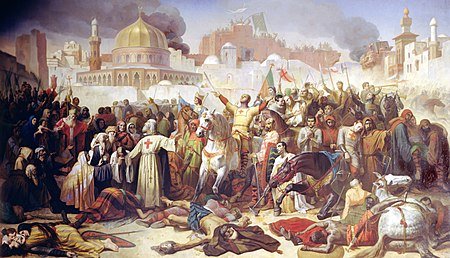
The Romans employed siege engines and a strategy of attrition, cutting off food and water supplies. Starvation and disease ravaged the city’s population. In August of 70 CE, Roman forces breached Jerusalem’s walls, leading to the destruction of the Second Temple, a pivotal event in Jewish history.
Siege of Jerusalem (70 CE), depicted in Francesco Hayez’s painting “Destruction of the Temple in Jerusalem”.
READ MORE: Greatest Roman Historians and their Major Works
Aftermath and Legacy of the Great Jewish Revolt
The revolt continued sporadically even after Jerusalem’s fall. The final holdout was the fortress of Masada, where a group of Sicarii resisted Roman forces until 73 CE. According to the historian Josephus, the defenders committed mass suicide rather than surrender.
The Great Revolt had devastating consequences for Judaea. The destruction of Jerusalem and the Temple marked the end of the Second Temple period, fundamentally altering Jewish religious and cultural life. The priestly class lost its central role, and the Pharisaic tradition evolved into Rabbinic Judaism, which became the dominant form of Jewish religious practice.
While the Great Jewish Revolt ultimately failed, its legacy resonated through history, shaping the development of Judaism and inspiring future movements for autonomy.
Judaea was heavily depopulated, with many Jews killed or enslaved. The Roman victory was commemorated with the construction of the Arch of Titus in Rome, depicting the spoils of the Temple.
The revolt deeply influenced Jewish identity and historical memory. It reinforced themes of resistance and martyrdom while underscoring the dangers of disunity. The destruction of the Temple became a focal point of Jewish mourning, commemorated annually on Tisha B’Av.
Questions and answers
What made the Roman Empire in the early 1st century CE so influential?
The Roman Empire’s military dominance allowed territorial expansion, and its centralized administrative system extended power from Rome to its provinces. The combination of hard power (military presence and cultural imposition) and soft power (infrastructure, trade, and entertainment) ensured broad acceptance of Roman rule.
How did Roman rule affect religious freedom in its territories?
Some subjects willingly traded religious freedom for the benefits of Roman civilization, such as sanitation and stability, although others resisted cultural and religious impositions like emperor worship.
What cultural influences shaped Palestine before Roman rule?
Palestine had been heavily Hellenized since 312 BCE under Seleucus I Nicator, incorporating Greek culture and a cosmopolitan lifestyle. This Hellenization persisted and evolved under Roman influence.
How did Roman rule change the Jewish elite in Palestine?
The Jewish elite became increasingly Romanized, leading to corruption similar to that seen during Seleucid rule. The Sadducees, a pro-Roman faction, dominated the Sanhedrin and supported the Herodian monarchy.
Which Jewish groups opposed Roman governance, and why?
The Pharisees and later the Zealots resisted Roman rule and the influence of Hellenism on Jewish religious practices, opposing the Roman-backed elite and their alignment with foreign customs.
What role did Roman-appointed procurators play in increasing tensions in Judaea?
Procurators like Pontius Pilate and Gessius Florus were notorious for corruption and indifference to Jewish concerns. Their policies, including theft from the Temple treasury and attempts to promote emperor worship, alienated the Jewish population.
What immediate actions by Gessius Florus provoked rebellion?
Florus plundered the Temple treasury to fund imperial projects and erected statues of Emperor Nero, desecrating the Temple, a sacred Jewish symbol. This act of sacrilege sparked widespread outrage.
How did the Great Revolt begin?
The revolt began in 66 CE with riots in Caesarea, where Zealots targeted Roman-backed Greek elites. Florus’s further provocations, including Temple desecration, led to widespread Jewish insurgency.
What were the early successes of the Jewish rebels?
Jewish insurgents expelled Roman authorities from towns across Judaea, and at the Battle of Beth Horon, they ambushed and defeated the Syrian legion, securing Jerusalem and emboldening the rebellion.
How did the Romans respond to the initial rebellion?
Emperor Nero sent General Vespasian, who, with his son Titus, led a systematic campaign to retake Judaea. By 67 CE, Galilee fell, and thousands of Jews were killed or enslaved.
What internal conflicts weakened the Jewish resistance?
Moderates like the Sadducees sought to surrender to save lives, but Zealots, led by John of Giscala, executed these voices and burned food stores to rally the population, causing widespread starvation.
How did the Roman siege of Jerusalem unfold?
In 70 CE, Titus besieged Jerusalem. Starvation, disease, and infighting ravaged the city. After months, Roman forces breached the walls, systematically destroyed the city, and burned the Temple.
What was the significance of the Temple’s destruction?
The Temple’s destruction marked the end of the Second Temple period, a devastating blow to Jewish religious and cultural life. It symbolized the loss of God’s presence in Jerusalem.
What were the broader outcomes of the Great Revolt?
Over a million Jews were killed, thousands enslaved, and 70,000 sent to Rome to build structures like the Colosseum. The destruction of the Temple led to the rise of Rabbinic Judaism and synagogues as the centers of Jewish life.
How did the Great Revolt shape Jewish identity?
The revolt dispersed the Jewish population further, creating a diaspora that relied on the Torah and rabbinic teachings. It fundamentally reshaped Jewish religious practices and cultural identity for centuries.





