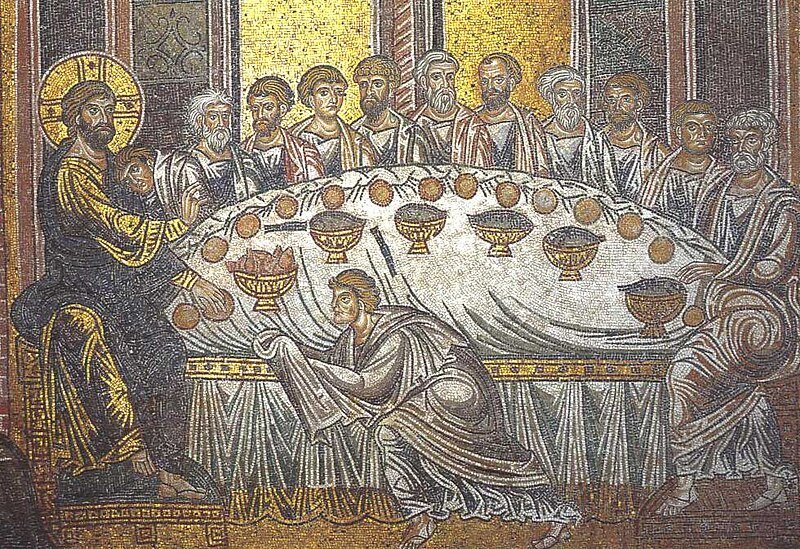
The Last Supper mosaic in Monreale Cathedral, Palermo, Sicily, Italy.
The Last Supper is one of the most significant events in Christian tradition, marking the final meal Jesus Christ shared with his apostles before his crucifixion. This meal, which is recounted in all four canonical Gospels and referenced in the First Epistle to the Corinthians, is considered the basis for the Christian sacrament of the Eucharist. It is commemorated particularly on Holy Thursday within the liturgical calendar.
Below, World History Edu explores the historical context, theological implications, and artistic depictions of the Last Supper, while also analyzing its influence on Christian practice.
The Scriptural Basis of the Last Supper
The earliest mention of the Last Supper appears in Paul’s First Epistle to the Corinthians, predating the Gospel accounts. The Synoptic Gospels (Matthew, Mark, and Luke) describe the meal as a Passover event, while the Gospel of John presents a slightly different chronology, positioning the meal before the official Passover feast.
Despite differences in detail, all accounts emphasize key moments: Jesus’ predictions of his betrayal and Peter’s denial, as well as the institution of the Eucharist.
Theological Significance
The Last Supper has profound theological implications, particularly regarding the doctrine of the Eucharist. Jesus’ words during the meal—”This is my body” and “This is my blood”—form the foundation of Christian Communion. Different Christian traditions interpret these statements in varying ways.
The Catholic Church upholds the doctrine of transubstantiation, asserting that the bread and wine become the actual body and blood of Christ.
Protestant denominations have diverse perspectives, ranging from symbolic interpretations to the belief in a spiritual presence of Christ in the elements.
Predictions and Farewell Discourse
A pivotal aspect of the Last Supper is Jesus’ prediction of his imminent betrayal. Judas Iscariot, one of the twelve apostles, is identified as the traitor, and Jesus warns that it would have been better for his betrayer if he had never been born. In addition to this dramatic moment, Jesus foretells Peter’s threefold denial before the rooster crows. These predictions underscore the themes of loyalty, human frailty, and divine foreknowledge.
The Gospel of John uniquely includes an extensive Farewell Discourse, in which Jesus imparts final teachings to his disciples. He emphasizes love, unity, and service, giving the new commandment to “love one another as I have loved you.” This discourse also introduces the concept of the Holy Spirit as the Advocate who will guide the disciples after Jesus’ departure.
The Institution of the Eucharist
The act of Jesus breaking bread and sharing wine with his disciples has become central to Christian liturgy. The Eucharist, also called Holy Communion or the Lord’s Supper, is a sacrament practiced by almost all Christian denominations. The variations in its observance—whether literal, symbolic, or mystical—highlight theological differences among Christian traditions.
The Synoptic Gospels depict Jesus blessing the bread and wine, instructing his disciples to partake “in remembrance of me.” Paul’s account in 1 Corinthians 11:23–25 echoes this, reinforcing the significance of the meal as a covenantal act. John’s Gospel, while omitting the Eucharistic institution, presents Jesus as the “bread of life,” a theme that complements the Synoptic emphasis on the significance of Jesus’ body and blood.
The Last Supper is central to Christian faith as it marks Jesus’ final meal with his disciples, during which he instituted the Eucharist, symbolizing his sacrifice and the New Covenant.
Time and Place of the Last Supper
Determining the exact date of the Last Supper remains a topic of scholarly debate. Traditional interpretations, based on the Synoptic Gospels, suggest that the meal coincided with the Jewish Passover. However, John’s Gospel implies that Jesus was crucified on the day of preparation for the Passover, indicating the Last Supper occurred a day earlier.
The location of the Last Supper is traditionally identified as the Cenacle, an upper room on Mount Zion in Jerusalem. While no archaeological evidence conclusively verifies this, the site has been venerated for centuries. Some scholars speculate that the location was in an Essene quarter of Jerusalem, reflecting a possible connection between Jesus and the Essene movement.
The Washing of the Disciples’ Feet
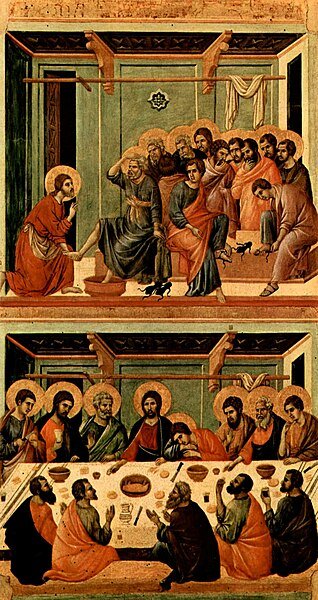
One of the most striking elements unique to John’s Gospel is Jesus washing his disciples’ feet. This act of humility underscores the theme of servant leadership, teaching that greatness in the kingdom of God is achieved through service to others. Peter initially resists this act, but Jesus insists that it is necessary for participation in his mission.
Artistic Depictions of the Last Supper
The Last Supper has been a subject of artistic representation for centuries. One of the most famous depictions is Leonardo da Vinci’s mural in Milan, painted between 1495 and 1498. This masterpiece captures the moment when Jesus announces that one of his disciples will betray him, with dramatic gestures and expressions conveying the disciples’ reactions.
Other notable representations include works by Tintoretto, Salvador Dalí, and Fra Angelico. These paintings often reflect theological themes, such as Christ’s divinity, the unity of the apostles, and the tension between light and shadow, symbolizing good and evil.
The Last Supper in Christian Worship
The commemoration of the Last Supper varies among Christian traditions. In Catholic and Orthodox churches, the Eucharist is a central sacrament, celebrated at every Mass or Divine Liturgy. Protestant churches, while also observing Communion, differ in frequency and interpretation. Evangelical traditions emphasize the symbolic remembrance of Jesus’ sacrifice, while Lutherans and Anglicans maintain a belief in Christ’s real presence in the elements.
Maundy Thursday, observed during Holy Week, specifically commemorates the Last Supper. It is often marked by foot-washing ceremonies, reflecting Jesus’ act of humility. The service typically includes a reenactment of the institution of the Eucharist and a focus on Jesus’ commandment to love one another.
Many artists, including Leonardo da Vinci, have depicted the Last Supper, emphasizing themes of betrayal, devotion, and theological symbolism.
Passover Parallels
The Last Supper shares significant parallels with the Jewish Passover meal, reinforcing its sacrificial and covenantal themes. Jesus, often identified as the “Lamb of God,” is seen as fulfilling the role of the Passover lamb, whose sacrifice brings salvation. The unleavened bread and wine mirror elements of the Passover Seder, though the specific structure of the meal Jesus shared remains a point of debate.
Some scholars suggest that Jesus reinterpreted the Passover symbols to establish a new covenant, replacing the traditional Jewish understanding with a focus on his impending sacrifice. This connection underscores the continuity between the Old and New Covenants in Christian theology.
The Last Supper in Islam
The Quran makes reference to a meal shared between Jesus (known as ʿĪsá in Islam) and his disciples in Surah 5:114. However, Islamic teachings do not associate this meal with Jesus’ crucifixion, as Islam denies that Jesus was crucified. Instead, the meal is viewed as a miraculous event affirming Jesus’ prophetic mission and God’s provision.
Whether understood through historical, theological, or artistic lenses, the Last Supper encapsulates the heart of Christian belief: Jesus’ self-giving love and his call for unity among his followers.
Historicity and Scholarly Perspectives
Most historians and biblical scholars agree that Jesus likely shared a final meal with his disciples before his arrest. The precise details, however, are debated. Some scholars argue that the Eucharistic traditions developed within early Christian communities rather than originating directly from Jesus’ words at the Last Supper. Others assert that the event reflects Jewish eschatological traditions and functions as a messianic banquet.
Notably, some Jesus Seminar scholars have suggested that the Last Supper narrative was shaped more by the early Christian liturgical practice than by historical events. Conversely, theologians such as Joachim Jeremias and N.T. Wright affirm the historicity of the meal as an integral moment in Jesus’ ministry.
The Last Supper remains a cornerstone of Christian faith, influencing theology, liturgy, and art. Its themes of sacrifice, service, and covenant continue to shape Christian identity and practice.