
Mesopotamian religion was polytheistic, meaning that they worshipped many gods, each believed to hold significant power over specific areas of life or the cosmos.
The Mesopotamian pantheon is one of the most intricate and ancient collections of gods. The pantheon provides a deep insight into the beliefs, values, and social structures of early civilizations in the region known today as Iraq, parts of Syria, and Turkey.
Mesopotamia, which means “land between rivers,” was the birthplace of many early civilizations, including the Sumerians, Akkadians, Babylonians, and Assyrians. These peoples shared cultural and religious practices, evolving over millennia, with a focus on understanding the universe, the natural environment, and human existence.
The gods of Mesopotamia were many and varied, with each representing different aspects of the world, from the forces of nature to human emotions and concepts of justice and governance.
The pantheon evolved over time, reflecting the different ethnic and linguistic groups that dominated Mesopotamia at various periods, but certain gods and themes remained consistent.
Sumerian Influence: The Foundation of the Pantheon

Goddess Ishtar stands on a lion and holds a bow, god Shamash symbol at the upper right corner, from Southern Mesopotamia, Iraq
The earliest records of the Mesopotamian gods come from the Sumerians, who settled in southern Mesopotamia around 3500 BCE. The Sumerians are credited with developing the first urban centers and writing system, cuneiform, which they used to document their religious beliefs.
The Sumerian pantheon laid the foundation for later Mesopotamian religions and introduced many of the deities that would continue to be worshiped throughout the region’s history.
Some of the key gods in the Sumerian pantheon included:
An (Anu): The sky god and father of all gods, An was considered the supreme deity in the early Sumerian religion. His primary domain was the heavens, and he represented the overarching authority and order of the universe. However, An’s role was more distant than that of other gods, as he seldom intervened in human affairs.
Enlil: The god of air, wind, and storms, Enlil was second only to An in the Sumerian hierarchy. He was often depicted as a powerful and sometimes wrathful deity, who could bring both blessings and destruction. Enlil was also associated with kingship and played a crucial role in legitimizing rulers. His temple in Nippur was one of the most important religious centers in ancient Mesopotamia.
Inanna (Ishtar): The goddess of love, beauty, fertility, and warfare, Inanna was one of the most complex and beloved deities in the Sumerian pantheon. She embodied both nurturing and destructive qualities and was associated with sexual desire, political power, and military might. Her myths, particularly the story of her descent into the underworld, highlight themes of life, death, and renewal.
Enki (Ea): The god of wisdom, water, and creation, Enki was one of the most benevolent gods in the Sumerian pantheon. He was believed to be the source of all knowledge and was often depicted as a trickster figure who used his intellect to outwit other gods or assist humanity. Enki’s association with water also tied him to fertility and agriculture.
Nanna (Sin): The god of the moon, Nanna played a vital role in both religious and agricultural practices, as the moon’s phases were crucial for determining the calendar and the timing of agricultural activities. Nanna was also the father of the sun god Utu and the goddess Inanna, further linking him to the celestial order.
Utu (Shamash): The god of the sun and justice, Utu was responsible for maintaining order and fairness in the world. He was believed to see everything that happened on Earth due to his position in the sky, making him the perfect judge of human affairs. Utu was often invoked in legal matters and contracts.
Ninhursag (Ki): The earth goddess, Ninhursag, was associated with fertility, childbirth, and the nurturing of life. She was revered as the mother of gods and humans, symbolizing the sustaining force of the earth. Her role in creating humanity was a key aspect of her worship.
Akkadian Adaptations and Expansion of the Pantheon

Marduk – 9th century BC depiction of the Statue of Marduk, with his servant dragon Mušḫuššu. This was Marduk’s main cult image in Babylon
As the Sumerians were gradually absorbed into the Akkadian Empire (circa 2334–2154 BCE), the Mesopotamian pantheon evolved, incorporating Akkadian deities and blending Sumerian and Semitic religious traditions. The Akkadian version of the gods often bore new names and additional attributes, but they retained many of their original characteristics.
Anu: In Akkadian culture, An retained his position as the supreme god, but like in Sumerian belief, he was often depicted as a distant and somewhat abstract deity.
Enlil: Enlil maintained his powerful status, and his role in governance and kingship remained a focal point of his worship. Kings continued to seek his approval for their rule.
Ishtar (Inanna): In Akkadian religion, Ishtar became even more prominent, reflecting the increasing importance of war and empire in Akkadian culture. Ishtar’s dual roles as both a loving and vengeful goddess made her one of the most dynamic and revered deities. She was widely worshipped in major cities like Uruk and Nineveh.
Marduk: One of the most significant changes during the Akkadian and later Babylonian periods was the rise of Marduk, who eventually replaced Enlil as the head of the pantheon. Originally a local god of Babylon, Marduk’s rise to prominence mirrored the city’s growing political power. He became associated with creation, wisdom, and kingship, and his myth, the Enuma Elish, told the story of his victory over the chaos monster Tiamat, cementing his place as the supreme god of Babylon.
Ashur: In the northern region of Assyria, the god Ashur rose to prominence. He became the patron deity of the Assyrian Empire and was often identified with Marduk, though he retained a distinct identity. Ashur’s role was closely tied to the military and expansionist policies of the Assyrian kings, who often invoked his name in their conquests.
READ MORE: The Conflict Between Marduk and Tiamat
Cosmology and the Role of Humans
The Mesopotamian pantheon reflected a worldview in which the gods were deeply involved in every aspect of life. They controlled natural forces like the weather, the fertility of the land, and the success of crops, as well as social and political matters, such as war, law, and kingship. Humans, in turn, were seen as servants of the gods, created to perform labor and provide for the deities through offerings and rituals.
One of the most important cosmological myths in Mesopotamian religion is the story of creation. In the Babylonian version, told in the Enuma Elish, the universe begins in a state of chaos, represented by the primordial waters of Apsu (freshwater) and Tiamat (saltwater). The younger gods, led by Marduk, wage war against Tiamat and her monstrous offspring. After defeating her, Marduk creates the world from her body, establishing order and assigning roles to the other gods.
Humans were believed to have been created from clay mixed with the blood of a god, often identified as Kingu, one of Tiamat’s allies. The creation of humanity was seen as a necessary part of maintaining the cosmos, as the gods required laborers to tend the earth and perform rituals to keep the divine order intact. This myth highlighted the precarious balance between chaos and order, with humans playing a crucial role in preserving the world.

The Role of Kings and Priests
In Mesopotamian society, kingship was seen as a divine institution. The king was often described as chosen by the gods to maintain justice, protect the land, and ensure the proper worship of the gods. Many rulers, especially during the Akkadian, Babylonian, and Assyrian periods, claimed to be directly appointed by gods like Enlil, Marduk, or Ashur. Kings were expected to build temples, make offerings, and lead the people in religious festivals.
The priesthood also played a central role in maintaining the relationship between humans and the gods. Priests conducted daily rituals, including sacrifices, libations, and prayers, to keep the gods appeased. They also interpreted omens, dreams, and celestial signs, which were believed to be messages from the gods. Temples, known as ziggurats, were the centers of religious life, often towering over cities as a visual representation of the connection between heaven and earth.
READ MORE: Most Famous Ancient Mesopotamian Kings
The Afterlife
The Mesopotamian conception of the afterlife was bleak compared to other ancient cultures like Egypt. In Mesopotamian belief, the afterlife was a shadowy, gloomy existence in the underworld, known as Irkalla or the “Land of No Return.” This realm was ruled by Ereshkigal, the goddess of the underworld, and her consort, Nergal. Once a person died, their soul (or gidim) descended to the underworld, where they lived a ghostly, joyless existence, regardless of how they lived their earthly life.
There was little hope of a blissful afterlife or resurrection in Mesopotamian religion. Instead, the focus was on living a good life and securing the favor of the gods while on earth. Offerings to the dead were essential, as it was believed that the spirits of the deceased needed food and drink to survive in the underworld.
Frequently asked questions
Mesopotamian deities Nabu and Marduk
Why was the Mesopotamian pantheon not uniform across regions?
The Mesopotamian pantheon varied across regions due to the diverse political and cultural landscapes of Mesopotamia. Different gods held prominence in various city-states and periods. For example, Marduk was the chief god in Babylon, while Enlil held a higher status in Sumer. This regional variation meant that gods’ names, powers, and roles were not consistent across all of Mesopotamia.

Image: A statue portraying the god Enlil.
How does the role of Marduk in Mesopotamian religion differ from the role of Zeus in Greek mythology?
While Marduk was highly venerated in Babylon, his rule was not universal across Mesopotamia. In contrast, Zeus in Greek mythology was recognized as the king of the gods throughout Greece. Marduk’s supremacy was mainly limited to Babylon, whereas gods like Enlil held higher prominence in other regions like Sumer.
What is the original meaning of the word “demon” in the context of Mesopotamian and Greek culture?
The term “demon” comes from the Greek word “daimon,” which originally meant a spirit or divine being and was not inherently evil. Similarly, in Mesopotamian mythology, entities referred to as “demons” were not necessarily malevolent. They played complex roles in rituals and could either help or harm, depending on the situation.
Who were the Abgal, and what role did they play in Mesopotamian mythology?
The Abgal were the seven sages sent by the god Enki to bring civilization to humanity. They taught humans sacred laws and played an important role in shaping early Mesopotamian society by introducing the rules and structures necessary for civilized life.
What was the significance of Apsu in Mesopotamian mythology, and what led to his death?
Apsu was the god of fresh water and the father of many gods in Mesopotamian mythology. He was killed by his son Enki, which initiated a cosmic battle between the gods, a key event in Mesopotamian mythological tradition.

Apsu was a primordial god in ancient Mesopotamia
How did Adad (Ishkur) function in Mesopotamian mythology?
Adad (known as Ishkur to the Sumerians) was the god of storms, representing both destructive forces and life-giving rain. Like many weather gods, Adad had a dual nature, bringing both beneficial and harmful effects depending on his mood or the situation.
What was Anu’s role in the Mesopotamian pantheon?
Anu (or An) was the sky god and father of many major deities in the early Sumerian pantheon. Although one of the highest gods, he was more distant and less involved in human affairs compared to other gods like Enlil and Enki.
What was Enki’s role in Mesopotamian myths?
Enki (also known as Ea) was the god of wisdom, water, and creation, often depicted as a trickster figure. He played a significant role in many myths, including the creation of humanity and saving mankind from the great flood. Enki was known for his cleverness and his protection of humans.
Why was Enlil important in Sumerian religion, and what object did he control?
Enlil was a central figure in Sumerian religion, serving as the god of air and storms. He controlled the Tablets of Destiny, which determined the fates of gods and humans, solidifying his status as one of the most powerful deities in the Mesopotamian pantheon.
Who was Inanna (Ishtar), and what themes were associated with her?

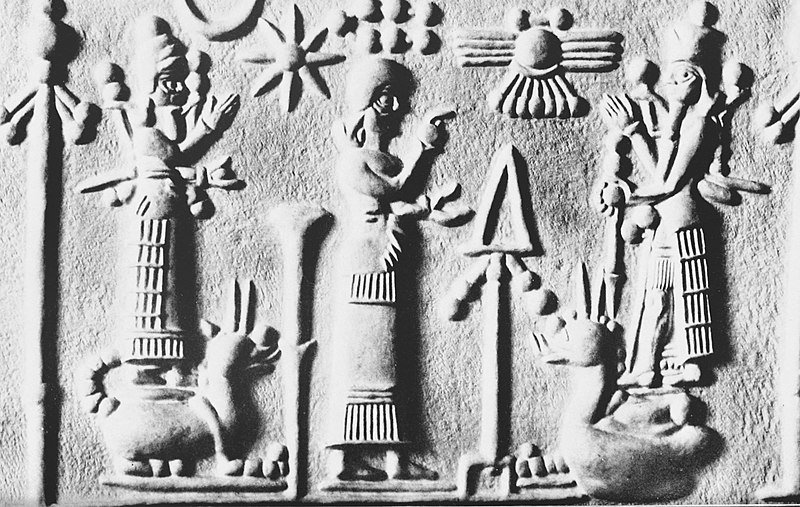
The Adda Seal, an ancient Akkadian cylinder seal showing (from left to right) Inanna, Utu, Enki, and Isimud (circa 2300 BC)
Inanna (known as Ishtar in Akkadian culture) was one of the most prominent goddesses in Mesopotamian mythology. She was associated with love, fertility, war, and power. Inanna’s stories often emphasize her boldness and involvement in both political and personal affairs, including her descent into the underworld and her role in warfare.
READ MORE: The Descent of Inanna into the Underworld
How did Marduk rise to prominence in Babylonian mythology?
Marduk became the chief god of Babylon through his victory over the chaos monster Tiamat in the creation myth Enuma Elish. His defeat of Tiamat symbolized the establishment of order in the universe, which positioned him as the dominant deity in Babylonian religious tradition.
Who was Tiamat, and what did her death symbolize?
Tiamat was the primordial goddess of the sea and the embodiment of chaos in Mesopotamian mythology. Her death at the hands of Marduk symbolized the victory of order over chaos, which was a central theme in Babylonian creation myths.

Marduk versus primordial goddess of chaos Tiamat
What was Nanna’s role in Mesopotamian religion?
Nanna (also known as Sin) was the god of the moon and played a vital role in Mesopotamian timekeeping and agricultural cycles. As the father of the sun god Utu (Shamash) and the goddess Inanna, he was integral to both the celestial and earthly realms of Mesopotamian belief.
What was Ninhursag’s function in the Mesopotamian pantheon?
Ninhursag (also known as Ki) was the earth goddess and a mother figure in Mesopotamian mythology. She was associated with fertility, creation, and the nurturing of life, playing a critical role in the creation of both gods and humans.

Depiction of Sumerian mother goddess Ninhursag





