The Western Wall in Jerusalem
The Western Wall, known in Hebrew as HaKotel HaMa’aravi, is an ancient limestone wall in the Old City of Jerusalem. It is a remnant of the Second Temple, which was expanded and fortified by Herod the Great in the 1st century BCE.
The Wall is considered one of the most sacred sites in Judaism and is a place of deep historical, cultural, and religious significance.
It is also known as the Wailing Wall in reference to Jewish mourning over the destruction of the Temple. In Islamic tradition, it is called the Al-Buraq Wall, associated with the Prophet Muhammad’s Night Journey.
Over the centuries, the Wall has been a focal point for Jewish prayer and pilgrimage, while also being a source of political and religious tension.

The Old City of Jerusalem is home to the Western Wall and the Dome of the Rock.
Historical Background
The Western Wall was part of a massive construction project initiated by Herod the Great around 19 BCE. The purpose was to expand the Temple Mount to accommodate a larger and more magnificent Jewish Temple. The wall itself served as a retaining wall to support the artificial expansion of the Temple Mount. While the Temple was destroyed by the Romans in 70 CE, the Wall remained intact, surviving as one of the last physical remnants of the sacred complex.
After the Jewish revolts against the Roman Empire, Jews were largely barred from Jerusalem. During the Byzantine period (4th–7th centuries CE), Jews were permitted to visit the site only once a year on Tisha B’Av, the day of mourning for the destruction of the Temple. By the early Islamic period, Jewish worship at the Wall was re-established to some extent.
Disputes over Jewish prayer rights at the Western Wall escalated tensions, leading to the 1929 Palestine riots, where over 200 Jews and Arabs were killed.
Following the Muslim conquest of Jerusalem in 638 CE, Jews were again allowed to pray near the Temple Mount. The Umayyads and later Islamic rulers recognized the Wall’s significance, but they also claimed it as part of the Haram al-Sharif, the Noble Sanctuary. The wall became known as Al-Buraq Wall, tied to the Islamic tradition that Prophet Muhammad tethered his celestial steed, Buraq, at the site during his Night Journey.
READ MORE: History of Islam: How and When Did Islam Begin?
During the Ottoman era (1517–1917), Jewish prayer at the Wall was tolerated but heavily regulated. The area in front of the Wall was narrow and surrounded by residential buildings of the Moroccan Quarter. Under the British Mandate (1917–1948), tensions over Jewish access to the Wall led to violent riots, most notably in 1929, when Jewish and Arab communities clashed over control and rights to the site.
Following the Arab–Israeli War of 1948, Jordan took control of East Jerusalem, including the Western Wall. For 19 years, Jews were barred from visiting the site. The situation remained unchanged until the Six-Day War in 1967, when Israel captured the Old City, reclaiming access to the Wall.
The Western Wall Under Israeli Control
After regaining control in 1967, Israeli authorities demolished the Moroccan Quarter, clearing space for the current Western Wall Plaza, which serves as an area for prayer, public gatherings, and national ceremonies. This transformation expanded the site, allowing for greater public access.
The Western Wall is the holiest place where Jews can pray freely. The Temple Mount itself is considered even more sacred, but due to religious restrictions, many Jews avoid ascending the platform. Today, the Wall serves as a place for prayer, reflection, and religious ceremonies such as bar mitzvahs and national celebrations.
Western Wall (HaKotel HaMa’aravi)
The earliest references to a “Western Wall” appear in Jewish texts from the Middle Ages. However, it is unclear whether these sources refer to the retaining wall of the Temple Mount or an actual wall of the Temple itself. By the 11th century, the term “Western Wall” was used explicitly to describe the site as it is known today.
Wailing Wall
The term “Wailing Wall” became common in English and European languages during the 19th century. It references Jewish mourning at the site over the destruction of the Temple. Though still recognized, the term is largely avoided by Jewish communities today.
Al-Buraq Wall
Islamic tradition identifies the Western Wall as the place where Prophet Muhammad tethered his steed, Buraq, before ascending to heaven. The association dates back at least to the 14th century and remains significant in Islamic teachings.
The Wall is a focal point of Israeli sovereignty over Jerusalem, disputed in Israeli-Palestinian negotiations, with Muslim authorities claiming it as part of the Al-Aqsa compound.
Physical Structure and Features
The Western Wall is part of a 488-meter-long (1,601 ft) retaining wall on the western side of the Temple Mount. The visible portion is about 57 meters (187 ft) long and 19 meters (62 ft) high, though much of the original structure extends underground.
The lower courses of the Wall are Herodian and feature massive stone blocks, some weighing between 2 and 8 tons. The upper sections were added in later periods, including Umayyad, Ottoman, and modern reconstructions.
A smaller section of the Wall, known as the “Little Western Wall,” is located in the Muslim Quarter. It is believed to be closer to the site of the Holy of Holies and is used for prayer by those seeking a more secluded experience.

A close view of the The Western Wall.
Religious Practices and Pilgrimage
Jews pray at the Western Wall daily, placing written prayers into its crevices. The site is a focal point for religious observances, including Tisha B’Av, Hanukkah, and the Priestly Blessing ceremonies during Passover and Sukkot.
Orthodox traditions require men and women to pray separately at the Wall. The men’s section is larger, reflecting traditional synagogue arrangements. The site follows strict religious guidelines, including modest dress codes and prohibitions on photography during the Sabbath.
Due to increasing demand for egalitarian prayer, a designated mixed-gender section was established at Robinson’s Arch in 2004. This area allows Reform and Conservative Jewish groups to conduct services with mixed participation.
The Western Wall remains one of the most revered and politically sensitive religious sites in the world. Its history spans millennia, reflecting the complex interplay of faith, heritage, and national identity.
Political and Religious Controversies
Control over religious practices at the Wall has been a source of contention between Orthodox and non-Orthodox Jewish movements. Ultra-Orthodox authorities enforce gender segregation, while progressive groups advocate for equal access.
Since the late 19th century, disputes over Jewish rights at the Wall have led to riots and political conflicts. Muslim authorities view Israeli control over the Wall as part of broader disputes concerning the Temple Mount and Jerusalem’s status.
Frequently Asked Questions
Why is the Western Wall significant in Judaism?
It is the closest accessible site to the Holy of Holies in the ancient Jewish Temple. Since Jews are restricted from praying on the Temple Mount, the Wall serves as the holiest place where they can worship.
Who built the Western Wall?
The lower part of the Wall was built by King Herod the Great in the 1st century BCE as part of his expansion of the Second Temple. Later additions were made during the Umayyad and Ottoman periods.

A depiction of Herod the Great
What is the “Wailing Wall” name?
The term “Wailing Wall” comes from the Jewish practice of lamenting the destruction of the Temple. It was mainly used by Christians, while Jews refer to it as the “Kotel.”
What is the significance of the Wall in Islam?
Muslims believe the Prophet Muhammad tied his winged steed, Buraq, to the Wall during his Night Journey before ascending to heaven.
What happened to the Western Wall during Jordanian rule (1948–1967)?
Jews were completely barred from the site when Jordan controlled East Jerusalem. Access was restored to Jews after Israel captured the Old City in the Six-Day War.
Why was the Moroccan Quarter demolished in 1967?
After Israel took control of Jerusalem, the Moroccan Quarter was demolished to create the Western Wall Plaza, expanding space for Jewish prayer and public gatherings.
What are the different sections of the Wall?
The prayer section of the Wall is 57 meters long, but the entire Western retaining wall of the Temple Mount extends 488 meters. Other sections include the Little Western Wall and Robinson’s Arch.
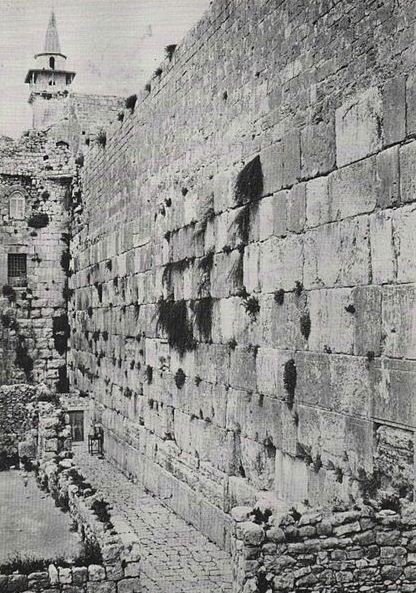
An 1870 photograph of the Western Wall.
What are the prayer traditions at the Wall?
Jews place written prayers in the Wall’s cracks, recite psalms, and follow gender-segregated prayer, though non-Orthodox groups have an egalitarian prayer space at Robinson’s Arch.
Why is the Wall considered indestructible in Jewish tradition?
Jewish texts state that the Divine Presence (Shechina) never departed from the Western Wall, and a Midrash claims it will never be destroyed.





