Titian: Life, Major Works, & Accomplishments of the Italian Renaissance Artist
Titian, born Tiziano Vecellio around 1488–1490 in the small town of Pieve di Cadore near Belluno, Italy, was one of the most significant artists of the Italian Renaissance and is widely regarded as the leading painter of the Venetian school. Known for his innovative use of color and skill in portraying diverse subjects, Titian helped elevate Venetian art to international acclaim. His work has influenced countless artists across Europe, leaving an enduring legacy that extends far beyond his own time.
Early Life and Training
Titian’s background was modest, with his father working as a manager for local landowners. Recognizing his artistic talent early on, Titian’s family sent him to Venice to train as a painter. He likely started his artistic education in the workshop of the mosaicist Sebastiano Zuccato and later moved to study under Gentile Bellini. However, it was under Gentile’s brother, Giovanni Bellini, that Titian developed his skills further. Giovanni Bellini, the leading painter in Venice at the time, was known for his rich use of color and for bringing the techniques of the Italian Renaissance into Venetian painting. Bellini’s influence on Titian’s early works is evident in Titian’s mastery of color and his ability to convey depth and realism.
As a young artist, Titian worked alongside another talented painter, Giorgione, who was also part of the Venetian school. This collaboration proved pivotal, as Titian and Giorgione both absorbed Bellini’s influence while exploring their own innovative styles. Together, they helped shape the unique qualities of Venetian Renaissance painting, marked by rich color palettes and atmospheric depth rather than the strict linear perspective typical of Florentine and Roman art.

Image: A self-portrait of Titian, located at the Museo del Prado in Madrid, Spain.
Rise to Prominence
Titian’s early successes included assisting Giorgione on commissions, such as frescoes and altarpieces. After Giorgione’s death in 1510, Titian began to gain recognition for his own work. He received his first independent commission, the “Assumption of the Virgin” for the Basilica di Santa Maria Gloriosa dei Frari in Venice, around 1516. This large-scale altarpiece was a breakthrough for Titian, showcasing his command of dramatic composition, vibrant color, and dynamic movement. The “Assumption of the Virgin” established Titian as one of the foremost painters in Venice, cementing his reputation.
Titian’s painting style diverged from his contemporaries through his remarkable ability to convey emotion and psychological depth. His characters appeared alive, capturing the attention of viewers with their expressive gestures and faces. Titian’s understanding of light, color, and texture created a sense of realism and atmosphere, which made his work distinct and innovative.
Major Works and Themes
Throughout his career, Titian worked across multiple genres, including religious scenes, mythological subjects, and portraits. He adapted his style to suit the requirements of each commission, revealing a profound versatility that made him highly sought after by patrons across Europe.
Religious Paintings
Titian’s religious works are characterized by their dramatic compositions and emotive power. In addition to the “Assumption of the Virgin,” another significant work in this category is the “Pesaro Madonna” (1526), also in the Frari Basilica in Venice. This painting demonstrated Titian’s innovative approach to composition, arranging figures diagonally rather than symmetrically, which created a sense of depth and movement. His religious paintings, including later works like “Ecce Homo” and “Pietà,” often depict powerful narratives that convey a deep spiritual connection.
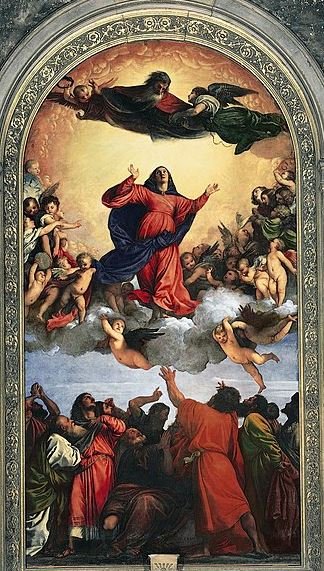
Image: “Assumption of the Virgin”, an artwork by Titian was completed during the late 1510s.
Mythological Scenes
Titian’s mythological paintings are celebrated for their sensuality, dynamic compositions, and vibrant color. Among his best-known works in this genre is the “Venus of Urbino” (1538), commissioned by the Duke of Urbino. This painting, which portrays a reclining nude figure of Venus, is noted for its sensuality and Titian’s mastery of light and color. Unlike the religious works that demanded reverence and spirituality, Titian’s mythological scenes often celebrated beauty, passion, and the human form, embodying Renaissance ideals of humanism and classical beauty.
Another significant mythological series includes “The Poesie,” a set of six paintings depicting scenes from classical mythology, created for Philip II of Spain. Among these works are “Diana and Actaeon” and “Diana and Callisto,” both of which illustrate Titian’s remarkable ability to tell stories through rich compositions and expressive figures. These mythological works highlight Titian’s skill in blending narrative with aesthetic beauty, making him one of the most admired painters in Europe.
Portraiture
Titian’s portraits were some of the most influential in Renaissance art, helping to establish standards for European portraiture for centuries. His portraiture was notable not only for its visual accuracy but also for its psychological depth. Titian had a unique ability to capture the inner character of his subjects, portraying them with a sense of dignity and gravitas. His portraits of European nobility, including Emperor Charles V, King Philip II of Spain, and Pope Paul III, are admired for their realistic detail and subtle expressions.
In “Portrait of Charles V at Mühlberg” (1548), Titian portrays the emperor in armor, emphasizing his power and authority. The composition, with Charles on horseback, is dynamic and regal, capturing the essence of Charles’s rule and persona. This painting, among others, solidified Titian’s status as a master portraitist who could convey not only the appearance but also the status and psychology of his subjects.
Innovations in Technique and Use of Color
One of Titian’s most significant contributions to art was his innovative use of color. Unlike other painters who relied heavily on line and form, Titian used color as the primary means of creating depth, mood, and texture in his work. His application of multiple layers of translucent paint, or glazing, allowed him to create rich, vibrant hues that seemed to glow from within. This technique added a sense of luminosity to his paintings, making his figures appear more lifelike and enhancing the emotional impact of his compositions.
Titian’s loose brushwork and subtle blending of colors were revolutionary, setting him apart from his contemporaries. He abandoned the precise outlines and tightly controlled techniques seen in earlier Renaissance art, opting instead for a freer, more expressive style. This approach allowed him to capture the textures of skin, fabric, and landscapes with a realism that was unprecedented at the time.
Titian’s innovative methods inspired generations of artists. His pioneering use of color influenced painters like Peter Paul Rubens, Rembrandt, and even the Impressionists centuries later. Through his techniques, Titian redefined the possibilities of painting, showing that color could be used not only for decorative purposes but also as a powerful tool for conveying emotion and atmosphere.
Later Life and Evolving Style
As Titian aged, his style continued to evolve. His later works exhibit a darker, more somber palette and a looser, more expressive brushstroke. These changes likely reflected Titian’s own introspection and the influence of the changing political and social climate in Europe. His later religious works, such as the “Pietà” (which he was working on at the time of his death), show an intensity and rawness that reveal a more personal, almost spiritual approach to his art.
During his final years, Titian continued to receive commissions from powerful patrons, including Philip II of Spain, who remained an enthusiastic supporter of his work. Despite his advancing age, Titian worked with remarkable energy and dedication, producing some of his most profound and mature works during this period. His influence remained strong, with younger artists looking to him as a model of artistic achievement and innovation.
Legacy and Impact on Western Art
Titian’s impact on Western art is profound. His innovative techniques, especially in color and brushwork, set a new standard for painters across Europe. The Venetian school, which he helped establish alongside Giorgione, became a major influence on later movements, such as Baroque art. Titian’s mastery of color had a lasting effect on artists like Rubens, Velázquez, and even Rembrandt, who admired his ability to convey atmosphere and emotion.
Moreover, Titian’s work influenced the development of portraiture in Western art, with his psychological approach to portraying his subjects becoming a model for generations of portraitists. His combination of realism and expressiveness set a new benchmark for capturing the complexity of human character, inspiring later artists to explore the subtleties of personality and status in their own portraits.
Titian’s mythological paintings also helped shape the way later artists approached classical themes. His ability to fuse sensuality with narrative richness made his mythological scenes some of the most iconic depictions of classical subjects in art history. His influence can be seen in the works of artists across Europe, from Rubens to Poussin, who drew on Titian’s compositions and use of color.
Conclusion
Titian’s life and career are a testament to the enduring power of artistic innovation and expression. His versatility, mastery of color, and psychological insight into his subjects distinguish him as one of the most remarkable figures of the Italian Renaissance. From religious altarpieces to intimate portraits and grand mythological scenes, Titian’s work demonstrates a profound understanding of both the aesthetic and emotional dimensions of art.
Titian’s legacy continues to be celebrated in the art world today. His influence can be seen in the works of countless artists who followed him, and his paintings remain some of the most cherished treasures in museums worldwide. As an artist who pushed the boundaries of his craft, Titian not only shaped the course of Venetian painting but also left an indelible mark on the entire history of Western art. His innovations in color, technique, and composition continue to inspire and captivate audiences, solidifying his place as one of the greatest painters of all time.
Frequently Asked Questions

Why was Titian sometimes called “da Cadore”?
Titian was referred to as “da Cadore” after his birthplace, Pieve di Cadore, to indicate his origins.
What made Titian a significant figure in Renaissance art?
Titian’s versatility and masterful use of color made him a pivotal figure in Renaissance art, shaping both the Venetian school and the future of Western art.
What types of subjects did Titian paint?
Titian’s work included portraits, landscapes, mythological scenes, and religious themes, displaying a broad range of subject matter.
What nickname was Titian known by among his contemporaries, and what inspired it?
He was called “The Sun Amidst Small Stars,” a title inspired by a line from Dante’s Paradiso, symbolizing his brilliance in the art world.
Who were some notable artists Titian worked alongside?
Titian worked alongside other influential artists, such as Giorgione, with whom he helped establish the Venetian school of Renaissance painting.
How did Titian’s style change over his career?
Titian’s style evolved from bright and vivid hues in his early works to a subtler and more sophisticated use of color and loose brushwork in his later years.
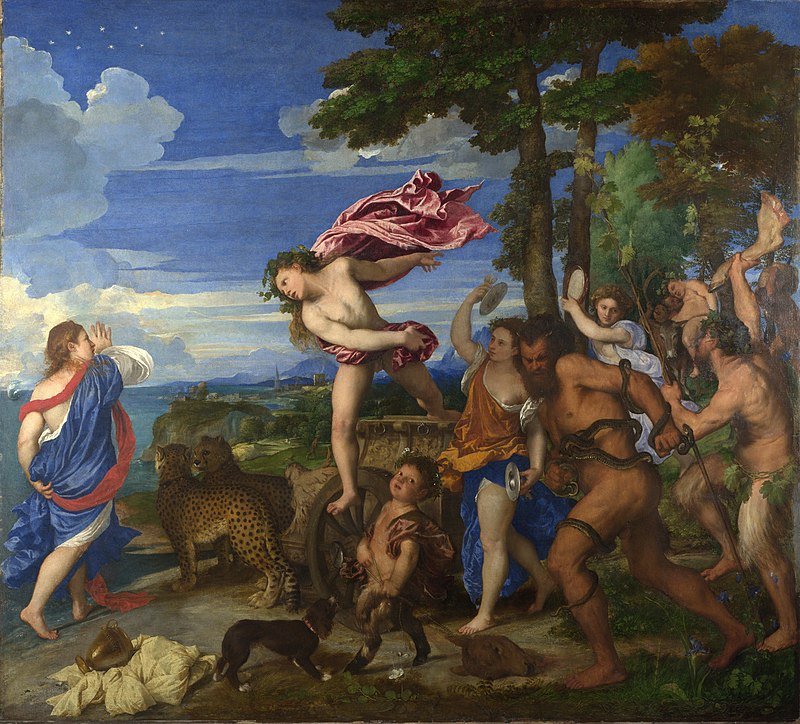
Image: Titian’s “Bacchus and Ariadne” was completed in the early 1520s.
What was unique about Titian’s approach to portraiture?
Titian’s portraits captured not only the physical likeness of his subjects but also their psychological depth, making them influential and widely imitated.
Who were some of Titian’s notable patrons?
He attracted patrons from across Europe, including North Italian princes, Habsburg monarchs, and the papacy, allowing him to achieve widespread influence.
What are examples of Titian’s mythological paintings?
Some of his famous mythological works include Bacchus and Ariadne and Venus of Urbino, known for their rich detail and narrative clarity.
What techniques did Titian use to enhance his paintings?
He utilized glazing, layering multiple translucent paint layers to achieve depth and luminosity, and loose brushwork, which added life and movement to his pieces.
How did Titian’s technique help distinguish the Venetian school from others?
The Venetian school, led by Titian, emphasized color, light, and texture, setting it apart from the more linear and form-focused Florentine and Roman schools.
What influence did Titian have on later artists?
Titian’s techniques in color, texture, and light inspired generations of artists, including Baroque painters like Peter Paul Rubens and Rembrandt.
How did Titian’s work impact the role of color in Western art?
He demonstrated that color could convey deep psychological and spiritual nuances, making it central to Western art’s expressive potential.
Why was Titian’s relationship with patrons significant to his career?
Titian’s connections with powerful patrons secured him commissions, allowing him to continue refining his art and maintain influence in European court circles.
How is Titian remembered in art history today?
Titian is celebrated for his emotional depth, technical innovation, and influential approach to color and composition, solidifying his legacy as a master of the Renaissance.





